
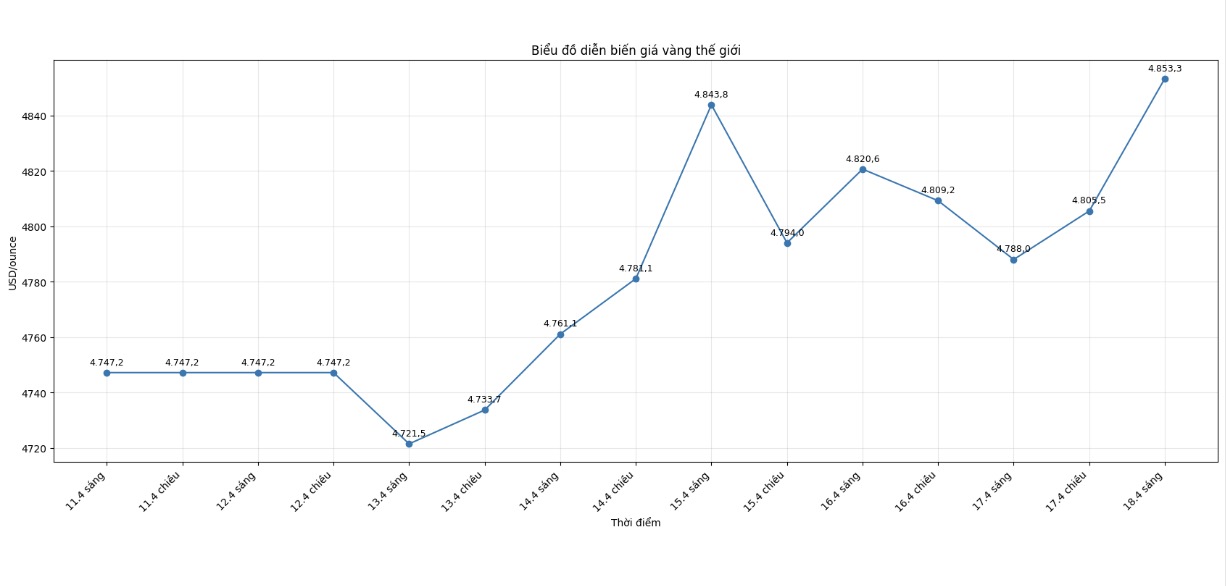
According to Kitco, gold prices last week fluctuated sideways but still maintained a positive trend, thanks to support from investors' defensive sentiment. The market recorded gold maintaining a high price level as confidence data weakened, while many hard economic indicators still showed the resilience of the US economy.
Meanwhile, silver performed less positively than gold at some points, as this commodity was more influenced by risk appetite and industrial production prospects. Concerns about slowing growth prevented silver from making a breakthrough commensurate with gold.
However, positive information on Friday morning about the Hoarmuz Strait being fully reopened, provided that ceasefires between Israel - Lebanon and Iran - the US continue to be maintained, has significantly improved market sentiment. In that context, gold and silver prices simultaneously increased sharply along with the upward momentum of the stock market.
As tensions in the Middle East temporarily cool down, investors' attention is likely to return to US economic data - a factor that could directly affect the policy expectations of the US Federal Reserve (Fed), thereby affecting the trend of precious metals in the short term.
At the beginning of the week, the market will follow the US retail sales report released on Tuesday morning, to assess consumer health. Although recent figures are generally still quite solid, many experts believe that the upward momentum may weaken after the previous unexpected positive period.
For the precious metals market, if retail sales exceed expectations, gold prices may be under pressure due to strengthening the possibility that the Fed will maintain high interest rates for a longer time. Conversely, if data is lower than forecast, gold and silver may be supported by increased expectations of monetary policy easing.
Also on Tuesday, the US unprocessed housing sales report in March will provide more signals about the housing sector - a sensitive area to interest rates. Many experts believe that the real estate market is still under great pressure as volatile material costs make it difficult for developers to value housing, while high interest rates continue to weigh on demand.
Another notable development is the hearing confirming Mr. Kevin Warsh for the new Fed Chairman position, which is also scheduled to take place on Tuesday. This hearing takes place in the context of many debates related to Mr. Warsh's personal assets of about 130 million USD as well as the possibility of conflicts of interest.
Some Democratic senators continue to push for the postponement of hearings, citing the ongoing US Department of Justice investigation into incumbent Fed officials. If Mr. Warsh sends a moderate signal on monetary policy, this could support gold prices to rise as lower interest rates will reduce the opportunity cost of holding precious metals.
Next Thursday, the weekly report on unemployment claims will be a rare data reflecting the developments of the US labor market next week.
If the number of unemployment claims increases sharply, it could quickly change current perceptions, thereby boosting safe-haven demand for gold amid growing concerns about the recession.
Also on Thursday morning, the market will monitor S&P Global's preliminary composite PMI index in April - one of the early measures of US economic activity.
If the PMI is disappointing, safe-haven demand for gold may be strengthened, especially in the event that data shows the US economy is widely slowing down.
Closing the week, the market will turn its attention to the final results of the Michigan University consumer psychology survey. This is an important indicator reflecting the level of confidence of US households in the context of still uncertain economic prospects.
Consumer sentiment has declined sharply since the Iran conflict broke out, while inflation expectations continue to rise. Even when hard economic data remains relatively stable, weakening consumer confidence is often a factor that benefits gold prices, as it shows that the economy still contains many risks.


