
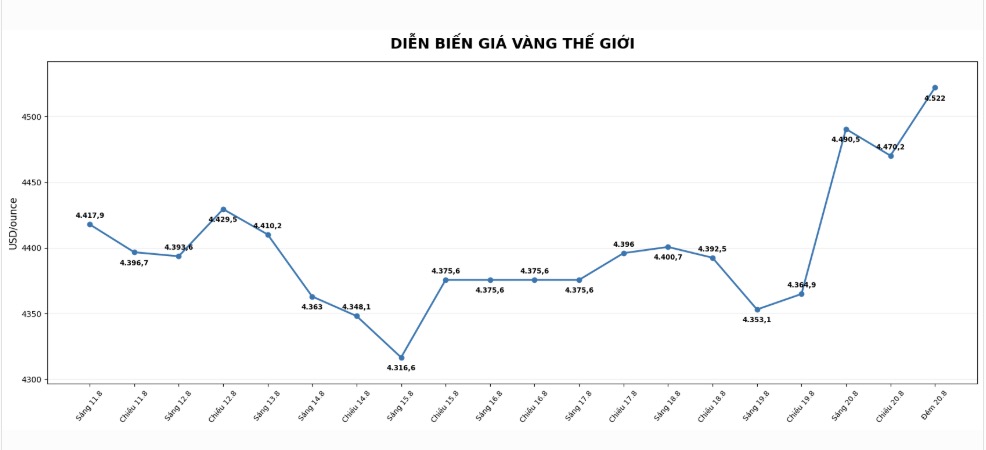
Recorded at 2:38 am on August 21, world gold prices surged to the threshold of 4,522 USD/ounce, reversing sharply compared to the previous weakening trend in the US trading session.
At the beginning of the session, the precious metals market was under pressure after a series of more positive US economic data than forecast reduced expectations of the possibility of bond yields continuing to cool down. At one point, spot gold traded around 4,454.7 USD/ounce, down 1.51% during the day.
Developments then changed rapidly. Gold prices recovered to around 4,470 USD/ounce after the market received the manufacturing report of the US Federal Reserve (Fed) Philadelphia branch, before accelerating and rebounding to the 4,500 USD/ounce zone.
One of the notable data is that the number of initial jobless claims in the US in the week ending August 15 decreased to 206,000 claims, lower than the market's forecast of 210,000 claims. Meanwhile, the number of people continuing to receive unemployment benefits increased to 1.799 million people.
Manufacturing activity in the Philadelphia area also attracted attention. The August Manufacturing Business Outlook Index increased from 41.4 points in July to 47.4 points, the highest level since April 2021 and far exceeding analysts' expectations.
The report shows that nearly 57% of surveyed businesses recorded increased activity, while about 10% said activity decreased. The job index increased sharply to 27.9 points, the highest since April 2022. However, price pressure in August showed signs of easing compared to the previous month.
Positive economic data creates more reason for the market to be cautious about the outlook for US monetary policy. The minutes of the Fed's most recent meeting show that some officials are willing to consider raising interest rates if inflation does not continue to cool down. The yield of 10-year US Treasury bonds in the session fluctuated around 4.7%.
However, the strong recovery of gold shows that safe-haven demand still plays a significant role. Tensions related to the Strait of Hormuz continue to affect oil prices, inflation expectations and investors' defensive sentiment.
WTI oil prices were recorded around 86.72 USD/barrel, while Brent oil was near 93.90 USD/barrel. High oil prices can increase inflation risks, thereby limiting the room for bond yields to decrease. However, geopolitical instability supports demand for gold, causing the market to experience strong fluctuations in both directions.
Technically, the 4,447 USD/ounce zone is being considered a noteworthy support level after gold broke out of this area in the previous session. If the upward momentum is maintained, the near resistance target of gold prices is around 4,595 USD/ounce. A sustainable step through this area could lead the market towards the 4,778 USD/ounce zone.
In the opposite direction, if losing the 4,447 USD/ounce mark, the next support zones are noted around 4,320 USD/ounce and 4,228 USD/ounce respectively.
After increasing to 4,522 USD/ounce at 10:38 PM, gold price movements show that market sentiment is still very sensitive to US economic data, fluctuations in bond yields, oil prices and geopolitical factors. Investors are currently focusing their attention on preliminary PMI data of the US announced in the last session of the week to find more signals about economic prospects and Fed policy.
The article updates market developments, not investment recommendations; investors need to consider before making a decision.


