
World gold prices continued to face pressure in the US trading session as the USD strengthened, US Treasury bond yields remained high, and inflation concerns related to oil prices weakened the attractiveness of the precious metal.
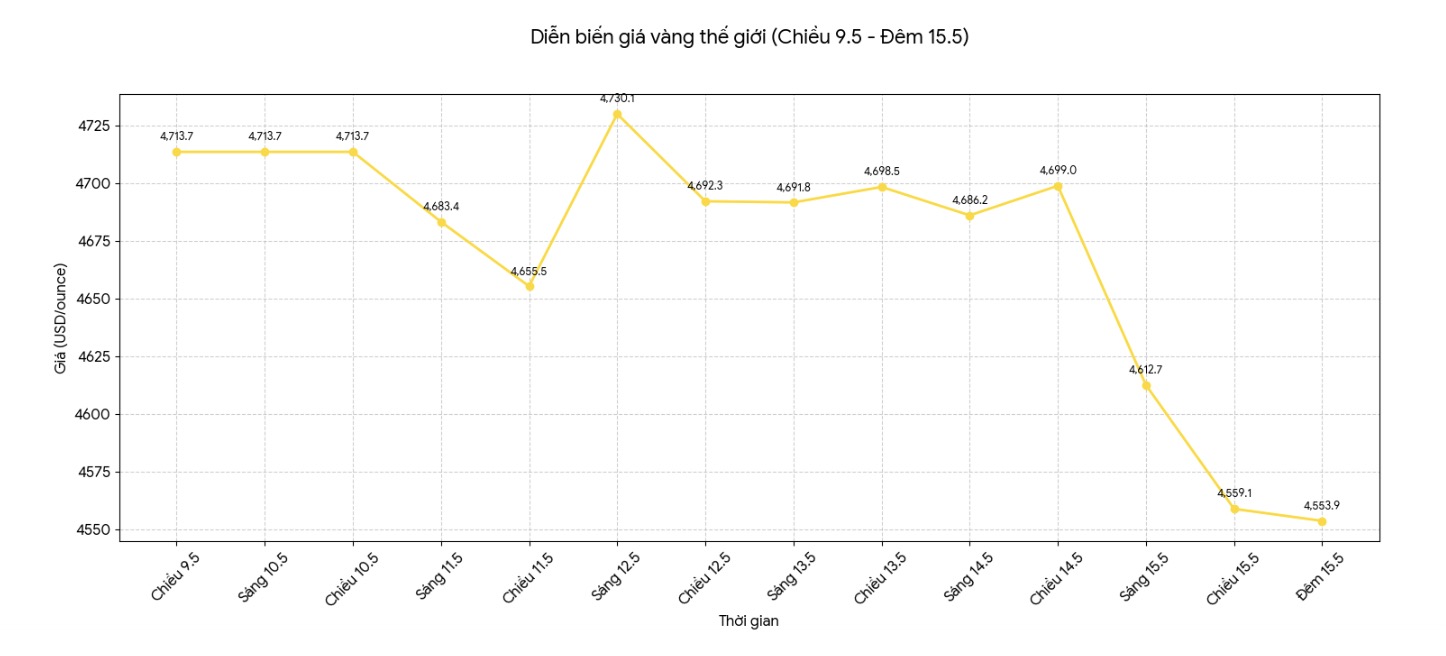
According to records, spot gold prices fluctuated around 4,550 USD/ounce at one point, down more than 2% during the day. Spot silver also fell sharply, retreating to around 77.970 USD/ounce, losing more than 6% during the session.
Gold's decline lasted for the fourth consecutive session after a series of inflation data in the US, making investors more cautious with expectations that the US Federal Reserve (Fed) will soon ease monetary policy. Data on CPI, PPI and import prices in April were all included by the market in recalculating the interest rate roadmap. Meanwhile, the yield of 10-year US Treasury bonds traded around 4.5%, while the USD index remained above 99 points.
Pressure on gold also comes from production data that is more positive than forecast. The New York Federal Reserve said the Empire State Manufacturing Survey index increased to 19.5 points in May, much higher than the 11 points of April and far exceeding analysts' forecast of a decrease to 7.3 points. This is a signal that manufacturing activity in this region is growing stronger than expected.
Mr. Richard Deitz - Economic Research Advisor at the New York Fed - said that New York state manufacturing activity increased at the fastest rate in more than 4 years. New orders and shipments both increased sharply, and jobs continued to improve. However, the rate of price increase also skyrocketed, while delivery times were longer and supply became less favorable.
The components in the report show that new orders increased to 22.7 points, from 19.3 points last month. The output index reached 18.9 points, almost equivalent to 20.2 points in April. Meanwhile, the job index slightly decreased to 8.3 points, showing that the labor market is relatively stable but shows signs of cooling down.

The noteworthy point is that price pressure continues to escalate. The paid price index increased sharply to 62.6 points, compared to 51 points in April. This data increased concerns that inflation could be more persistent, thereby making it difficult for the Fed to cut interest rates soon. Some experts believe that if economic data continues to be solid, the market may even consider the possibility that the Fed will have to maintain high interest rates for longer, which is detrimental to gold - an asset that does not yield yields.
Besides the interest rate factor, the precious metal market is also affected by tensions around the Strait of Hormuz. Although the ceasefire agreement between the US and Iran has been maintained for more than a month, sea transport has not yet returned to normal. The flow of goods through this area is still limited, causing oil prices to continue to linger high.
US WTI oil prices traded around 100.54 USD/barrel, while Brent oil was near 108.68 USD/barrel. High oil prices increased concerns about inflation, pushed bond yields up and put pressure on gold. However, geopolitical tensions still partly supported defense demand, making gold's outlook precarious.
Technically, the near support zone of spot gold is around 4,541.88 USD/ounce. If this mark is broken, the price may be under further downward pressure to 4,503.3 USD/ounce, or even 4,481.78 USD/ounce. In the opposite direction, buying force needs to bring the price back to the 4,605.15-4,637.31 USD/ounce range to improve the short-term trend.


