
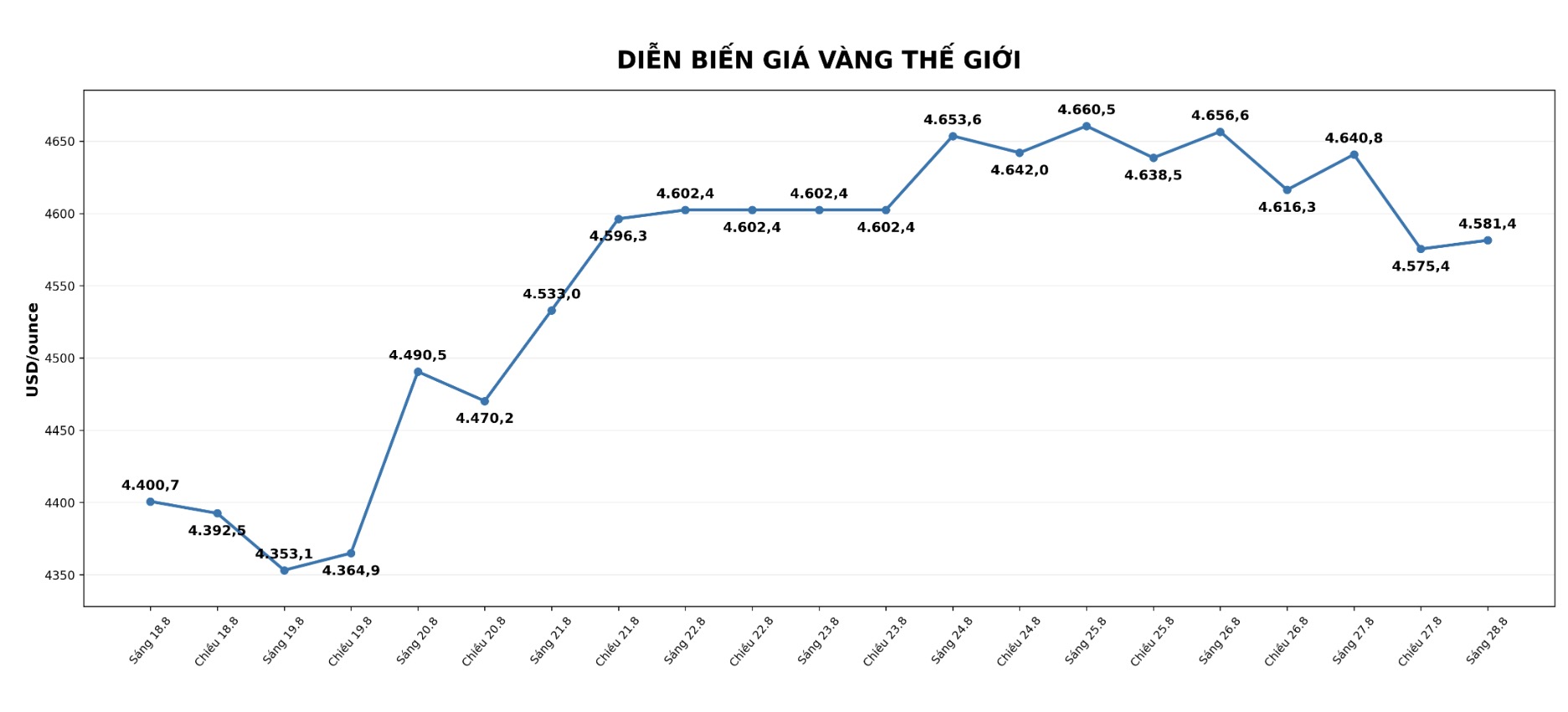
World gold prices are maintained around the 4,600 USD/ounce range as investors continue to look for safe haven assets amid concerns about the size of US public debt and the risk of a decline in USD purchasing power.
After increasing by about 15% in August, the precious metal has surpassed many important resistance zones. However, the hot upward momentum also makes investors more cautious as technical signals show that the market is falling into a state of over-buying.
In the most recent trading session, spot gold prices fluctuated around 4,601.6 USD/ounce, almost flat compared to the previous session. Buying power is still maintained thanks to the need to hedge against financial risks, but the recovery of US bond yields is limiting the potential for a stronger breakthrough of the precious metal.
Weakening USD supports gold prices
One of the biggest drivers of gold prices recently is the trend of investors worrying about the depreciation of the USD as US government debt increases.
As the greenback weakens, gold often becomes more attractive to investors holding other currencies. In addition, concerns about the ability to control the US budget deficit also drive cash flow to defensive assets.
However, the market is showing signs of rebalancing. The US Treasury Department's increase in long-term bond purchases to reduce borrowing costs has partly helped stabilize yields in the long-term group.
Reduced bond yields often create an advantage for gold, because precious metals do not create a fixed cash flow. However, if yields do not continue to fall sharply, gold's upward momentum may encounter further obstacles.
US economic data makes interest rate expectations unclear
Besides the USD factor, newly released US economic data is also strongly impacting market sentiment.
The number of initial jobless claims in the US in the week ending August 22 decreased to 203,000, lower than the forecast of 208,000. The number of people continuing to receive unemployment benefits also decreased to 1.778 million.
Positive signals from the labor market make investors not completely sure about the possibility that the US Federal Reserve (Fed) will soon ease monetary policy.
Previously, data on personal consumption inflation (PCE) in July showed that the price index increased by 0.2% compared to the previous month and increased by 3.7% compared to the same period last year. The core PCE index also increased by 0.2% in the month and increased by 3.3% year-on-year.
These figures show that inflationary pressure is still higher than the Fed's target of 2%, causing the market to continue to closely monitor policy signals in the coming time.
Currently, the yield of 10-year US government bonds is maintained around 4.7%, while the USD Index is stable in the 99.2 point range. These are factors that are holding back the rise of gold.
Zone 4. 600 USD/ounce is an important test
Technically, gold prices have recently approached the important resistance zone of 4,655-4,700 USD/ounce. This used to be an area with strong selling pressure in previous months.
If it crosses this zone, gold may expand its upward momentum and head towards new highs. Conversely, the inability to break through may trigger profit-taking activities after a period of strong increase.
In the opposite direction, the nearest support zone for gold is determined around USD 4,515/ounce, corresponding to the area that was previously resistance and near the 200-day moving average. Further, the USD 4,400/ounce zone is considered an important support threshold.
In the current context, the long-term trend of gold still receives many supporting factors, especially from the need to defend against financial and geopolitical risks. However, investors need to further monitor US bond yields, the strength of the USD and new signals from the Fed before expecting a further strong increase.
The article only provides market information, not investment recommendations.


