
In a report released on Wednesday morning, experts from J.P. Morgan (one of the world's largest financial and banking corporations) said strong demand would push gold prices up to $6,300/ounce by the end of 2026.
Previously, at the end of December, J.P. Morgan's 2026 outlook predicted that the gold price rise market would continue, as the main drivers remained positive. New demand from Chinese insurance "giants" and the cryptocurrency community is expected to bring the precious metal above $5,055/ounce by the end of 2026.
The upward momentum of gold is not going straight, but we believe that the trends that are pushing gold revaluation to a higher level are not over yet.
The long-term trend towards diversifying formal reserves and investment portfolios in gold still has room" - Ms. Natasha Kaneva, Head of Global Commodity Strategy at J.P. Morgan, commented.
J.P. Morgan said gold both plays the role of a hedging tool against currency devaluation and is a non-performing asset competing with US Treasury bonds and money market funds.
According to estimates, in the third quarter of 2025, total gold demand from investors (ETFs, futures contracts, gold bars and coins) and central banks reached about 980 tons, more than 50% higher than the average of the previous four quarters," said Gregory Shearer, Head of Basic Metals and Precious Metals Strategy at J.P. Morgan.
J.P. Morgan Global Research's price forecasts are based on the assumption that investment demand continues to be strong, in parallel with persistent buying power from central banks, expected to reach an average of 585 tons per quarter in 2026.
We continue to rely on the relationship between the quarterly net demand volume from investors and central banks and price fluctuations to build forecasts" - Mr. Shearer said - "In 2026, we estimate average demand at about 585 tons/quarter, including about 190 tons/quarter from central banks, 330 tons/quarter from gold bars and coins, and 275 tons/year from ETFs and futures contracts, mainly concentrated at the beginning of the year.
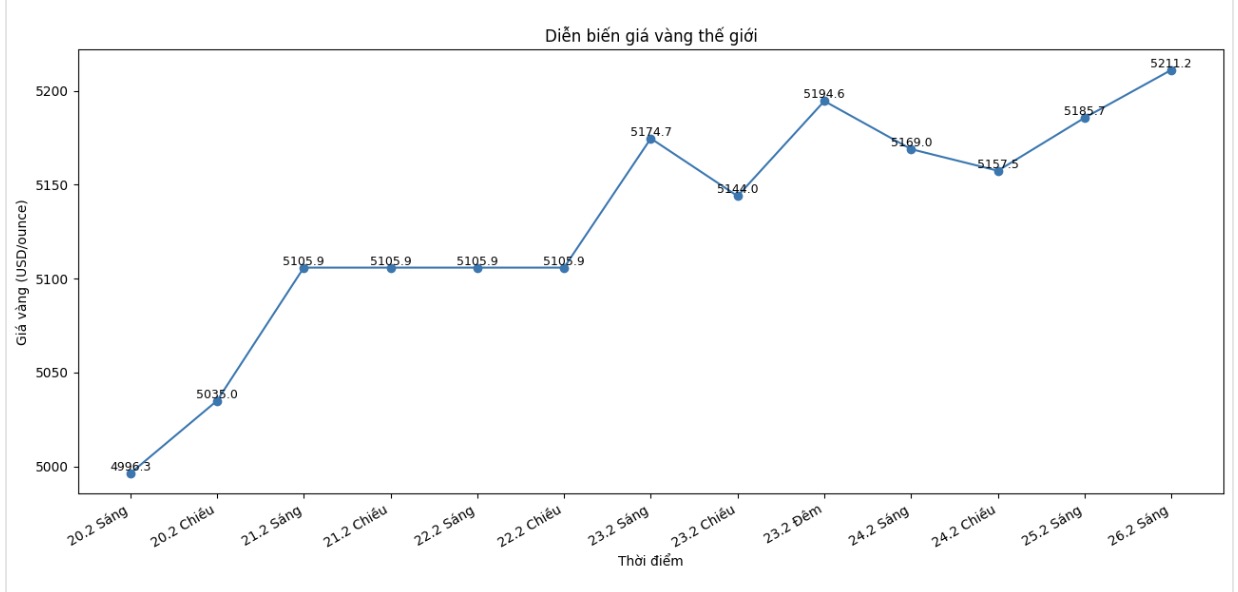
According to J.P. Morgan, this relationship explains about 70% of quarterly gold price fluctuations. The report suggests that the market needs at least 350 tons of net demand per quarter for prices to increase and "each 100 ton exceeding the 350-ton threshold may correspond to a quarterly increase of about 2%".
Central banks are forecast to continue to be an important pillar of the gold market.
After three consecutive years of net buying over 1,000 tons, the high gold buying trend of central banks is likely to continue in 2026" - J.P. Morgan Global Research said. However, purchasing power in 2026 may reach 755 tons, lower than the peak of 1,000+ tons in the past three years, but still significantly higher than the average of 400-500 tons before 2022.
Reducing purchasing volume is more technical than structural change" - the report said - "When gold prices are around $4,000/ounce or higher, the central bank does not need to buy as many tons of gold as before to increase the proportion of gold in reserves.
Investment demand is also expected to continue to increase based on the solid foundation of 2025.
In the financial market, investors' futures contract positions still lean towards buying, reflecting expectations that prices will continue to rise" - experts J.P. Morgan wrote - "Although capital flows through futures contracts fluctuate rapidly, this is only a small part of investors' total gold holdings, besides ETFs and physical gold.
J.P. Morgan forecasts that capital inflows into ETFs could reach about 250 tons in 2026, while demand for gold bars and coins is likely to exceed 1,200 tons/year.
This bank also sees room to expand the group of investors holding gold, with Chinese insurance companies and the cryptocurrency industry as potential demand.
Accurately determining when new catalysts and capital flows appear is difficult, but we maintain strong belief that gold demand is strong enough to push prices towards 5,000 USD/ounce in 2026" - Mr. Shearer emphasized - "Even our assumption of investment demand may be cautious. Just 0.5% of foreign assets invested in the US being diversified into gold, the price could rise to 6,000 USD/ounce".
In the context of gold mining supply reacting slowly to high prices and demand being forecast to remain stable, risks are leaning towards the scenario of reaching price targets in many years earlier than expected" - Mr. Shearer concluded.


