
World gold prices recorded a sharp decrease yesterday, falling below the threshold of 4,500 USD/ounce, extending the weakening trend of the precious metal. Overall last week, gold lost nearly 4% of its value, marking the lowest level since the end of March and retreating deeply from the historical peak of 5,595 USD/ounce set at the end of January.
The direct reason comes from the fact that US inflation data is hotter than expected, causing bond yields to soar and erasing all hopes that the US Federal Reserve (Fed) will cut interest rates in 2026.
According to CME Group data, 97.4% of investors currently predict the Fed will keep interest rates unchanged at 3.50–3.75% at the June meeting, while expectations of possible interest rate hikes before the end of the year begin to emerge.
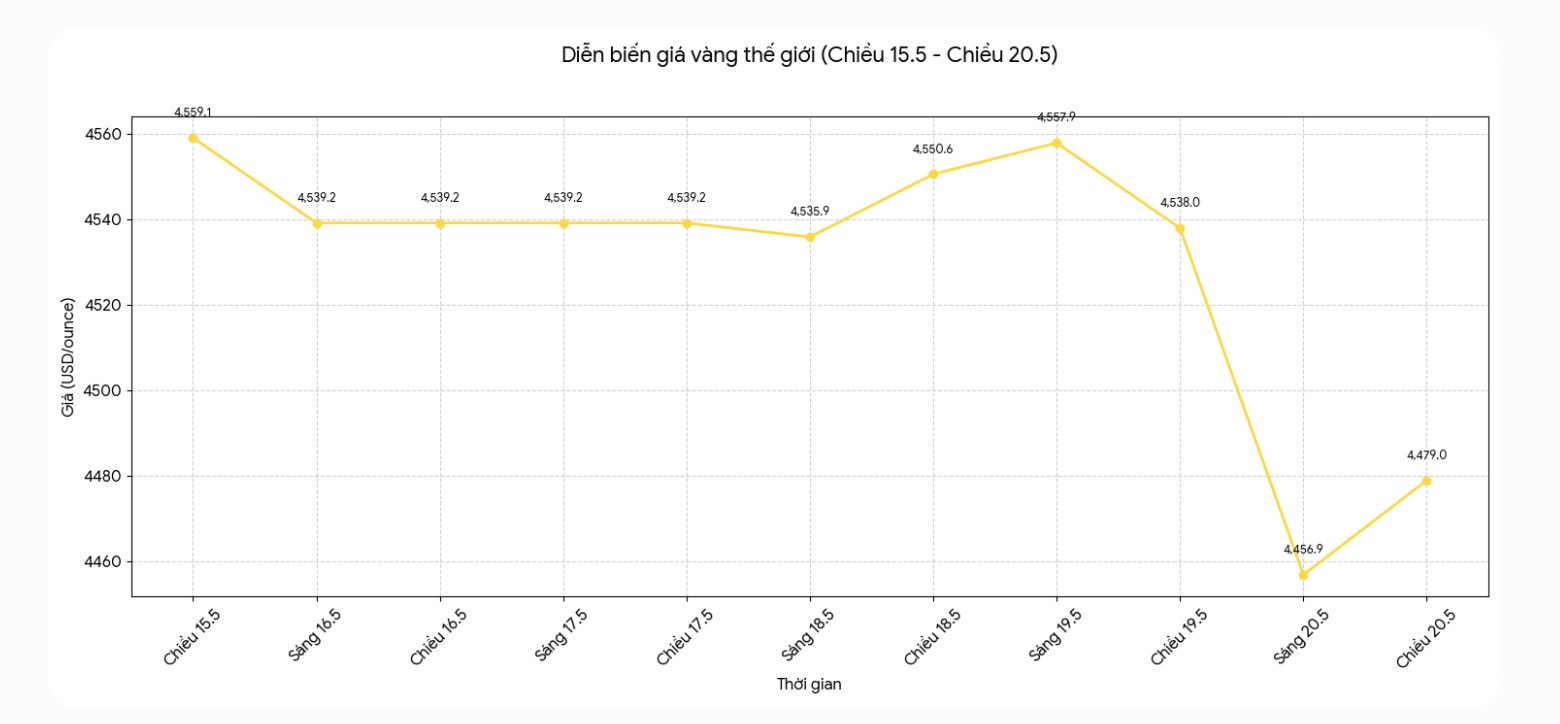
The high interest rate environment makes gold, a non-rotating asset, less attractive than profitable investment channels. The strengthening USD further increases pressure, making gold prices more expensive for investors holding other currencies, limiting demand in Asia and Europe.
In addition, geopolitical tensions in the Middle East, although once supporting gold prices, are also not enough to hold the market. News about the possibility of US-Iran negotiations temporarily reduces geopolitical risk factors, but warnings from US President Donald Trump and energy facility attacks in the Gulf region push the tense situation back, indirectly pushing inflation up, consolidating a tight monetary policy.
In the long term, the outlook is still positive. The World Gold Council report said that global gold demand in Q1/2026 reached a record 1,231 tons, up 2% over the same period, thanks to demand for gold bars and coins increasing by 42% due to Asian retail investors.

The central bank is still a positive buyer, with a forecast of total official purchase volume in 2026 of about 755 tons. Analysts maintain the gold price target of 5,000 USD/ounce by the end of the year, with the possibility of reaching 6,000 USD/ounce in the long term.
However, in the immediate future, gold's path is still trending downwards. Technical analysis shows that the precious metal has broken through the support zone of 4,600–4,650 USD/ounce, and is likely to test the floor zone of 4,466–4,423 USD/ounce, with the next strong support appearing around 4,368 USD.
During the week, important economic data such as the FOMC minutes, unemployment data, PMI and Michigan inflation expectations will continue to create volatility for the market. Until inflation cools down or the geopolitical context changes significantly, gold is unlikely to regain strong growth momentum.


