
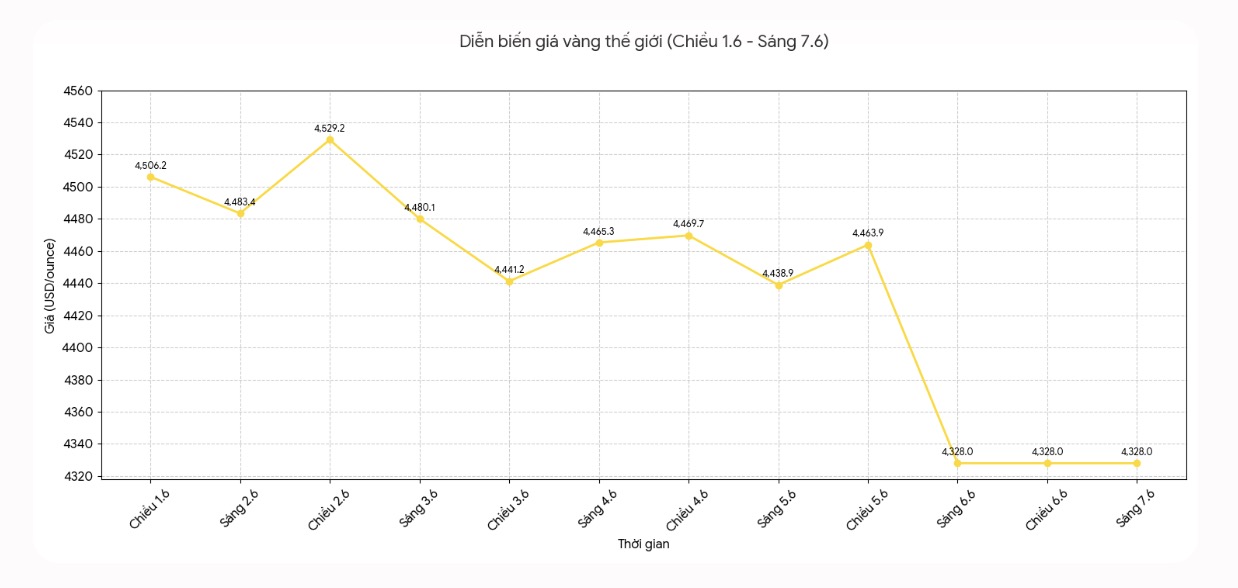
World gold prices are under strong downward pressure after the US jobs report showed that the world's largest economy still maintains better resistance than forecast. This data weakens expectations that the US Federal Reserve (Fed) will soon cut interest rates, thereby reducing the attractiveness of the precious metal.
Mr. John Weyer - Director of Trade Protection at Walsh Trading - said that payroll data was higher than expected, combined with the fact that data from previous months was adjusted upwards, creating a positive trend for the US labor market.
Mr. Weyer noted a noteworthy point that 55,000 job positions in the report came from local government recruitment. This is a fairly large number and may be difficult to maintain in the near future. However, when placed next to the upward adjustment figures of previous months, the overall picture of the US labor market is still more positive.
However, this expert believes that there are still some signals to monitor. The number of prolonged unemployed people is increasing, especially the group that has left work for 6 months or more. This is a factor that may cause concern, although overall, the fact that the data is better than expected is still seen by the market as a positive signal.

Another factor affecting market sentiment is tensions related to Iran and the Strait of Hormuz. According to Mr. Weyer, this is still an issue to be monitored, but when there are no new attacks or bombings, this risk has partly become a factor recognized by the market.
He believes that the market can handle good or bad news, but what the market does not like most is uncertainty. When the geopolitical situation becomes more certainly clear, the demand for safe haven in precious metals also cools down. If the situation changes to a worse direction, gold and silver may recover a significant portion of the decline.
Mr. Weyer said that in the short term, positive economic data gives investors more reason to believe that precious metals are no longer a prominent haven channel at the present time. This puts pressure on gold prices, especially when the USD and US bond yields increase.
Interest rate expectations also changed rapidly after the payroll report. According to Mr. Weyer, developments in the bond market show that investors almost no longer expect the Fed to cut interest rates soon. He said that it is very difficult to justify a wave of interest rate cuts at the present time and this possibility may be removed from the table for a while.
Agreeing with this view, Mr. Kevin Grady - Chairman of Phoenix Futures and Options - said that concerns about the possibility of a serious US economic downturn have been exaggerated. According to him, the figures in the jobs report are all positive, while the adjusted figures have also been raised.
Mr. Grady believes that the US economy is in a better state than many investors previously feared. This reduces the attractiveness of gold, which is often sought after when the market is concerned about economic risks or expectations of falling interest rates.
According to Mr. Grady, the latest jobs report has cooled down discussions about the Fed's early easing of monetary policy. Although the market is still closely monitoring the interest rate roadmap, the Fed needs more data before making a decision, instead of rushing to change policy.
Regarding the downward trend of gold prices, Mr. Grady said that investors should not overreact to fluctuations in a thin liquidity market. Weak trading volume and low number of open contracts show that many investors have stood outside the market, making fluctuations easily amplified.
The gold market has stalled in the high price range, but there is no new buying force strong enough to participate. In that context, the big question is who will be the next buyer. Previously, the buying force of central banks was an important driving force supporting the upward momentum of gold. Therefore, the market needs to observe whether this buying group will return when prices fall deeper or not.
Mr. Grady also added that the current decline is not necessarily a large-scale liquidation wave. This development may come more from speculative short selling and algorithmic trading, while not many investors are willing to stand out to absorb selling pressure.


