
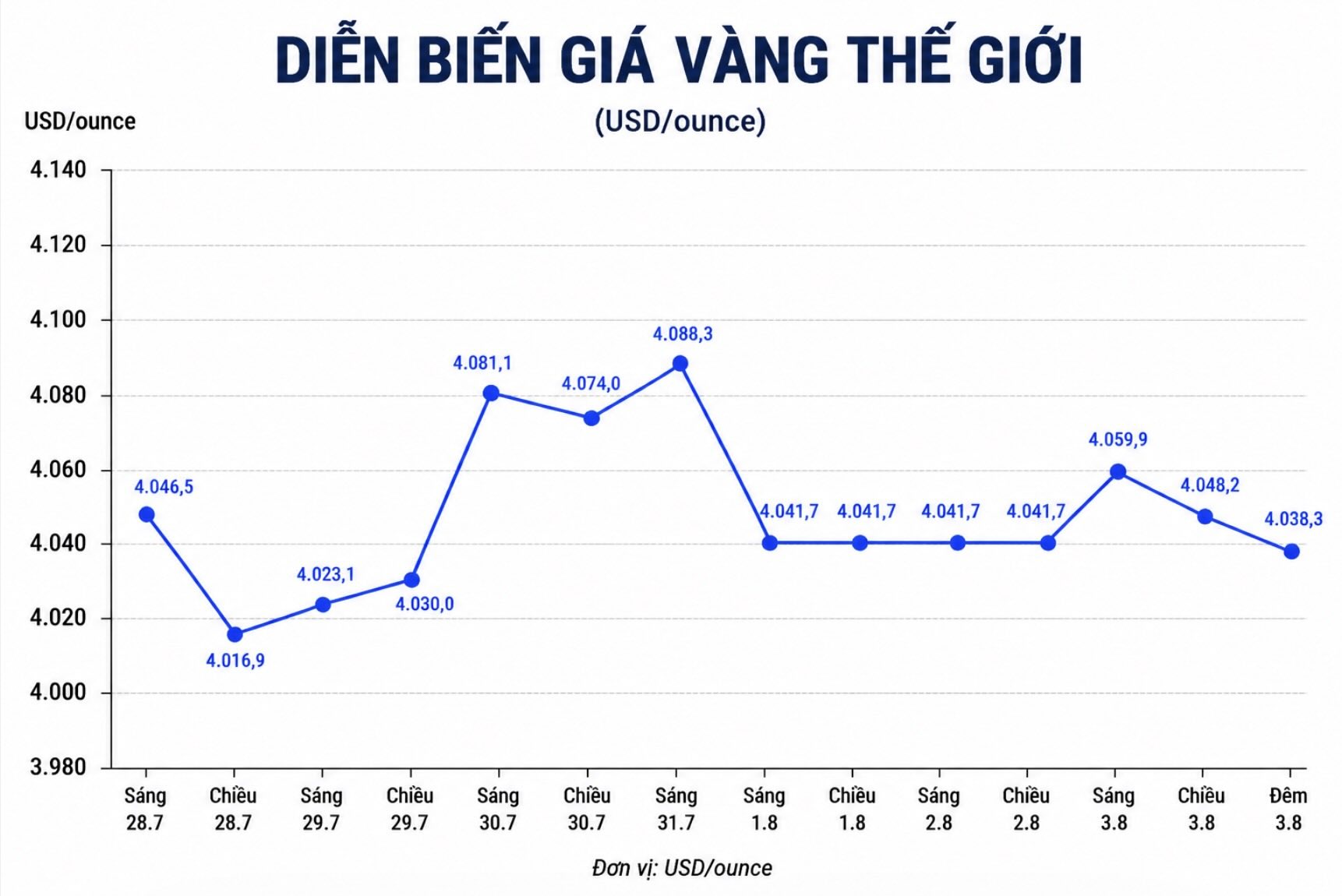
World gold prices are recording many sideways sessions. The precious metal is supported by the weakening USD, falling oil prices and US bond yields, but is under pressure as US manufacturing data is more positive than forecast.
In the trading session on August 3, spot gold prices fluctuated around 4,047.9 USD/ounce at times. However, the upward momentum did not last long. By the end of the morning in the US market, gold prices retreated to nearly 4,030 USD/ounce, down about 0.3%.
The 4,000 USD/ounce mark continues to be an important psychological support zone. Despite repeatedly checking this area, gold prices have not created a clear trend, while safe-haven demand and interest rate pressure are constantly struggling.
US manufacturing boom puts pressure
The US Institute for Supply Management announced that the manufacturing sector purchasing managers' index in July reached 55.6 points, up from 53.3 points in June. This is the highest level since May 2022 and marks the seventh consecutive month of manufacturing activity maintaining an expanded state.
New orders, output, employment, delivery time and inventory indicators are all in the growth zone. Notably, the employment index returned above the 50-point threshold for the first time in 33 months, showing that labor demand in the manufacturing sector is improving.
Better than forecast data may cause the US Federal Reserve (Fed) to continue to prioritize controlling inflation. This is a disadvantage for gold, because high interest rates increase the cost of opportunity to hold non-rotating assets.
Previously, the Fed kept the operating interest rate unchanged in the range of 3.5-3.75% with a voting ratio of 9-3. Three members wanted to increase by an additional 0.25 percentage points. This result caused the market to view the Fed's decision in a tough direction, instead of a signal of preparing to ease monetary policy.
Price pressure remains as the personal consumer spending price index in June decreased by 0.1% compared to the previous month but increased by 3.7% compared to the same period in 2025. Core inflation, excluding food and energy, increased by 3.3% compared to the same period, significantly higher than the Fed's target of 2%.
Market awaits job report
On the supporting side, oil prices fell after the risk of conflict in the Gulf region temporarily cooled down. Falling energy prices contributed to reducing inflation expectations, while putting pressure on US bond yields and the USD.
However, the impact on gold is not entirely positive. Cooling geopolitical tensions may weaken demand for safe-haven assets, while falling yields and the USD support precious metals. Two opposing forces make gold prices continue to fluctuate in a narrow range.
The US July jobs report will be the next focus, as these figures could directly affect interest rate expectations. Previously, the number of initial jobless claims increased by 9,000, to 197,000 claims in the week ending July 25. Despite the increase, this figure still reflects a relatively stable US labor market.
Technically, the 4,000-4.021 USD/ounce zone is a near support for gold prices. If breaking the 4,000 USD mark, selling pressure may increase. Conversely, gold prices need to surpass the 4,807-4,116 USD/ounce area to consolidate the recovery momentum, before heading towards the 4,150 USD and 4,200 USD/ounce marks.
Information in the article is only intended to reflect market developments and provide reference data, and should not be considered an investment recommendation. Gold buyers need to consider their financial capacity, risk acceptance level and closely monitor price fluctuations before deciding to trade.


