
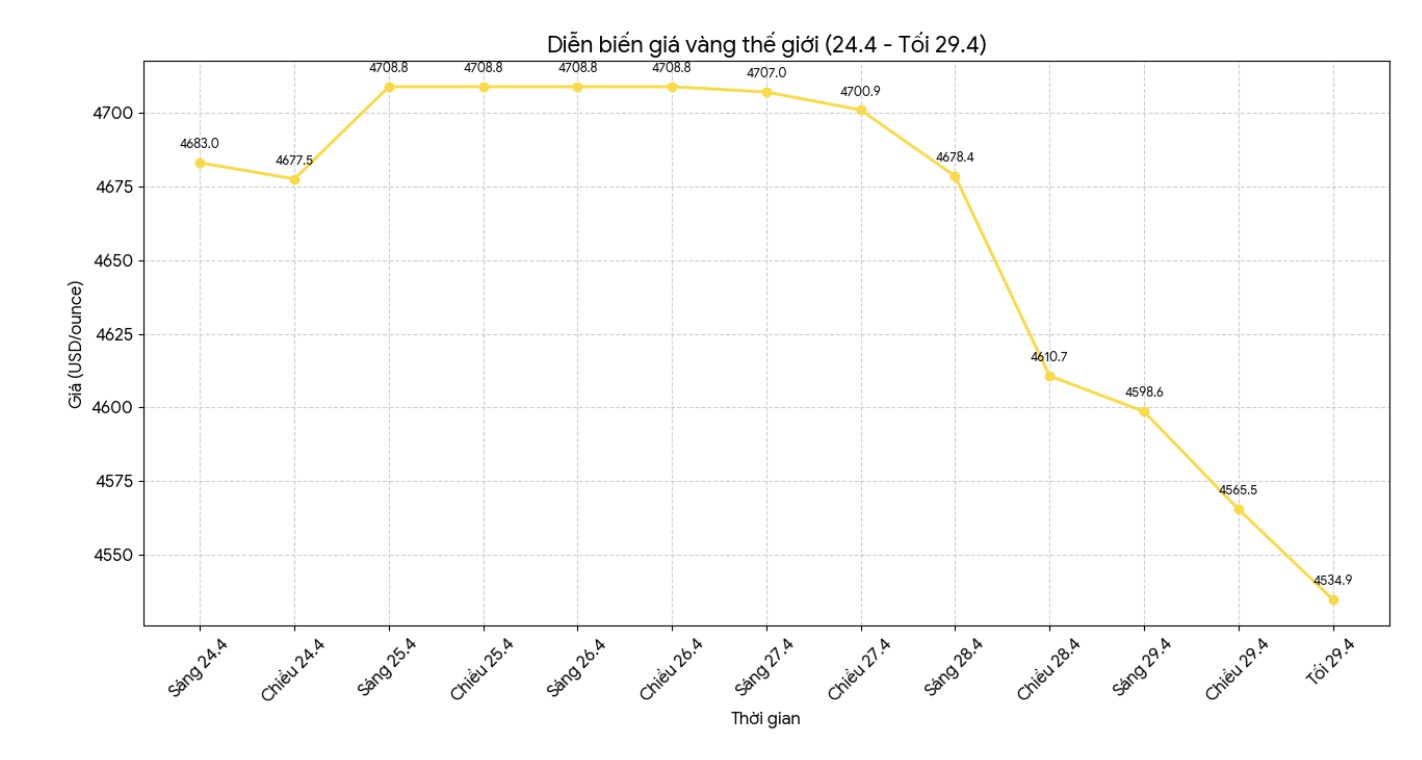
World gold prices continued to fall deeply in the evening trading session of April 29 (Vietnam time) as investors were cautious ahead of the policy meeting of the US Federal Reserve (Fed) and a series of US economic data exceeding expectations.
At 8:30 PM on April 29 (Vietnam time), world gold prices were listed around the threshold of 4,582.8 USD/ounce, down 94.4 USD/ounce compared to the previous session.
According to records from the international market, gold and silver prices simultaneously weakened in the morning trading session in the US before the Fed announced its monetary policy decision. Gold futures for June at one point fell 29.1 USD, to 4,579 USD/ounce, while silver futures for May fell 0.669 USD, to 72.56 USD/ounce.

Pressure on precious metals comes from the return of US bond yields along with concerns about inflation escalating due to strong oil prices. WTI crude oil prices on the Nymex exchange have returned above the 100 USD/barrel mark, trading around 103.5 USD/barrel. Meanwhile, US 10-year Treasury bond yields stood at 4.36%, and the USD index also increased in price.
The market is currently focused on the results of the meeting of the US Federal Open Market Committee (FOMC), expected to end on the evening of April 29. Most analysts believe that the Fed will keep interest rates unchanged in the range of 3.5%-3.75% for the third consecutive time.
TradingEconomics believes that the prospects for the remaining months of the year are still quite uncertain as rising oil prices may cause inflation to rise again, although the US labor market still maintains relatively good resistance.
In addition, a series of newly released US economic data continues to show that the country's economy has not shown clear signs of weakening.
The US Department of Commerce said that the number of houses started in March increased by nearly 11%, reaching a seasonally adjusted annual rate of 1.502 million units, higher than the forecast of 1.38 million units by experts. However, the number of construction permits decreased by nearly 11%, to 1.372 million units.
In another report, US durable goods orders in March increased by 0.8%, higher than the forecast of 0.5%. Core orders (excluding the transportation sector) increased by 0.9%, far exceeding market expectations.
These positive figures reduced expectations that the Fed would cut interest rates soon, thereby putting pressure on gold - a non-performing asset.
However, the World Gold Council (WGC) said that central banks are still actively buying gold. In the first quarter, the net gold purchase volume of central banks reached 244 tons, a sharp increase compared to 208 tons in the previous quarter.
Mr. John Reade - chief strategist of the WGC - said that the recent correction of gold has created an opportunity for many central banks to return to buying at more attractive prices.


