
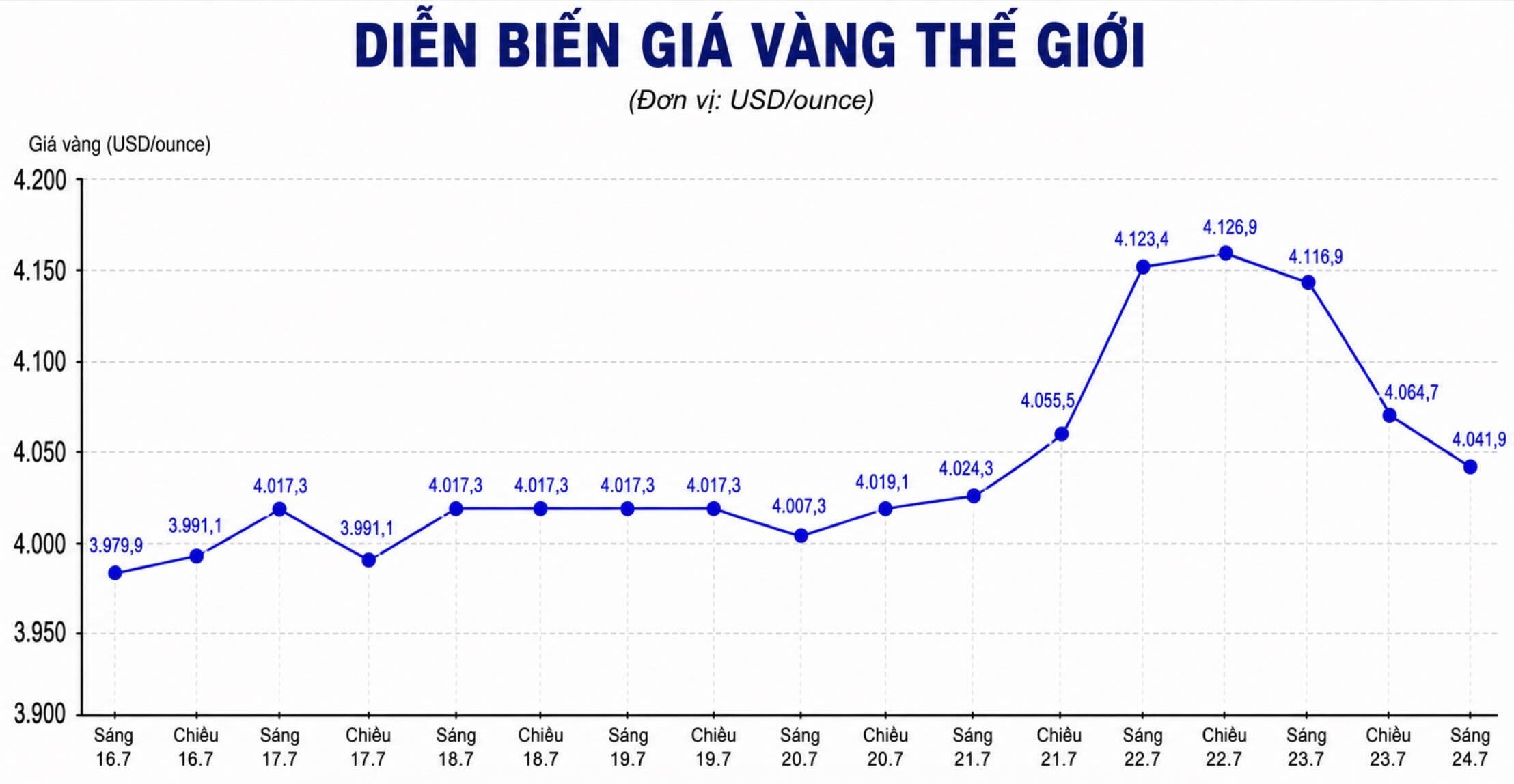
World gold prices fell sharply in last night's trading session, despite geopolitical tensions in the Middle East continuing to increase. The pressure mainly came from the upward momentum of US government bond yields, the strengthening of the USD and the escalating crude oil prices.
At one point, spot gold prices fell to 4,039.4 USD/ounce, approaching the lowest level of the day. At the time of writing (8:05 AM on July 24 - Vietnam time), this precious metal traded around 4,041.9 USD/ounce.
The fluctuation range of gold prices in the session is in the range of 4,039.4-4,141.7 USD/ounce. Failure to overcome the trend resistance zone increased selling pressure, pulling gold prices below the 4,100 USD/ounce mark.
US job data puts pressure on gold prices
One of the direct reasons for the sharp drop in gold prices is the latest data on the US labor market that is more positive than forecast.
According to the US Department of Labor, the number of initial jobless claims in the week ending July 18 reached 187,000, significantly lower than the forecast of 212,000. This is also the lowest level in decades.
Last week's data was adjusted to 209,000 units, from the initial announced level of 208,000 units.
On average, the 4-week fluctuation of unemployment claims, the indicator is assessed to be more stable, falling to 207,500 claims. This figure is lower than the forecast of 213,000 claims and the level of 214,750 claims of the previous week.
Meanwhile, the number of people continuing to receive unemployment benefits reached 1.796 million people, lower than the forecast of 1.809 million people.
These figures show that recruitment activities in the US may be slowing down, but the number of laid-offs remains low. The labor market maintains its resilience, causing investors to reduce expectations that the Fed will soon switch to a loose monetary stance.
Maintaining high interest rates is often detrimental to gold, because precious metals do not bring periodic yields like bonds.
Bond yields and USD rise together
After the jobs data was released, the yield of 10-year US Treasury bonds traded around 4.7%.
Rising yields make the opportunity cost of holding gold higher. A part of investors therefore shifts capital to profitable assets, creating more selling pressure on precious metals.
At the same time, the USD index maintained its upward momentum. The strengthening greenback made gold more expensive for buyers using other currencies, thereby weakening demand in the international market.
Although recent inflation figures have somewhat eased, the market is still cautious about the possibility of high energy prices causing inflation to return.
The European Central Bank kept interest rates unchanged at 2.25%, while continuing to emphasize inflation risks related to energy. In the US, positive labor data and rising oil prices have led investors to believe that the Fed is likely to keep interest rates unchanged at the July 29 meeting, instead of signaling clear easing.
Rising oil prices create two-way impact
Tensions in the Strait of Hormuz and the Red Sea region continue to support the need to seek safe assets. However, this factor is not enough to stop gold prices from falling.
Brent oil prices at times exceeded 100 USD/barrel, while WTI oil traded around 92 USD/barrel. Concerns about oil transportation and the risk of supply disruption are pushing energy prices up sharply.
Usually, geopolitical instability can drive cash flow to gold. However, rising oil prices also increase inflation expectations, thereby pulling bond yields up and strengthening the strength of the USD.
This creates a two-way impact on gold. Shelter demand still exists, but is overwhelmed by pressure from yields and monetary policy.
Developments in the financial markets show increased risk avoidance sentiment. The S&P 500 index fell 1.2%, Nasdaq Composite lost 2.2%, Dow Jones fell 1%, while many European stock markets also simultaneously went down.
However, cash flow has not shifted strongly to gold because US bond yields are at an attractive level and the USD continues to be supported.
The market is waiting for new signals from the Fed, US Purchasing Managers' Index data and developments on important oil shipping routes in the Middle East.
Information in the article only reflects market developments, not investment recommendations.


