
Analysts believe that information about the US and Iran ceasefire agreement lasting two weeks is pushing both gold prices and the stock market up, while crude oil prices plummeted. In overnight trading, S&P 500 futures rose more than 2% in the session. At the same time, West Texas Intermediate (WTI) crude oil futures fell 18%.
Changes in gold market sentiment have pushed prices through important resistance levels. The nearest spot gold price was traded at 4,809.2 USD/ounce, up more than 2% in the session.
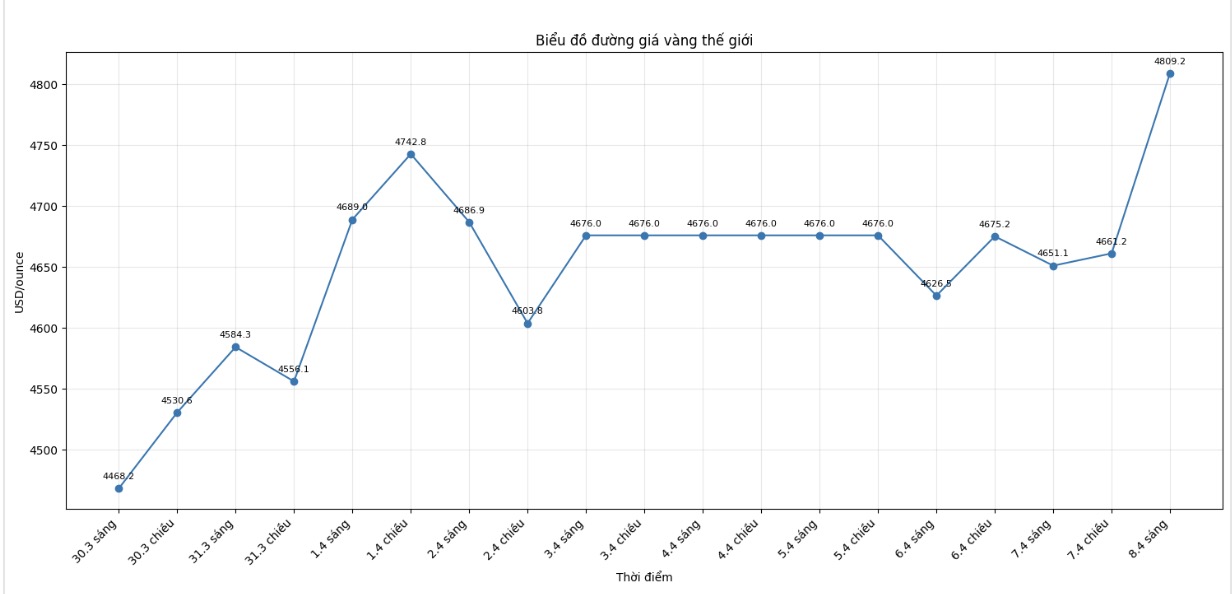
Analysts say gold needs to surpass the initial resistance level of 4,800 USD/ounce to attract more buying power in an upward trend; however, the key milestone is still 5,000 USD/ounce.
Silver prices also increased sharply, exceeding the threshold of 76 USD/ounce, up more than 4% in the session.
Analysts believe that gold will benefit if the conflict ends, as this could create conditions for the US Federal Reserve (Fed) to consider cutting interest rates by the end of this year.
Despite increasing geopolitical risks due to the war with Iran, gold prices faced difficulties in attracting safe-haven cash flow. Last month, gold prices fell more than 11%, recording the strongest monthly decline since the early 1980s. Analysts believe that gold prices fell because investors and central banks were forced to sell this precious metal to meet liquidity demand.
In a double impact, increased inflation concerns pushed interest rate expectations higher, increasing the opportunity cost of gold - a non-interest-generating asset.
Rising oil prices due to prolonged chaos in the Middle East have caused serious disruptions in the global supply chain, pushing oil prices above $100/barrel. Rising energy prices have raised the risk of inflation escalating, forcing many central banks to stop the current monetary easing cycle.
Although the two-week ceasefire is expected to ease supply chain problems, some analysts believe it is still too early to determine the extent of the damage that the global economy has suffered, as well as the impact that high oil prices will have on inflation.
The focus at this time will also shift strongly to the economic damage that the conflict, as well as the soaring energy prices, have caused to the global economy, not only from the perspective of inflation but also in the growth drags stemming from the negative demand shock afterwards.
If energy prices actually start to stabilize again, central banks are likely to "look through" the upcoming full inflation increase and consider it just a temporary factor, thereby significantly reducing the possibility of policy tightening in the short term - something I have always thought the market has gone too far ahead" - Mr. Michael Brown, Senior Market Analyst at Pepperstone, said.
Of course, the big risk here is that the ceasefire is not maintained, the conflict escalates and we return to the starting line once again.
If that happens, although of course we hope it will not come true, then at least we have become too clear of the scenario in the past few weeks - crude oil increases sharply, the USD is the only safe haven asset that really works, and all other types of assets from stocks, bonds to metals will be under significant pressure" - this expert said.


