
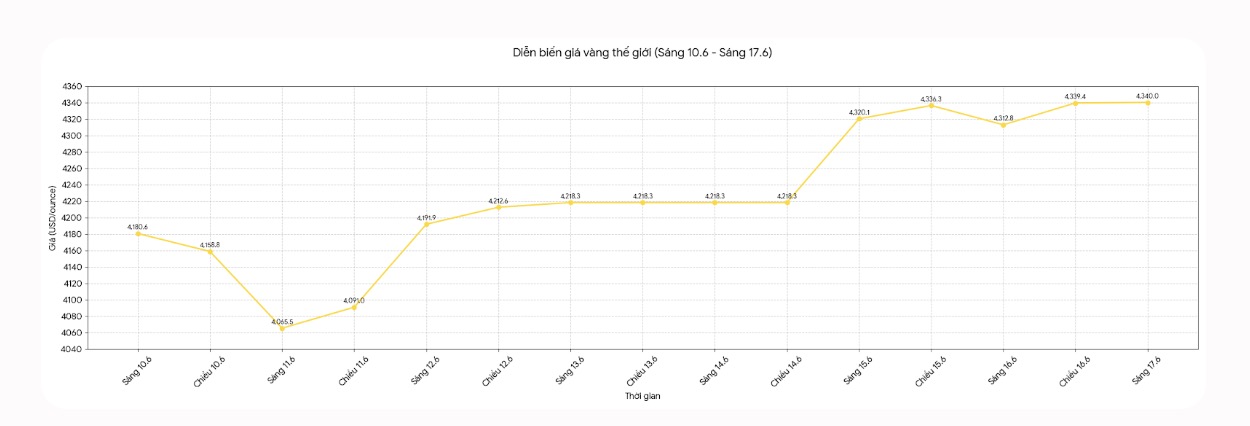
Recorded at 1:05 AM on June 17 (Vietnam time), world gold prices were listed around the threshold of 4,340 USD/ounce, an increase of 18.2 USD/ounce compared to the previous day.
The diễn biến of the precious metals market is currently strongly influenced by the energy price - interest rate channel. US May inflation data previously still made the market maintain expectations that the US Federal Reserve (Fed) will be cautious in policy management. However, the sharp drop in crude oil prices after risks in the Strait of Hormuz cooled down somewhat eased expected inflationary pressure, thereby supporting gold.
The Fed's June policy meeting takes place on June 16-17. Although the market does not have high expectations for the possibility of interest rate changes right at this meeting, investors are particularly interested in the updated economic forecast and signals about the interest rate roadmap in the coming time. This is considered a factor that can determine the short-term trend of gold.
Another factor affecting market sentiment is the information that the US and Iran reached a preliminary agreement to end the conflict, reopen the Strait of Hormuz and continue negotiations for 60 days. However, this agreement has not been officially announced, while Israel is said to have not accepted a condition related to the withdrawal of troops from Lebanon.
Oil prices are the asset that reacts most clearly to the above information. Brent oil at one point fell below 80 USD/barrel, the lowest level since the beginning of March, after information emerged that Iranian oil tankers resumed transportation. US WTI oil also fell, trading around 78.4 USD/barrel.
For gold, the impact from geopolitical developments is currently two-way. When the risk of war cools down, safe-haven demand may be limited. However, falling oil prices and falling US bond yields support non-performing asset groups such as gold.
Besides energy and monetary policy factors, newly released US economic data also contributes to strengthening purchasing power for gold. The US Department of Commerce said that the number of houses started in May decreased by more than 15%, to 1.18 million units at an annual pace that has been seasonally adjusted. This figure is significantly lower than the forecast of economists, who expected relatively stable construction activities around 1.43 million units.
April data was also adjusted down sharply, down to 1.39 million units. Compared to the same period in May 2025, housing construction activity in the US decreased by 8.9%. The report also shows that the possibility of a strong housing market recovery in the second half of the year is not high, when the number of construction permits - an indicator for future construction activities - decreased by 0.7%, down to 1.413 million permits in May.
Mr. Jeffrey Roach - Chief Economist at LPL Financial - said that the housing market may continue to put pressure on US GDP growth in the second quarter. According to him, although monthly data is often fluctuating, the sharp decrease in the number of started houses is an unusual development.
With the slowdown in new housing construction, housing investment is likely to reduce GDP growth in this quarter. In the first quarter, this group decreased by 0.25 percentage points in the overall GDP and the second quarter may be even less positive. In general, the housing market is still in a tight state" - Mr. Jeffrey Roach said.
Technically, analysts believe that gold buyers need to bring prices back above the 200-day exponential moving average. If the upward momentum is maintained, the next target may be the 50-day moving average and the 4,600 USD/ounce zone. Conversely, if the price falls below 4,200 USD/ounce, selling pressure may expand to the 4,000 USD/ounce zone.
For silver, the 70 USD/ounce zone continues to be an important milestone. If maintained above this threshold, silver prices may head towards the resistance area of 72.47-74.6 USD/ounce. In the opposite direction, losing the important technical support zone can pull the price back to 63.5 USD/ounce, even 60 USD/ounce.


