
Gold benefits from weakening USD and monetary policy expectations
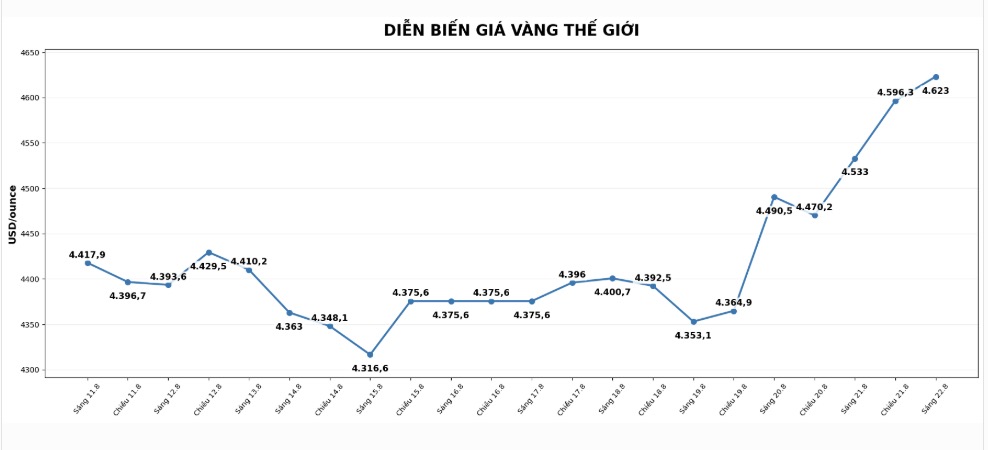
Recorded at 0:20 on August 22, world gold prices were listed around 4,623 USD/ounce, up 140.3 USD compared to the previous day. The strong increase brought gold to a new high price range, showing that buying power in the market is maintained very positively.
Cash flow continues to flow to the precious metal group in the context of market expectations falling that the US Federal Reserve (Fed) will continue to raise interest rates in the near future.
Recent US economic data shows that the growth picture is differentiated. Some indicators such as inflation, retail sales and consumer sentiment show that the economy is suffering certain impacts from the high interest rate environment.
Meanwhile, the minutes of the latest Fed meeting show that some officials still maintain the view of needing to be cautious about inflation. However, most of the market currently leans towards the possibility that the Fed will maintain its policy in the upcoming meeting.
The fact that interest rates have not shown signs of further increase helps reduce pressure on gold, because precious metals often benefit in a stable or decreasing interest rate environment. In addition, the weakening USD also makes gold more attractive to investors holding other currencies.
Geopolitical risks continue to support shelter needs
Not only affected by monetary policy, gold prices are also supported by instability in the international market.
Cargo transportation through the Strait of Hormuz continues to be affected, increasing concerns about global energy supplies. This is a factor that could put pressure back on oil prices and inflation.
Currently, Brent oil is trading around 93.45 USD/barrel, while WTI oil is around 86.53 USD/barrel. Energy prices maintained at a high level, causing the market to continue to be concerned about the possibility of inflation returning, thereby boosting the demand for gold defense.
Notably, gold still increased sharply even though the yield of long-term US government bonds is maintained at a high level. This shows that the current price increase momentum comes not only from interest rate expectations but also reflects the need to preserve assets against economic and geopolitical risks.
US economic data creates mixed signals
Besides supporting factors, the gold market is also closely monitoring new data from the US economy.
The preliminary composite PMI index for August increased to 56 points, higher than the 54.5 points of the previous month and exceeding market forecasts. In which, the service sector continued to play an important role when the service PMI increased to 56.8 points.
This figure shows that business operations in the US are improving strongly, especially in the service group. Some businesses are also increasing recruitment as expectations for consumer demand improve.
However, the manufacturing sector recorded a slowdown signal when the manufacturing PMI decreased to 53.2 points. Difficulties from supply chains, inventory and input costs still put pressure on production activities.
After PMI data was released, gold prices at times adjusted slightly from the high in the session but still maintained a large increase, reflecting that buying power is still dominant.
Gold heads towards higher price zones
Technically, surpassing the 4,600 USD/ounce zone helps strengthen the upward trend of gold. The 4,671 USD/ounce zone is being considered the next target, and further away is the 4,778 USD/ounce zone.
In the opposite direction, the 4,447 USD/ounce zone is considered an important support area. If gold prices fall below this zone, adjustment pressure may increase with lower support zones around 4,320 USD/ounce.
In the short term, the diễn biến of the USD, the Fed's interest rate policy, inflation and geopolitical risks will continue to be factors determining the trend of the gold market.
The article updates the developments of the gold market, not investment recommendations. Investors need to carefully consider risk factors before making a decision.


