
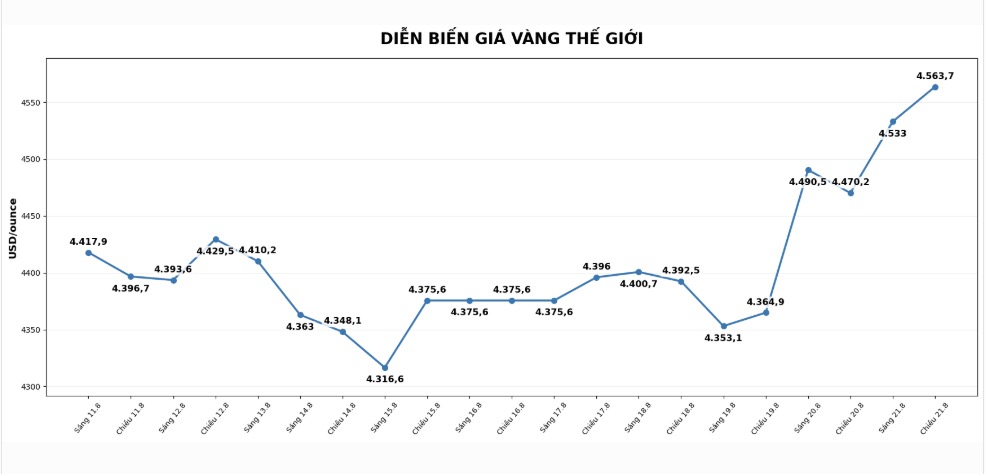
On August 21 (Vietnam time), spot gold prices increased sharply by 0.98%, to 4,563.7 USD/ounce. Previously, this precious metal had hit its highest level since the beginning of June. Overall for the week, gold prices increased by about 3.6%.
Gold futures in the US also recorded an increase of 0.5%, to 4,593.9 USD/ounce.
The main driving force supporting gold prices comes from the weakening of the USD. As the greenback depreciates, gold - which is valued in USD - becomes more attractive to investors holding other currencies. In addition, the developments in US bond yields are also creating more momentum for the precious metal.
Another notable factor is the US Treasury Department's move to buy back US government bonds. Some sources say it will increase the scale of the long-term bond repurchase program in the next quarter to at least 4 billion USD per tranche, double compared to before.
The market assesses that this move may affect the performance of bond yields and expectations for monetary policy in the coming time. If yields decrease, the attractiveness of non-profit assets such as gold may be improved.
Meanwhile, US Federal Reserve (Fed) officials remain cautious about the impact of changes in US public debt management on monetary policy.
Investors are currently focusing on monitoring the next signals from the Fed, especially the possibility of interest rate adjustments in the coming months. According to the interest rate expectation tracking tool, the market currently forecasts the possibility of the Fed keeping interest rates unchanged in the upcoming meeting at 63%, while the possibility of raising interest rates is 37%.
Usually, high interest rates can put pressure on gold prices because precious metals do not generate periodic cash flow such as bonds or deposits. Conversely, when interest rate expectations fall or bond yields fall, gold often benefits from its role as a risk hedging asset.
Besides the monetary factor, the US economic situation is also being concerned. The number of latest unemployment claims has slightly decreased, showing that the labor market still maintains stability even though July jobs data is somewhat weaker than expected. This makes the Fed continue to consider between the goal of controlling inflation and supporting economic growth.
In the international market, geopolitical developments also contribute to maintaining investor caution. Claims about the possibility of applying additional sanctions against Iran continue to increase demand for safe-haven assets.
Not only gold, many other precious metals also recorded increases in the week. Spot silver price increased 1.4% to 68.91 USD/ounce. Platinum price increased by 2.46%, reaching 1,871 USD/ounce, while palladium increased by 1.45%, to 1,332 USD/ounce. All three metals are heading towards a week of price increases.
In the context of the weakening USD, expectations of changing monetary policy and economic - geopolitical instability still present, gold continues to be considered one of the assets of interest to investors. However, price movements in the coming time still depend heavily on new signals from the Fed and global financial markets.
The article updates market developments, not investment recommendations; investors need to consider before making a decision.


