
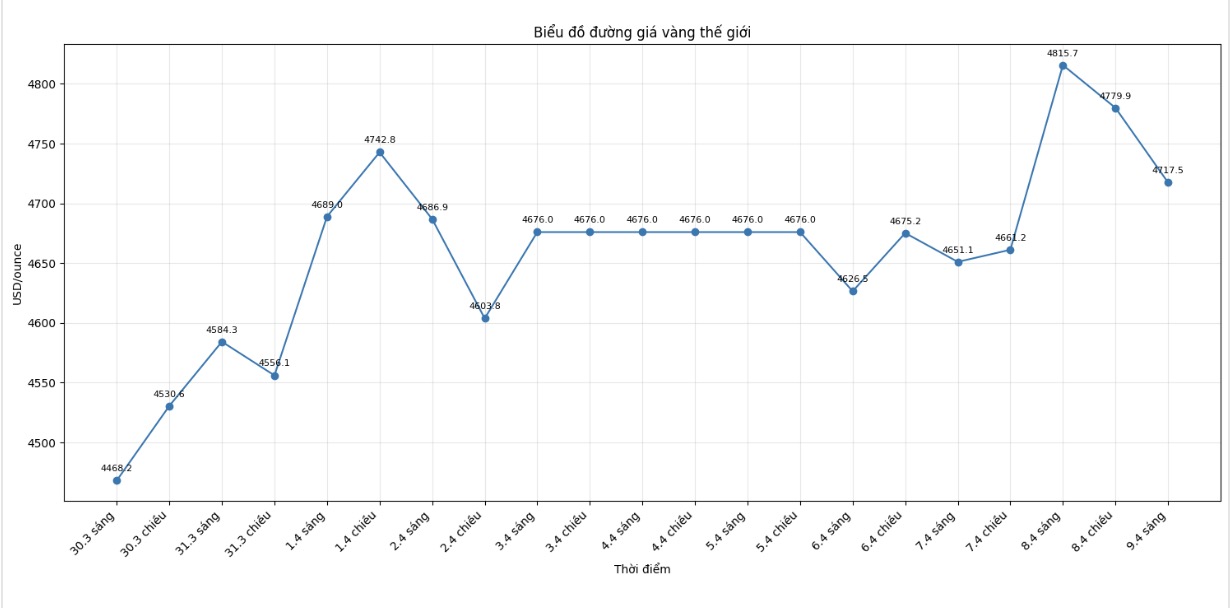
According to Kitco, despite recent fluctuations in gold prices and the fact that this precious metal has not attracted safe-haven cash flow in the context of increasing geopolitical risks, the role of gold in the investment portfolio has not changed structurally, according to a market analyst.
In an interview with Kitco News, Ms. Indrani De - Head of Global Investment Research at FTSE Russell, said that recent gold price movements reflect the collision of many mixed macroeconomic factors, thereby reshaping how investors interact with this metal in the short term.
According to Ms. De, gold still benefits from geopolitical instability, but investors need to clearly distinguish between long-term fundamentals and short-term trends and resistance.
She explained that the attractiveness of gold as a safe haven asset is being somewhat neutralized by a strong resistance, which is the increasing cost of holding non-rotating assets. The turmoil in the Middle East has caused significant disruptions in the oil supply chain, pushing energy prices up and raising new concerns about inflation.
These concerns, in turn, increase expectations that central banks will be forced to raise interest rates. This means that investors face higher opportunity costs when allocating capital to gold.
Gold does not bring any regular income... so the problem lies in the cost of holding an asset that does not generate yields. And that is the point that has changed very strongly" - she said.
At the same time, the increase in gold prices from the beginning of the year to a record high of 5,600 USD/ounce also makes gold more like a financial asset, including stronger profit-taking after large price increases. This shift makes gold more sensitive to the general liquidity conditions of the market, especially during periods when investors prioritize holding cash.
Although recent gold price movements have disappointed some investors, Ms. De noted that gold's decline is generally similar to the global stock market. This shows that the precious metal is not moving separately but is part of a widespread revaluation process in many asset groups.
Although short-term trends and market momentum have changed, Ms. De affirmed that gold is still an important diversification tool for investors and can completely regain its position as a key safe haven asset.
She said a new trend is beginning to form in the global economy, as the market is increasingly sending signals about an "inflation-free" environment - that is, slowing growth while inflationary pressure remains persistent. In such a context, real assets often play a more prominent role in the investment portfolio.
Ms. De also emphasized that it is too early to say that the recession is certain, but the current environment shows that the conditions are gradually ripening. She pointed out that rising oil prices are sending signals of inflationary pressure, while weakening copper prices reflect concerns about economic growth.
The commodity market is sending a clear signal about the risk of inflation. As economic instability increases, the benefits that portfolio diversification brings also increase," she said.
In that environment, Ms. De believes that gold still plays a distinct role as a defensive support, but is no longer the only commodity option. She said other assets, especially energy and industrial metals, are more directly sensitive to inflation and growth developments.
Although not giving specific recommendations on the allocation ratio, Ms. De's message is quite clear: in the context of increasing uncertainty and increasingly differentiated economic scenarios, the basis for holding gold - as well as commodities in general - has strengthened.
Regarding other commodity groups that she rated positively, Ms. De said that the wave of promoting artificial intelligence (AI) globally and the green energy transition process are creating sustainable demand for some types of resources, especially industrial metals and metals serving energy transition.
Goods that play a role in the AI transformation or green transformation are likely to continue to be supported by favorable factors," she said.


