
Gold prices continued to rise in the latest trading session after US inflation data matched market forecasts. This development partly eases concerns that the US Federal Reserve (Fed) must continue to raise interest rates in the September meeting.
According to data from the US Bureau of Labor Statistics, the consumer price index (CPI) in July increased by 0.1% compared to the previous month. The core CPI, excluding volatile food and energy prices, increased by 0.2%. The figures are all relatively close to analysts' forecasts.
Inflation not exceeding expectations is considered a favorable factor for gold - an asset that does not bring yields. In the session, gold futures prices increased by 41.2 USD, equivalent to 0.93%.
Notably, this is the seventh consecutive session that gold prices have formed higher peaks and bottoms than the previous session. This development shows that the short-term recovery trend is being maintained quite clearly after a period of pressure from high interest rate expectations.
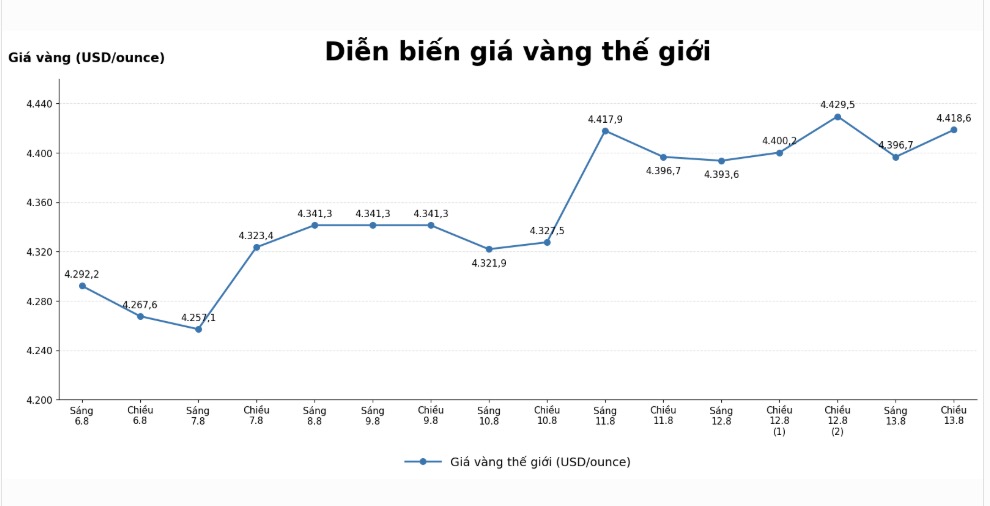
In terms of technical analysis, gold prices have surpassed the 100-day moving average and approached the resistance zone around 4,474 USD/ounce. This is an area formed from the peak in the session on July 17, and is also related to some important bottom zones that appeared from the end of last year to the first months of this year.
The 4,474 USD/ounce zone and the 100-day moving average are currently considered notable barriers to the upward trend.
According to technical analysis based on the short-term declining triangle model, if gold maintains its current price range and convincingly surpasses the above resistance level, the next target for futures gold may be around 4,600 USD/ounce. For spot gold, the target range is set around 4,500 USD/ounce.
The 4,600 USD mark is also close to the 200-day moving average of gold futures, making this area an important technical threshold that investors can monitor in the coming sessions.
In addition to technical factors, the outlook for US monetary policy continues to play a decisive role in the direction of the precious metal.
Before the CPI report was released, the market was worried that the Fed might continue to raise interest rates at the September meeting. However, July inflation figures were not higher than forecast, coupled with previous weakening signals in the labor market, are causing policy expectations to change.
In fact, the pressure forcing the Fed to continue raising interest rates has decreased significantly. The Fed still has one more inflation report before making a decision at the September meeting. If the next data does not unexpectedly increase sharply, the possibility of the Fed keeping interest rates unchanged may continue to be strengthened.
This is a noteworthy factor for gold. High interest rates often increase the opportunity cost of holding non-interest-generating assets like gold. Conversely, when interest rate hikes are expected to weaken, pressure on precious metals also decreases.
In the short term, the 4,474 USD/ounce zone is considered a tracking point. If gold prices can close stably above this area, the upward trend may be strengthened, thereby expanding the room towards the 4,500-4,600 USD/ounce zone.
However, the diễn biến of gold still largely depends on US economic data and policy signals from the Fed. Changes in interest rate expectations may cause the market to fluctuate strongly in the coming sessions.
Information in the article only reflects market developments, technical opinions, not investment recommendations.


