
After setting a historical peak on January 29, 2026, world and domestic gold prices entered a strong fluctuation cycle with the main trend being downward adjustment and re-accumulation.
From a record high price (reaching 5,594.82 USD/ounce), the world market quickly reversed when macroeconomic factors changed, especially the stronger USD and expectations that the monetary policy of the US Federal Reserve (Fed) would no longer be as loose as in the previous period.
Immediately after January 29, the market reversed at an unusual pace. Short-term profit-taking pressure from traders appeared after gold and silver simultaneously set records.
By dawn on January 31, the world gold price at one point was only about 4,740 USD/ounce. SJC gold at Bao Tin Minh Chau also decreased from 187.8–190.8 million VND/tael on January 29 to 169–172 million VND/tael at the end of January 31.
In February, gold entered a recovery phase, but the fluctuation range was still very large. On February 1st, world prices were at 4,889.4 USD/ounce. By the end of the month, February 28th, the precious metal increased to 5,278.2 USD/ounce, while SJC gold at Bao Tin Minh Chau reached 184-187 million VND/tael. The recovery momentum was supported by concerns about the US inflation heating up again, the Fed's caution and increased safe-haven demand in the face of tense developments in the Middle East.

But March marked a new sharp decline. On March 4, world gold still stood at 5,183.4 USD/ounce, but by March 20, it had broken through the 4,600 USD/ounce mark. At the end of the month, on March 31, the world price was recorded around 4,456.6 USD/ounce; SJC gold during the day was once listed at 173-176 million VND/tael.
Pressure in March comes from rising US inflation, the prospect of the Fed maintaining high interest rates and rising oil prices due to the Middle East conflict. Rising oil prices increase the risk of inflation, thereby weakening expectations of interest rate cuts. This is a noteworthy paradox when geopolitical tensions are no longer strong enough to pull gold up as before.
Entering April, gold prices had recovery sessions but could not return to the peak area. On April 2nd, the world price rose to 4, 769.5 USD/ounce, but by April 30th it was only about 4, 578.5 USD/ounce. At the same time, SJC gold bars were listed at 163-166 million VND/tael.
The USD appreciates, US bond yields rise, and the Fed's view of not rushing to lower interest rates continues to put pressure on gold. At the end of April, the precious metal experienced three consecutive declining sessions in the context of the market adjusting expectations about the path of interest rates.
In May, the market continued its weakening trend. On May 15, the world gold price was at 4,612.7 USD/ounce. By the end of the month, the trading price was around 4,534.3 USD/ounce; SJC gold decreased to 156-159 million VND/tael. Thus, the selling price of gold bars alone decreased by more than 30 million VND compared to the price range at the end of January 29.
During this period, the market was dominated by many conflicting flows of information. Progress in US-Iran negotiations at times reduced safe-haven demand, while inflation and energy prices caused market concerns that interest rates would have to remain high longer. These are all unfavorable factors for non-performing assets such as gold.
June continues to be a difficult period for the gold market. After still standing above 4,000 USD/ounce for most of the first half of the month, world gold prices plummeted at the end of the month. At 9:20 am on June 25, the precious metal fell to 3, 974.6 USD/ounce, officially breaking through the psychological threshold of 4,000 USD/ounce. The weakening momentum then continued, until the morning of July 1, world gold prices were recorded at 3, 975.4 USD/ounce.
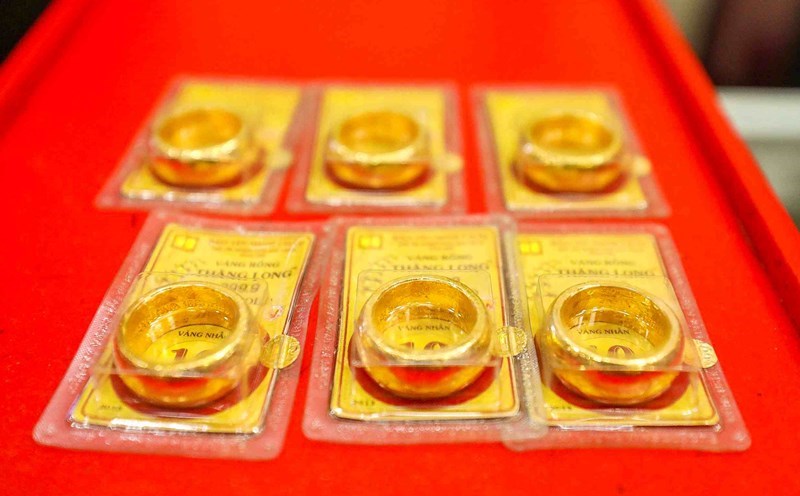
After a sharp drop, gold prices began to recover. On the morning of July 6, world gold prices were recorded at 4,176.4 USD/ounce. SJC gold at Bao Tin Minh Chau was listed at 147.5-151 million VND/tael. The world gold market also just ended a four-week consecutive decline and had its first week of increase.
From the peak of 5,594.82 USD/ounce on January 29 to 4,176.4 USD/ounce on July 6, world gold prices have decreased by about 25.4%. Domestically, if comparing the selling price of 190.8 million VND/tael at the end of January 29 with the 151 million VND/tael area on July 6, SJC gold has lost nearly 40 million VND/tael, equivalent to about 20.9%.
More than 5 months since the historical peak shows that the gold market has experienced many reversal phases: sell-offs after the peak, strong recovery, then continued weakening under pressure from the USD, bond yields, inflation, oil prices, Fed policy and geopolitical fluctuations. This development also shows that even in a long-term upward cycle, gold prices can still experience very deep corrections in the short term.


