Ignoring the goals and professional factors, if we had to choose a symbolic image to become a mass cultural heritage at the 2026 World Cup, it would definitely have to be the "Viking Row" celebration of the Norwegian team and fans.
From escalators in Boston, bustling intersections in Times Square in New York, to the Norwegian Parliament, this wave swept the world spectacularly.
The spread of "Viking Row" is not just a social media phenomenon. It is proof of how a country tells its historical story in the language of modern football, turning local identity into a universal global message.
From its origin, "Viking Row" is a quintessential distillation from the history of Northern European warriors. It recreates the accompanying rhythm of the rowers on the legendary Longship ships crossing the ocean thousands of years ago.
If Iceland's "Viking Clap" focused on the fierce "voice" part (the "HUM!" shouting combined with collective applause) to threaten the opponent, then Norway's rowing was more "visual" and narrative.
The idea of implementing this collective action is actually very new, sparked in December 2025 by Ole Froystad - the man now affectionately called "Mr. Row Row" - along with the Oljeberget Supporters Association.
When the sound of prisoners and Vikings echoed, thousands of people had to put aside their usual cheering habits to sit down together, creating a harmonious plane. Under the rhythm of the old Torstein Hamran drum bought in 2023, the shouts "Ro!" (Cheo!) echoed in unison. Its sound turned the entire football field into a giant boat spinning waves, even when the opponent's fans were still there.
The greatest value of this cultural spread is that "Viking Row" has broken the boundaries of uniqueness to become a shared experience. High-level sports often push rivalry to the maximum, but this Norwegian cultural feature has a strange ability to persuade.
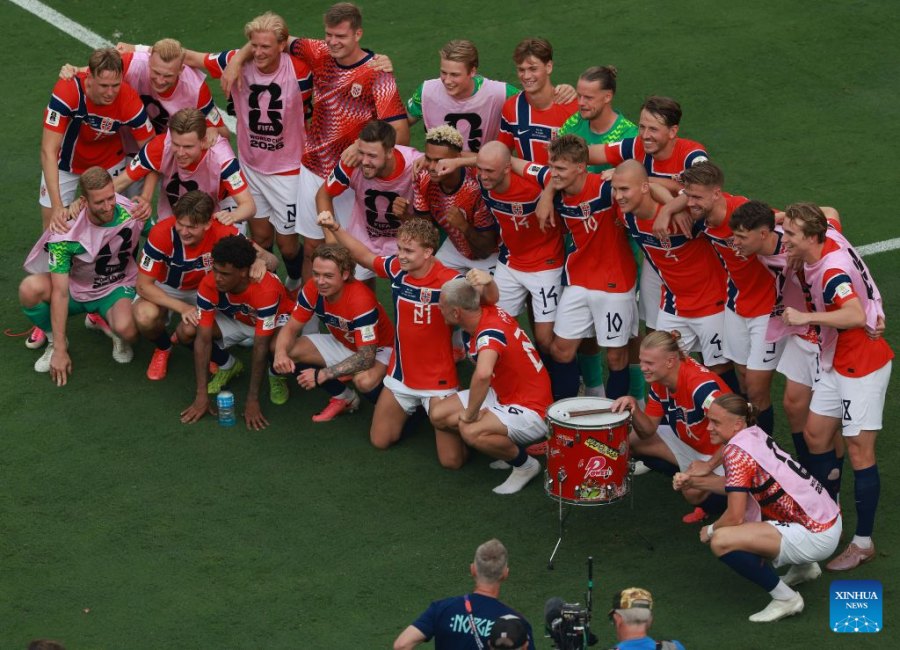
As Torstein shared, fans from other countries are completely fascinated by this ritual. They are willing to sit down and perform it with the Norwegians before and after the match.
That is the most original and beautiful nature of a World Cup - where people from different cultures not only come to witness the winners and losers, but also to share humane moments of sublimation.
A local cultural feature, when spread with sincerity and martial spirit, will naturally have vitality, turning strangers into "cheo friends" on the same emotional river.
Moreover, this celebration is a stern declaration of the rise of a generation.
For Norway, the 2026 World Cup ends 28 years of waiting since their last appearance in 1998. The appearance of big stars like Martin Odegaard or Erling Haaland is like new leaders leading this country's football boat into a new era.
Initially, when testing in a friendly match with Switzerland in March 2026, this ritual faced many skeptical views, even considered "a bit silly".
But when Haaland scored explosive goals, when captain Odegaard directly held the drumstick, leading the whole team to sit on the lawn to "chèo" with the bright red color in the stands, people understood that this was not a variety show.
That is the affirmation of position, a message that Norway has returned and is a force that cannot be underestimated.
Football, after all, is a mirror reflecting the soul of a nation. When "Viking Row" crossed the oceans to resonate in North America, it brought the spirit of solidarity, collective strength and indomitable will of the Norwegians to the world.