Launch pad from 2025 - year of records
Right from the moment of New Year's Eve of the 2026 New Year, Vietnam's tourism industry officially opened up a new and promising opportunity. Millions of tourists immersed themselves in the bustling atmosphere of the journey to start the new year.
Enjoying the brilliant fireworks displays on Phu Quoc Island, Rahul Sharma, an Indian tourist, shared: "Every year I travel to welcome the New Year, but I have never seen the atmosphere anywhere as great as here. Everyone dances, laughs, cheers, the atmosphere is so wonderful to gather friends.
Bustling destinations welcoming tourists, countdown festivals celebrating the New Year or welcoming "first-footing" groups of visitors make a strong impression on international tourists.
This is not at all a random lucky start, but must be based on the solid launching pad of 2025 - the "year of records" for Vietnamese tourism.
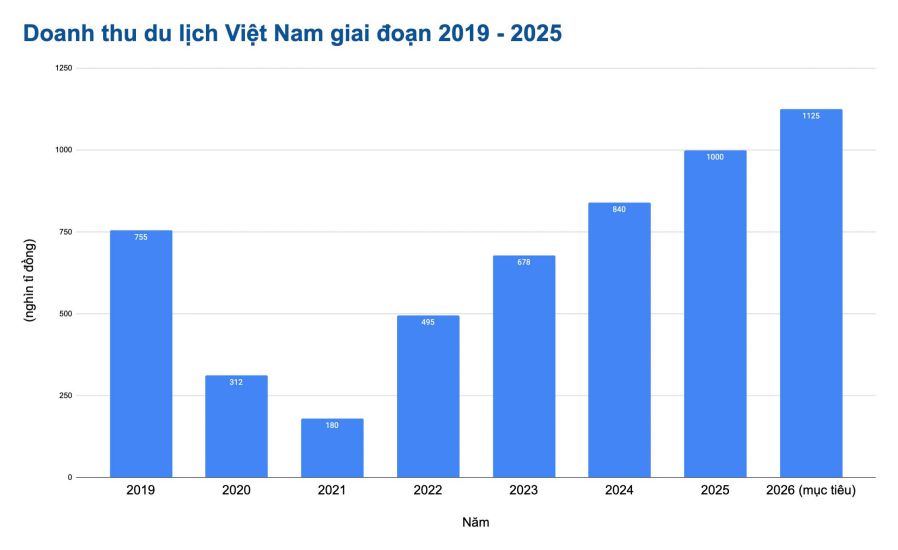
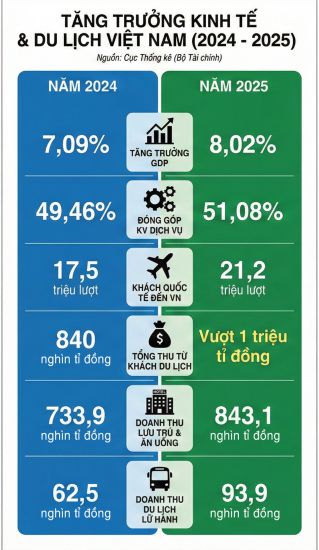
Data from the Statistics Office shows that for the first time in history, Vietnam welcomed nearly 21.2 million international visitors (up 20.4% compared to 2024), far exceeding the 18 million visitors mark of the golden age of 2019 before the pandemic. Total revenue from tourists for the first time exceeded the threshold of 1 million billion VND.
Director of the Vietnam National Administration of Tourism Nguyen Trung Khanh emphasized that 2025 is a year of particularly important significance to the country, when many important events commemorating major national holidays such as the 50th anniversary of the Liberation of the South, national reunification; the 80th anniversary of the National Day of the Socialist Republic of Vietnam; the 95th anniversary of the establishment of the Communist Party of Vietnam, along with the organization of Party Congresses at all levels, towards the 14th National Congress of the Party.
In the context of 2025 marking the full year, the year of establishing diplomatic relations between Vietnam and many countries, international cooperation activities in the field of tourism are strengthened through bilateral and multilateral mechanisms, contributing to expanding market connectivity, promoting people-to-people exchanges, and enhancing Vietnam's tourism position in the international arena.
For the tourism industry, 2025 is also an important milestone year, celebrating the 65th anniversary of its formation and development. This is also the year that Vietnamese tourism continues to record many outstanding milestones with a series of prestigious international awards. UN Tourism honors Lo Lo Chai Village and Quynh Son Village as the best tourist village in the world; Vietnam is recognized for the 6th time as the Leading Heritage Destination in the world and the 7th time to achieve the title of Leading Destination in Asia.
In the picture of achievements in 2025, the bright spot is the synchronization between policy and implementation is also clearly recognized, creating momentum for Vietnamese tourism to accelerate.
Typical examples include the visa exemption policy continuing to be expanded; applying electricity selling prices for tourist accommodation establishments equivalent to the production sector; reducing travel business licensing fees; promoting administrative procedure reform, simplifying tourism business conditions...
Expectations and challenges in 2026
Stepping into the early days of 2026, the tourism industry sets a series of higher goals. However, high expectations always come with no small pressure. The first pressure comes from the fierce competition of countries in the region such as Thailand and Malaysia when they continuously launch "huge" stimulus packages and wider visa exemption policies.
The second pressure is how to maintain service quality when the number of visitors increases rapidly. Tourism infrastructure, especially at emerging destinations, is facing the risk of overload. Besides, there is the problem of sustainable tourism development in the face of natural disasters and climate change.
The target of 25 million visitors is a goal that needs to be conquered, but should not be the biggest pressure. The tourism industry needs to be alert to look at quality indicators rather than chasing quantity. Experts point out that the current data is only stopping at counting the number of visitors, not going deep into analyzing spending levels, sources of visitors and specific tourism goals.
Mr. Nguyen Tien Dat, CEO of AZA Travel, emphasized that the tourism industry needs to focus on other important indicators such as the average spending of tourists, accommodation time and have a development strategy for each market segment, especially the high-spending customer segment.
The success of Vietnamese tourism in the new era must be defined by attracting the high-spending segment, instead of chasing after the number of cheap customers but putting great pressure on infrastructure and the environment. Typically, the lesson from Phu Quoc: after controversies about the popular segment, Ngoc Island is gradually affirming its position as a high-class resort destination - where Korean and European and American tourists are willing to pay for high-class services.
In the context that 2026 no longer has special events like 2025, promotion and advertising work needs to be effective. The Vietnam National Administration of Tourism and related agencies need to continuously implement promotion programs in key markets, with many diverse forms such as tourism fairs, international conferences..., through cinema and promotion activities in other fields abroad.
Mr. Nguyen Tien Dat especially warned about environmental challenges. Hanoi's continuous ranking in the top air-polluted cities in the world, or the successive natural disasters in the North and Central regions in recent times are alarm bells.
If visitors come to tourist destinations that own "world heritage" such as Hue, Hoi An ancient city but have to face flooding, landslides or smoke and dust pollution, disappointment can turn into negative reactions spreading on social networks.
Therefore, tourism innovation in 2026 is not only about innovating tour methods, but also about innovating urban management and environmental protection thinking. Developing Net Zero tourism or sustainable tourism at this time is no longer an option, but a survival requirement to retain high-end tourists.
In 2026, Vietnamese tourism, with the launching pad being records achieved in 2025, is facing a great opportunity to affirm its role as a spearhead economic sector. By focusing on tourism products imbued with cultural identity, promoting green transformation and proactively adapting to external fluctuations, the tourism industry can completely turn the goal of becoming a true economic pillar into reality.