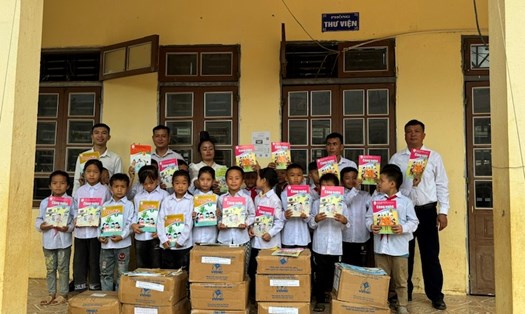
It is not difficult to see that money for children is usually only of temporary value. A few tens of thousands, a few hundred thousand VND can quickly be spent on toys, snacks, or even unnecessary items. This habit, if repeated, easily forms a mindset of valuing short-term material values, even a mentality of "waiting" for money every holiday. Even if not supervised, money will draw children into activities such as game addiction.
Conversely, a book has the ability to open up a whole world. It can be fairy tales that nurture imagination, pages of science books that inspire passion for exploration, or skill books that help children form personality.
In the digital age, books are not limited to printed books. Electronic books, audiobooks, online reading platforms... can all become useful tools if used properly. The important thing is not the form, but the content and habit of learning knowledge. For young children, printed books still have their own values: Helping to increase concentration, reduce dependence on screens and create a feeling of closeness and familiarity.
It is worth mentioning that giving money to children sometimes inadvertently creates a gap in education. When children receive money without guidance, the value of money is "relaxed". Children do not understand labor, do not feel accumulation, and also find it difficult to form a sense of thrift. Meanwhile, a book, if chosen appropriately and given with the sharing and guidance of adults, will help children understand that knowledge is the most valuable "asset".
From a broader perspective, giving books also contributes to building a learning society. When each family, each organization, each trade union or business chooses books as gifts for children, a "reading ecosystem" will gradually take shape. Family bookshelves, trade unions, and school libraries will become vivid knowledge spaces, instead of just being formalistic. Many models of giving books to workers' children have shown clear effectiveness. Bookshelves in boarding houses and reading corners at cultural houses not only expand access to knowledge but also help children get away from the screen in the digital age. There, books become a bridge between family and children, between trade unions and workers, between the present and the future. However, for giving books to be truly effective, it is necessary to change both ways of thinking and doing. Not just giving books is enough. It is important to choose the right books that suit the age, interests and needs of children. More importantly, adults need to accompany: To read together, to chat together, to evoke excitement together. A book only truly "lives" when there is interaction, when children are guided to understand and love reading.
However, it is also necessary to frankly recognize that giving money still has a certain place, especially in difficult circumstances. But even then, it is entirely possible to combine: A small part is money, the rest is books to both meet immediate needs and invest in the long-term future of children.