
On March 18, the Management Board of Chu Mom Ray National Park (Quang Ngai province) said that for many years, the park has installed 320 automatic cameras in the forest to monitor biodiversity. Through this, the board has discovered many rare animal species in the park, which are on the list of endangered species that need to be protected.
The garden has a total area of 56, 249 ha, located in the southwest of Quang Ngai province (belonging to the communes of Sa Thay, Ro Koi, Mo Rai, Ya Ly, Sa Loong and Bo Y).
The forest has high biodiversity, with more than 1,000 animal species (including 112 species on the list of endangered, precious, and rare species prioritized for protection) and 1,895 plant species (including 192 endemic, precious, and rare species).
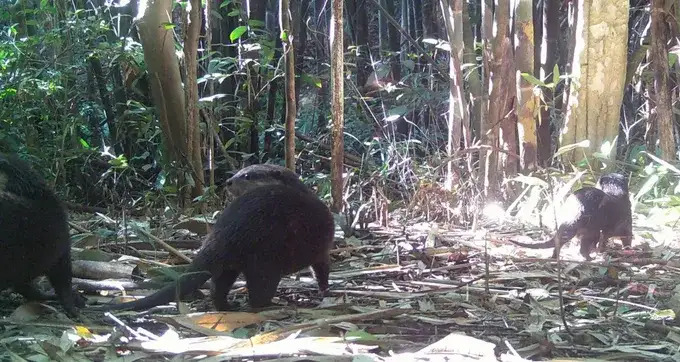
In March 2026, Chu Mom Ray National Park recorded the appearance of two rare animal species, otters and hong hoang birds. Accordingly, the camera trap recorded 1 hong hoang bird individual. This is a large bird, living on trees; when mature it can weigh up to 3 kg, wingspan nearly 1 m. The image was recorded when this individual descended to the ground to forage.
Ratfish are highly valuable skin animals, so they are heavily hunted, leading to the risk of extinction in the wild.
Through camera traps, many other species are also recorded such as monkeys, gibbons, douc langurs, pheasants, common muntjacs, forest cats, snakes and reptiles.
Previously, camera traps recorded images of Asiatic black bears appearing in Chu Mom Ray National Park - a very rare, almost extinct animal in the wild.
Asiatic black bears are also known as Tibetan black bears, Himalayan black bears or Asian black bears. This species is listed in the World Red Book (IUCN), belonging to the group of vulnerable animals.
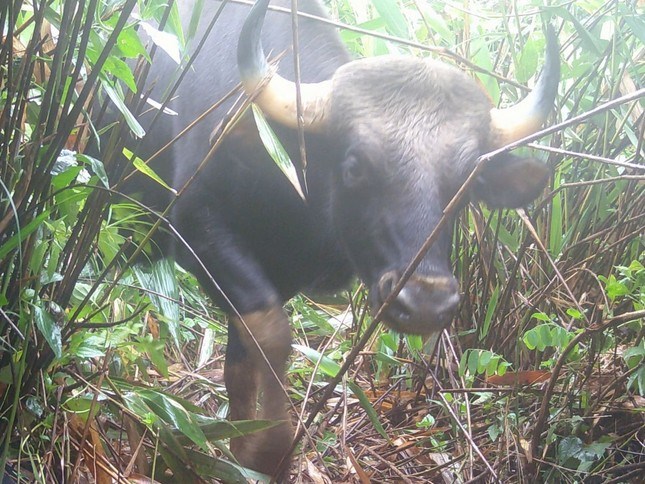
In addition, the camera trap has also just recorded images of 4 gaur in stable health. These are rare animals, often moving and not fixed in their habitat.


