
People struggle to manage water sources
Despite having an irrigation canal system with reserves of about 275 million m3 and Khanh An freshwater reservoir of nearly 3.85 million m3, domestic water supply in Ca Mau still faces many difficulties, especially in the dry season.
The main reason is that the centralized water supply system is not synchronized, small in scale, lacks connections, and many works are degraded after a long period of use. Many works no longer ensure stable water supply.
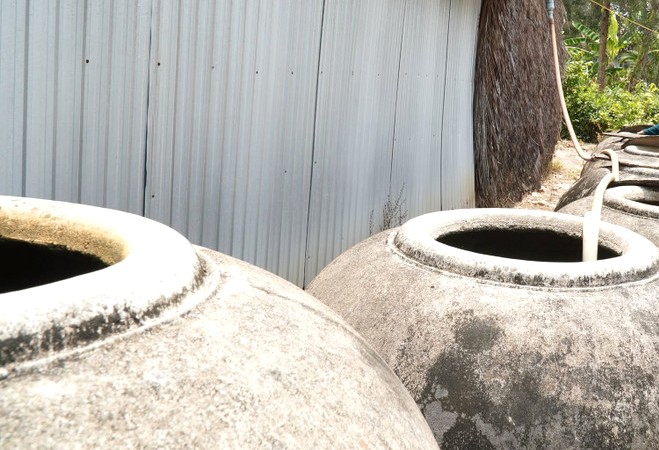
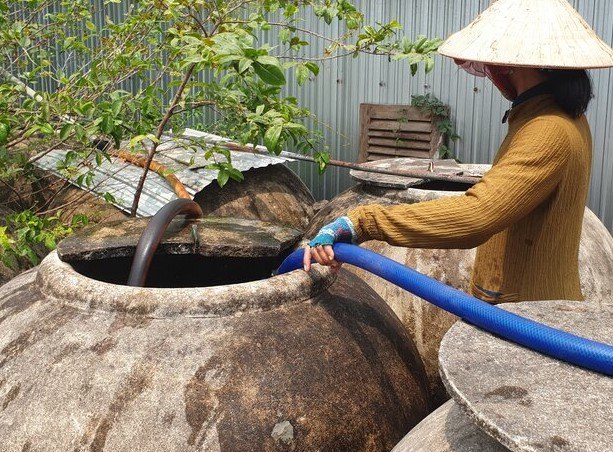
In many rural areas, people still have to find ways to ensure domestic water. In U Minh and Nguyen Phich communes, where there are no fresh groundwater sources and surface water is contaminated with alum, people mainly depend on stored rainwater.
Ms. Nguyen Thi Phung (Ong Bich hamlet, Khanh Binh commune) said that people have proactively stored water early to cope with saltwater intrusion. "Currently, there is still enough water to use, but if the sun lasts, I am very worried about water shortage," Ms. Phung said.
A similar situation occurred in Bien Bach commune when surface water was contaminated with alum and salt, unable to be used directly. Meanwhile, Ganh Hao commune does not have a centralized water supply system, and people have to drill small wells for use.
The whole province currently has 364 centralized water supply projects, but only about 42.86% operate sustainably, nearly 25% have stopped operating. Many construction projects from the period 1998 - 2013 have now seriously deteriorated. Currently, only about 50% of the rural population uses water from centralized water supply systems; 48% use household well water, and the rest depends on rainwater.
Meanwhile, more than 285,000 drilled wells are being exploited with a total flow of about 590,506 m3/day. Small-scale, uncontrolled exploitation not only affects water quality but also poses a potential risk of depletion of groundwater resources.
According to the leader of Ca Mau Provincial People's Committee, in drought conditions, water sources are prioritized for agricultural production, and at the same time, localities are required to ensure domestic water supply for people.
Water supply still cannot keep up with demand
Faced with prolonged water shortage pressure, Ca Mau Provincial People's Committee has approved the Emergency Rural Water Supply Project for the period 2026 – 2030.
The project aims to build and upgrade centralized water supply works in water-deficient areas, drought-stricken areas, and saltwater intrusion-prone areas, contributing to improving living conditions and people's health.
The province will build 5 new projects and upgrade and expand 1 water supply project, with a total capacity of about 11,200 m3/day and night, expected to serve about 6,000 households in Bien Bach, Dat Moi, Dat Mui, Da Bac, Tran Van Thoi and Khanh An communes.
The projects are invested according to centralized water supply technology lines, using groundwater sources, including drilled wells, treatment systems, tanks and distribution networks.
However, compared to actual needs, the scale of the project is still limited when the whole province still has many areas lacking domestic water, especially deep-lying and coastal areas.
In parallel with the immediate solution, Ca Mau province is also studying a large-scale water supply plan from the upper reaches of the Hau River to ensure a long-term stable water source.
According to the investor's proposal, the project will invest in a raw water pumping station with a capacity of about 600,000 m3/day and night, combined with a transmission pipeline system, with a total estimated investment of more than 5,300 billion VND.
The project aims to meet water demand for urban areas from 2029 and gradually expand to rural areas.
The combination of short-term and long-term solutions is expected to help Ca Mau gradually reduce the pressure of domestic water shortage in the context of increasingly complex drought and saltwater intrusion.


