
According to statistics from Dak Lak Provincial People's Committee, the whole province currently has more than 743,000 hectares of land with forests. Of which, about 530,000 hectares are natural forests and 212,000 hectares are planted forests, with a forest cover rate of 41.06%.
There are two areas with high risk of forest fires with large areas in the area. Specifically, the western area is about 62,000ha, and the eastern area is nearly 34,000ha.
At the peak of the dry season, the risk of forest fires increases, especially in Khop forests - the typical dry forest type of the Central Highlands - and areas of planted forest adjacent to people's fields.
This is also the time when subjects take advantage of dry conditions and favorable forest roads to increase illegal logging and transportation of forest products.
Faced with that reality, the forest protection force has implemented many synchronous solutions. In which, focusing on integrating forest fire prevention and control inspection with the task of preventing illegal exploitation and transportation of forest products in key areas.
From mid-March to the end of April 2026, an inter-sectoral inspection team including police, military and forest rangers will inspect 11 areas with 38 locations at high risk of forest fires managed by forestry companies and People's Committees of communes and wards.
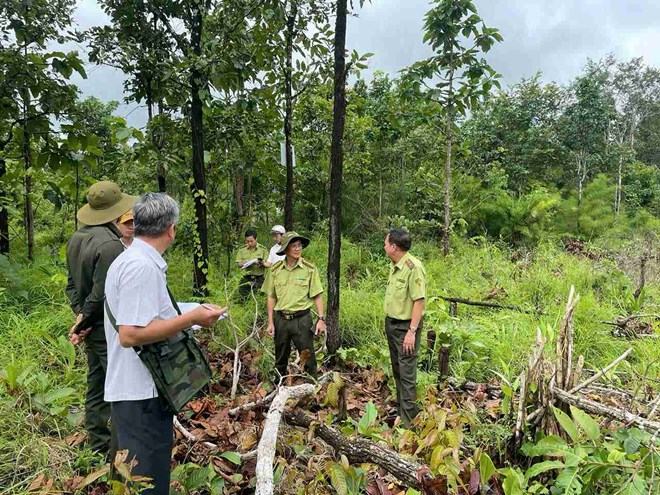
Mr. Nguyen Quoc Hung, Head of Dak Lak Provincial Forest Protection Department, said that the situation of illegal logging and transportation of forest products of unknown origin is still latent in some areas. To proactively prevent it, the unit has developed a patrol and inspection plan in the direction of combining many tasks in one working period.
When organizing inspections of forest fire prevention and fighting work in key areas, the forest ranger force also monitors forestry routes, wharves, and timber product gathering points. Through this, they promptly detect and handle violations of the law on forestry," Mr. Hung said.
According to Mr. Hung, in many areas with large forest areas, forest ranger stations have coordinated with local authorities, forest owners and functional forces to organize inter-sectoral patrol teams.
During the scene inspection, functional forces also reviewed signs of illegal logging such as newly opened trails, timber gathering yards in the forest or vehicles transporting illegal forest products.
The integration of these two tasks is expected to bring clear efficiency. Instead of deploying multiple individual inspections, the forest protection force can take advantage of the same patrol to simultaneously implement many goals.
In addition to patrol activities, the forest ranger force also strengthens propaganda in residential communities living near the forest.
People are disseminated regulations on forest fire prevention and fighting, instructions on safe treatment of vegetation when producing in swidden fields. People are also mobilized to participate in detecting and denouncing acts of deforestation and illegal logging" - Mr. Hung added.


