
The Vietnam Road Administration (DRVN) has just piloted the installation of a solar-powered reflective nail system on National Highway 6 (Son La province), to assess the effectiveness of new technology solutions in improving traffic safety in mountainous areas, where fog is frequent and traffic conditions are complex.
According to the DRVN, the pilot project will be implemented from July 1 on the section Km176+200 - Km176+700, National Highway 6, belonging to Van Ho commune, Son La province. Based on the proposal of Kien Quoc Transport Engineering Joint Stock Company, the DRVN assigned Road Management Zone I to organize the implementation and monitoring, evaluating the effectiveness of the system.
According to Road Management Zone I, the selected section has a road surface width of 7 - 9m, a roadbed of about 9m, located in a pass area with many continuous curves and a vertical slope of 2 - 5%. In the rainy season, the road surface is often slippery, and thick fog appears, limiting visibility and posing a potential risk of traffic unsafety.
Starting from this reality, the road management unit decided to pilot the installation of solar-powered reflective nails to enhance the ability to guide and visually warn vehicle drivers, especially at curved roads, out of sight or in unfavorable weather conditions.
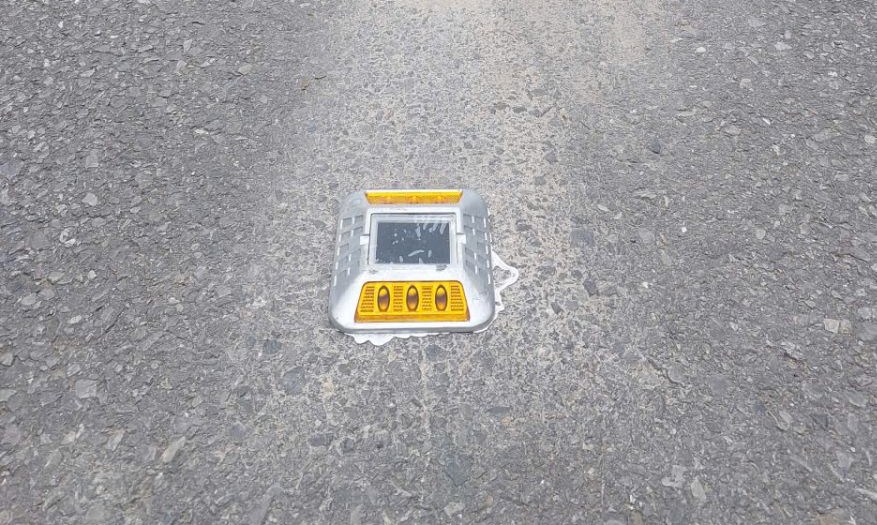
Unlike conventional reflective nails that only reflect light from car lights, the new system operates entirely on solar energy. During the day, the device absorbs and stores energy through the sensor panel; when it is dark or light is weak, the reflective nails will automatically glow in a flash mode, forming a continuous guide strip on the road surface.
Thanks to its proactive lighting capability, the device helps drivers recognize directions from a longer distance, supports determining road edges and dangerous curves, contributing to reducing the risk of traffic accidents on steep mountain passes.
Representatives of Road Management Zone I said that the entire cost of implementing the pilot plan, including the cost of installing and completing the traffic safety system and organizing traffic during construction, is self-guaranteed by Kien Quoc Traffic Works Joint Stock Company.
In the process of implementation, construction must strictly comply with regulations on ensuring traffic safety on the route being operated. Road Management Office I.1 is assigned to preside over and coordinate with relevant units to inspect the scene, organize traffic and supervise the construction process to ensure smooth traffic, without affecting people's travel.
Mr. Dinh Trung Thanh - Director of Road Management Zone I - said that after the pilot period, the unit will coordinate with relevant agencies to comprehensively assess the effectiveness of the system based on criteria such as navigation capability, level of support for traffic participants, equipment durability and operating efficiency in actual conditions.
The evaluation results will be the basis for considering the possibility of replicating the model on routes with similar conditions.
In fact, this is not the first time the DRVN has applied new technology to improve traffic safety on national highways. Previously, the unit had coordinated with 3M Vietnam Co., Ltd. to pilot the installation of the 3MTM StamarkTM Tapes 380 AW reflective strip system on the section Km144+600 - Km145+500 National Highway 6.
The continuous research and testing of new technology solutions shows the direction of modernizing the road sign system of the DRVN, while contributing to improving the efficiency of management, maintenance of traffic infrastructure and reducing the risk of accidents on national highways, especially in mountainous and steep mountainous areas.


