
News being "transformed" on social networks
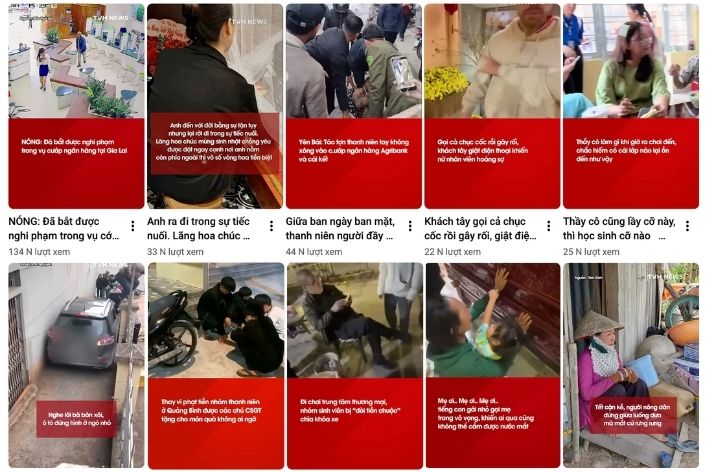
Just surfing social networks for a few minutes, it is not difficult to encounter a series of "hot news", "shocking news" videos cut and edited from official newspaper content.
The general formula of these videos is: no permission, no source, no link to the original article with the ultimate goal of attracting views to earn advertising money.
Recently, the report "The Singaporean Kombo potted rice processing place exposes an unbelievable scene" made by a group of Lao Dong Newspaper reporters, which was just posted, was quickly taken back by many TikTok, Facebook, and YouTube accounts.
Many pages even cut off the logo of press agencies, changed headlines in a sensational direction, and added curious captions to attract views. Some videos after just a few minutes of posting have attracted tens of thousands of views, while the origin of journalistic works is almost "erased".
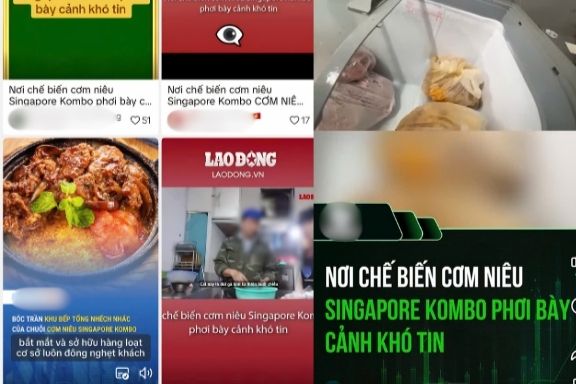
Not only Lao Dong Newspaper, many other official press agencies are also continuously being illegally copied content.
Notably, from a journalistic work that invested effort, time and operating costs, many contents have been cut, added, creating drama to attract interaction and profiteering on social networks.
According to journalist Nguyen Thanh Thang, Journalist and Public Opinion Newspaper, the situation of copyright infringement of journalistic works is increasingly common, especially in the digital environment with the development of social network platforms.
The pressure of viewership competition is pushing a part of content creators into a race regardless, ready to distort information to attract attention.
As a result, false information spreads faster than accurate information, creating a "chaotic vortex", weakening public trust in mainstream journalism.
For press agencies, copyright infringement not only causes economic damage but also directly affects reputation and brand. In addition, violations in the digital environment are often anonymous and cross-border, causing difficulties for handling.
Tighten legal corridors, prevent "vacuity" from existing
Although detecting copyright infringement is not difficult, handling these acts effectively is not simple, requiring solutions to be implemented comprehensively and synchronously.
From a legal perspective, lawyer Do Xuan Thuan (Ho Chi Minh City Bar Association) believes that reusing press content without permission, especially cutting and pasting, distorting content, not only violates copyright but can also infringe on the personal rights of the author. Depending on the nature and severity, the violating entity may be administratively sanctioned, civil compensation or even criminal prosecution.
Although the legal corridor for protecting copyright for journalistic works and sanctions have been defined through the 2015 Civil Code, the 2005 Law on Intellectual Property (amended and supplemented in 2025), the 2016 Press Law (amended and supplemented in 2025), Decree No. 131/2013/ND-CP, Decree No. 22/2018/ND-CP,... but the actual application still has limitations, which is that the level of administrative sanctions for violations of press copyright is still relatively low, so it is not sufficiently deterrent and preventive.
Sanctions also face challenges when it is not easy to identify the violating entity.
Lawyer Do Xuan Thuan said that it is necessary to soon complete the legal corridor, create a close environment between functional agencies, social network platforms and the press agencies themselves to detect, prevent and handle violations.
“Protecting press copyright is not only a story of protecting the economic interests of a editorial office, but also protecting the sanctity of knowledge and the public's right to access authentic information.
In the context of a volatile digital age, the legal corridor needs support from modern scanning technology solutions and a sense of copyright supremacy from users. Only when an ecosystem is established where all creative values are properly valued and strictly protected, will the mainstream press have enough resources to continue to fulfill its mission of serving the community," lawyer Do Xuan Thuan said.
The Prime Minister has just issued Official Dispatch No. 38/CD-TTg dated May 5, 2026, focusing on directing the drastic implementation of solutions to combat, prevent, and handle acts of intellectual property rights infringement.
The Prime Minister requested to drastically direct functional forces to launch campaigns, focus resources, and immediately implement necessary measures to fight, prevent, and handle acts of intellectual property rights infringement nationwide from May 7, 2026 to May 30, 2026, strictly implement legal regulations and strictly handle violations in the spirit of no forbidden zones, no exceptions.


