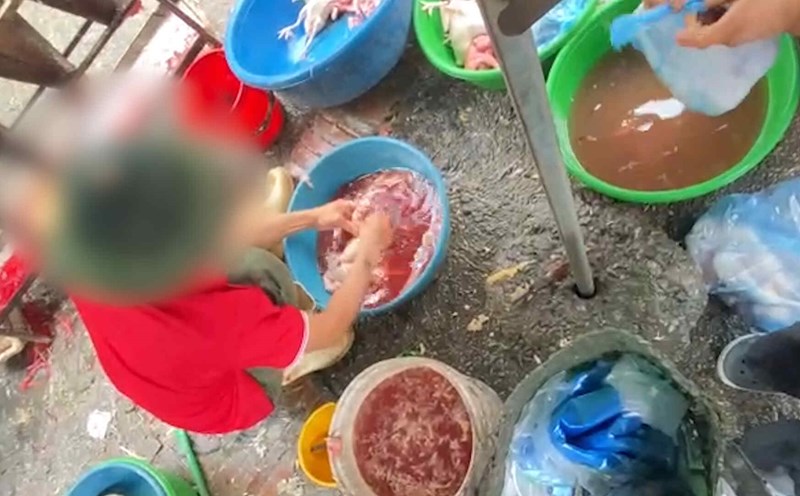
The city currently has 565 small-scale slaughterhouses that do not meet the conditions, are not controlled, pose a risk of epidemics, food insecurity and cause difficulties for management. At many people's markets, poultry slaughtering still takes place on the spot, wastewater and waste are discharged directly into the environment, causing serious pollution and unsanitary conditions. In just 5-7 minutes, poultry slaughtered without quarantine does not ensure safe procedures.
Dr. Nguyen Ngoc Son - Vice Chairman of the Vietnam Livestock Association - said that small-scale slaughter causes pollution, increases the risk of disease spread and makes it difficult to control food safety and detect pathogens.
The reason is small-scale farming, consumption habits of buying wherever is convenient, and violation handling is not thorough; while investing in centralized slaughterhouses is still entangled with land and large costs, so businesses are not interested. Currently, Hanoi has arranged 80 temporary centralized slaughterhouses; some localities such as Phuc Loc commune have stopped small-scale slaughtering, reaching a capacity of 300-350 heads/day.
In Tran Phu commune, the Commune People's Committee has arranged and put into operation 2 temporary centralized slaughterhouses, receiving 39 small-scale slaughtering households. The Commune People's Committee also coordinates with specialized veterinary agencies to guide and complete conditions on facilities and veterinary hygiene to put households into operation.
After nearly half a year of implementing the plans of the Hanoi People's Committee on slaughtering management and food safety assurance, the city has reduced 101 small-scale slaughtering facilities compared to August 2025. Mr. Do Quoc Phan - Deputy Head of the Sub-Department of Livestock, Aquaculture and Veterinary Medicine of Hanoi City - said that Hanoi has directed communes and wards to urgently develop plans to arrange, relocate, and terminate small-scale slaughtering, and bring households to centralized slaughtering facilities.
Many localities have completed the plan, aiming to completely stop facilities that do not meet the conditions before June 30.
According to representatives of the Sub-Department of Livestock, Fisheries and Veterinary Medicine of Hanoi City, in the coming time, the first solution is still to strengthen propaganda and dissemination of laws so that households slaughtering and trading animal products better understand the requirements of veterinary medicine, food safety and environmental protection.
In the coming time, the city will tighten the management of slaughtering, business, and transportation of animals, especially at wholesale markets and people's markets - important transit points of the food market. At the same time, promote the application of information technology in origin tracing, improving transparency and consumer confidence.
Mr. Do Quoc Phan said that attracting investment in industrial slaughter is still difficult due to large capital, long recovery time and land obstacles. Specialized agencies will advise on building specific mechanisms and policies according to the Capital Law to encourage businesses to invest, creating a platform to expand the centralized slaughtering network, replacing small-scale models.