
The introduction of the agricultural origin traceability system into operation from July 1, 2026 (after 6 months of piloting origin traceability for durian fruit), demonstrates the determination of the Ministry of Agriculture and Environment to take data as a foundation to serve quality management, ensure food safety, market development and enhance the reputation and value of Vietnamese agricultural products.
Not only helping people and businesses easily look up and verify product information, the system also forms a shared data platform, ensuring the ability to connect, share and interlink with ministries, branches, localities, businesses and units providing traceability solutions.
Data transparency, chain-wide connection
The agricultural origin traceability system is built with 3 main components, including: Component for people to look up information; management component serving management agencies, businesses and chain participants; application installed on mobile phones, smart devices.
Developed in a modern architecture, service-oriented and with flexible expansion capabilities, the system ensures continuous operation, meeting the requirements of a national common platform in the agricultural sector.
An important new point of the system is the ability to authenticate, be transparent and ensure data integrity through electronic digital signatures, blockchain technology; product identification according to GS1 international standards, QR code according to GS1 Digital Link; data exchange according to unified standards, creating conditions for many solution units to participate, regardless of a single technology provider.
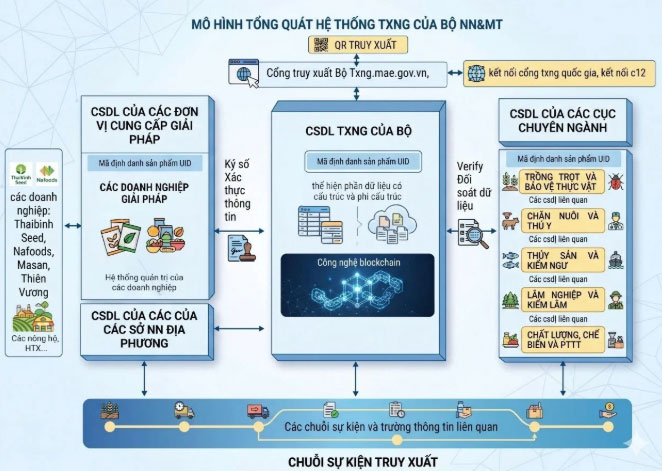
According to test results, the agricultural origin traceability system has the ability to meet about 1,000 scans/second; 30,000 people scanning traceability stamps simultaneously; over 85 million traceability stamp scans/day and about 50 data bulletins with a capacity of 2 MB/second. This is an important technical basis for the system to expand when deployed nationwide in the near future.
In addition, the agricultural origin traceability system has also been and is being connected with units providing origin traceability solutions, enterprises producing, processing, exporting, and importing agricultural products; localities already have origin traceability systems; and at the same time ensure connection and intercommunication requirements with relevant ministries and sectors and the National Data Center under the Ministry of Public Security according to regulations on information security and network security.
Representative of the technology unit building the agricultural origin traceability system shared at the announcement ceremony on the afternoon of June 30, Mr. To Nguyen Thanh, Technology Convergence Corporation (Netacom) emphasized: The system announced today is not the result of a single organization, but is the crystallization of the consistent and close direction of Party and State leaders, and the Ministry of Agriculture and Environment.
Currently, the system has been handed over, installed, assessed for information security and officially transferred intact to the Ministry of Agriculture and Environment for management, ready for official operation from July 1, 2026.
These are completely data, assets of the State, of the Ministry of Agriculture and Environment. The origin tracing system launched today is also a strong affirmation of the spirit of innovation, national digital transformation and raising the level of Vietnamese agricultural products in the international market," Mr. Thanh emphasized.
Digital platform for agricultural products to reach further
According to the Ministry of Agriculture and Environment, traceability is an inevitable requirement in the context that domestic and international markets increasingly value quality, transparency, supply chain responsibility and food safety.
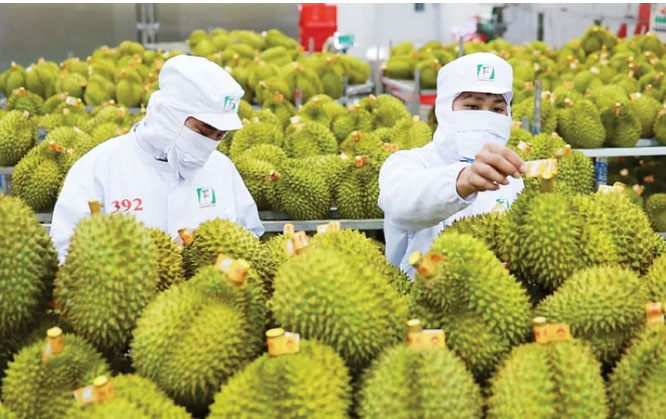
Therefore, officially putting the agricultural origin traceability system into operation will contribute to protecting consumer rights, supporting businesses and producers to standardize data, improve product value; and at the same time strengthening state management capacity in monitoring, warning, tracing and handling when quality and food safety issues arise.
Along with that, the agricultural origin traceability system also creates an important foundation for localities, businesses, cooperatives, production households and entities in the agricultural product value chain to gradually standardize, update, and share data on growing areas, production facilities, packaging facilities, processing, distribution, export and consumption of products. Through this, the system is expected to contribute to forming a unified and synchronous agricultural data ecosystem, serving digital transformation of the agricultural sector and development of the agricultural digital economy.
Therefore, officially putting the agricultural origin traceability system into operation will contribute to protecting consumer rights, supporting businesses and producers to standardize data, improve product value; and at the same time strengthening state management capacity in monitoring, warning, tracing and handling when quality and food safety issues arise.
Reality shows that the strong development of science, technology, innovation along with new cooperation mechanisms will open up opportunities to access financial and technological resources to serve green transformation, in accordance with the spirit of Resolution No. 57-NQ/TW dated December 22, 2024 of the Politburo on breakthroughs in science, technology, innovation and national digital transformation.
In the coming time, the Ministry of Agriculture and Environment will continue to coordinate with ministries, branches, localities, industry associations, businesses and technology units to expand the scope of system implementation; prioritizing key agricultural, forestry and fishery product groups, export products, products with high requirements for quality, food safety and transparency of origin.
At the same time, state management agencies in the field of agriculture and environment will also strengthen guidance and support for localities, businesses, cooperatives and people to participate in updating, exploiting, and using the system effectively, contributing to building a modern, transparent, sustainable and highly competitive agriculture in the international market.
To date, the system has integrated information and traceability data of over 18,500 products, belonging to 181 product groups of 170 businesses in 24/34 provinces and cities.
For durian export products, 16 enterprises have participated in the pilot program; initially, 6 containers of enterprises successfully exported to the Chinese market through the application of electronic traceability on the Ministry's system.


