
After two long-term investigative series: "Bringing sand pirates on the Gianh River to light" and "Gold pirates cutting hills, operating rampantly in the border area of Hue City", functional agencies of Quang Tri province and Hue City simultaneously intervened to handle them drastically. These positive movements have initially revived rivers and streams, returning the inherent peaceful life to the people.
Eating on the bank, sleeping in the dust, ambushing sand pirates
At the end of December 2025, Lao Dong Newspaper received feedback from people about the rampant illegal sand mining on the Gianh River, passing through Tuyen Hoa and Tan Gianh communes, Quang Tri province. At that time, when many families were busy preparing to welcome the 2026 Lunar New Year, the group of reporters decided to stick to the area for many days. After many surveys, at times being exposed, causing the subjects to temporarily stop operating, we still persistently stuck and returned to the scene.
On the night of January 16, early morning of January 17, 2026, the group of reporters divided into many reconnaissance teams. One ambushed at the riverbank section passing through Xuan Son village, Tuyen Hoa commune; one stayed in Truong Long village, Tan Gianh commune; one tried to infiltrate sand gathering yards to record the pumping process. Around midnight, "ghost" boats began to appear, approach the shore and then simultaneously operate large-capacity pumps. The roar of engines, the sound of sand and gravel crashing into the boat's hold echoed in the sleeping residential area. To avoid being detected, reporters had to repeatedly jump into thorns or lie close to the deep mud pit. At times, sand dredgers were only less than 5 meters away from the reporter's filming location.
Meanwhile, at the Son Ha gathering yard, Tan Thi village, Tan Gianh commune, reporters' lenses recorded a series of ships carrying full of sand continuously docking, pumping directly to the yard. This is the most dangerous location when this area is equipped with dense security cameras, there are fierce dogs and there are often patrols to protect. Once, hearing dogs barking continuously, the protection group held flashlights to scan everywhere, causing reporters to soak in the cold water, hiding behind the sand pumping pipe. In Truong Long village, Tan Gianh commune and Tung Cat gathering yard, Xuan Ha village, Tuyen Hoa commune, illegal sand mining activities also took place rampantly from night to morning.
By early February 2026, a group of Lao Dong Newspaper reporters had coordinated and shared the collected information with the Economic Police Department of Quang Tri Provincial Police. From there, this unit developed a plan to encircle and arrest them. On the night of February 4 and early morning of February 5, 2026, the police force secretly deployed forces around the wharf area. In Xuan Son village, a strange fishing boat continuously used spotlights to shine at the shore, carefully probing before letting the train line up to put up sand suction pipes. At the same time, at the river section through Truong Long village, functional forces promptly approached and caught two boats and many subjects illegally mining sand. The subjects recklessly fled, forcing the police to fire warning shots to suppress and control at the scene.
After a series of investigations and raids by functional forces, sand mining activities on the Gianh River were basically stopped.
Up to now, functional agencies have prosecuted the case, prosecuted the defendants against two subjects and administratively fined three subjects. At the same time, local authorities and commune police have simultaneously intervened to prevent illegal sand mining, thereby significantly reducing riverside landslides.
Facing "gold pirates" at the border
In April 2026, when the story of sand pirates on the Gianh River temporarily subsided, the group of reporters continued to receive the task of investigating the situation of illegal gold mining in the mountainous forest area bordering Hue City and Quang Tri province. Initial information originated from an unusual phenomenon of the Dakrong River, Quang Tri province. The river water suddenly turned cloudy red, dense alluvium lasted for many days, causing people to suspect large-scale mineral mining activities upstream.
To find the answer, the group of reporters organized to wade through forests and streams, trying to approach remote areas in A Luoi 1 commune. The deeper we went, the more dangerous the terrain became, and the phone signal was completely lost. The next day, in the role of people collecting acacia, we approached local people and identified the road leading to the "major construction site" for illegal gold mining. The road through the forest is full of ramparts, steep slopes, and there are people guarding strictly along the trails.
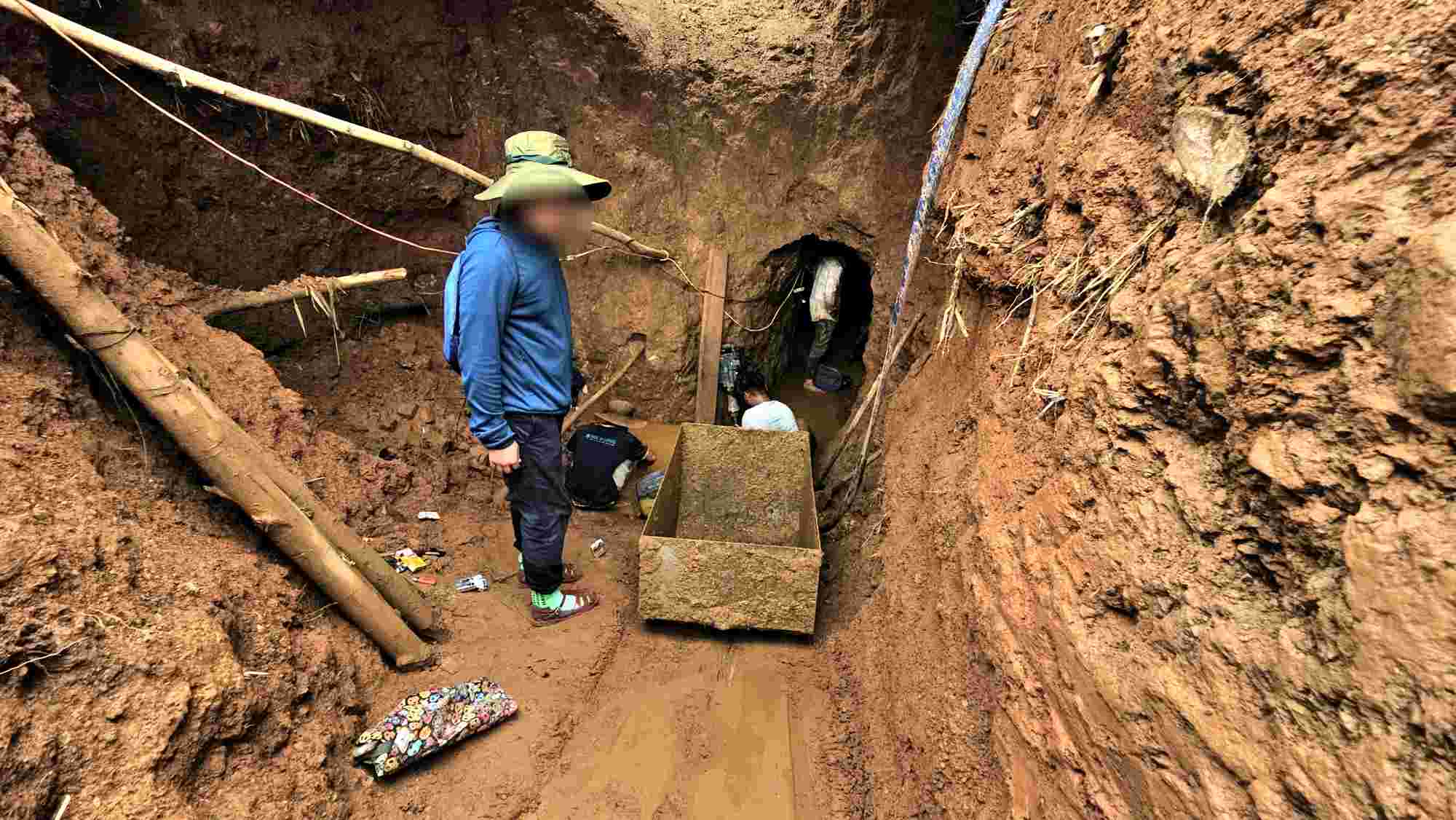
Overcoming the layers of warning, reporters approached Ru Rau stream and Bun stream, also known as Bung stream. Here, the hills were shattered and jagged. The subjects used high-powered generators, spraying high-pressure water on the mountainside to dig up soil to dig gold, and discharge mud directly into the stream. Along the streams, many solid camps appeared, machinery and a system of pipes were intertwined. After collecting enough documents, the group of reporters decided to face directly with some subjects, clearly exploit the identity, hometown and sophisticated organizational methods of the "gold digger" gang before safely withdrawing from the scene.
As soon as the series of investigative articles was published in Lao Dong Newspaper, Hue City People's Committee and Hue City Police issued urgent directives. Inter-sectoral forces including police, border guards, forest rangers, militia and A Luoi 1 commune authorities immediately launched a general sweep operation. When functional forces crossed the forest to approach the hideout, the "gold digger" group panicked and fled into the deep forest.
At the scene, the inter-sectoral force controlled the entire area, leveled and burned down the camp system, confiscated and destroyed many large-capacity generators, water pumps and hundreds of meters of water pipelines. Currently, functional agencies have established fixed checkpoints at forest entrances and exits. Thanks to that, the water of Ly Leng stream and Dakrong river has become clear again.
After the series of articles "Sand pirates drain the Gianh River", Quang Tri Police prosecute the case and prosecute the defendant
After a series of investigation articles by Lao Dong Newspaper reflecting the situation of illegal sand mining on the Gianh River, functional agencies have initiated a case, prosecuted defendants and proceeded to sanction related subjects.
On June 9, the Economic Police Department, Quang Tri Provincial Police said that they had initiated a criminal case and prosecuted Hoang Van Quan (born 1996, residing in Tan Gianh commune) and Nguyen Xuan Quynh (born 1977, residing in Tuyen Hoa commune) for the act of violating regulations on resource exploitation.
In addition to criminal handling, the Economic Police Department has issued decisions to sanction administrative violations against many other subjects.
Lieutenant Colonel Truong Quoc Vuong - Head of Riverine Police Team No. 2, Traffic Police Department of Quang Tri Provincial Police said that immediately after Lao Dong Newspaper reflected the situation of illegal sand mining on the Gianh River, the unit coordinated with the police of riverside localities to promote inspection, propaganda and prevention of violations.
Functional forces have organized dissemination of laws on waterway traffic and mineral exploitation to nearly 100 households and businesses operating in the field of sand and gravel. At the same time, 9 businesses and wharf owners have signed commitments to comply with legal regulations.


