
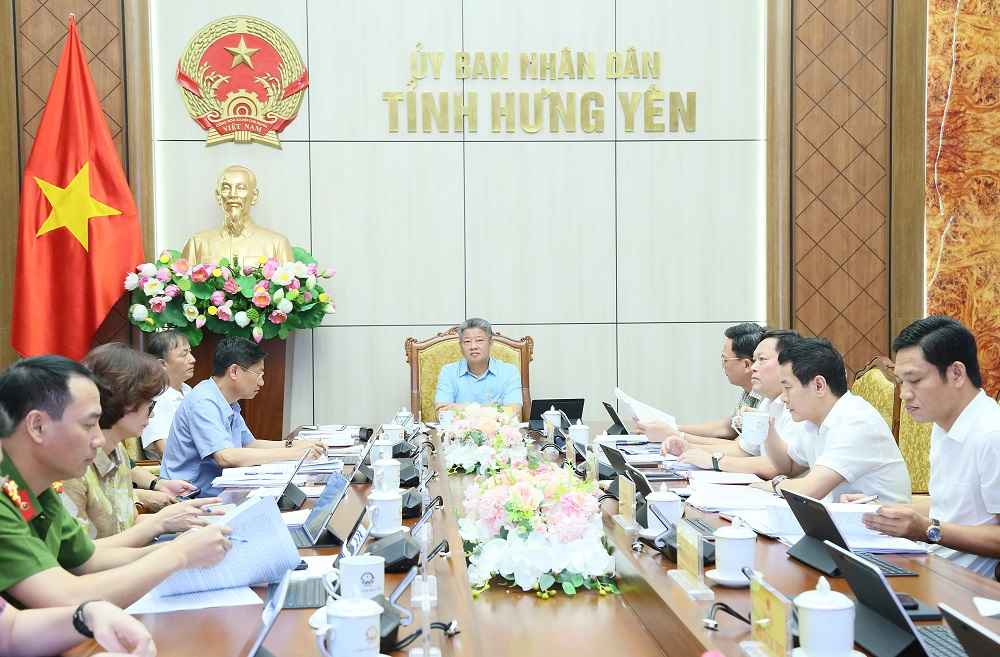
On May 27, Chairman of the Provincial People's Committee Nguyen Manh Quyen chaired a meeting to listen to the Hung Yen Provincial Department of Agriculture and Environment report on the sustainable poverty reduction plan for 2026; list of centralized clean water supply projects and plans for planning and investing in waste treatment projects in the province.
According to the report, by the end of 2025, the whole province has 10,335 poor households, accounting for 0.99%; of which 7,725 poor households are unable to work. The draft plan for 2026 sets a target of no longer having poor households according to multidimensional poverty standards, while ensuring the full implementation of support policies, improving the quality of life and access to basic social services for people.
For the clean water sector, the whole province currently has 121 projects and water supply networks according to the plan, including 46 projects in the old Hung Yen area and 75 projects in the old Thai Binh area, managed by 69 units.
The connection rate for using clean water reached about 70%, equivalent to more than 826,000 households; the coverage rate of pipelines reached about 96%. Many water supply projects continue to be invested and expanded to meet the needs of urban development, population and industrial parks.
Regarding domestic waste treatment, the amount of waste generated in the province is about 1,977 tons/day, the collection rate reaches about 98%. Based on forecasts to the periods 2030, 2035 and 2050, the Department of Agriculture and Environment proposes planning 3 centralized waste treatment areas, and at the same time zoning collection, transportation and treatment to reduce operating costs and meet long-term environmental protection requirements.
Concluding the meeting, Chairman of the Provincial People's Committee Nguyen Manh Quyen emphasized that tasks on poverty reduction, clean water supply and waste treatment must be implemented with long-term development thinking, synchronously with the orientation of building the province into a centrally-run city.
Regarding poverty reduction, the Chairman of the Provincial People's Committee requested to review and accurately unify poor household data; put households that are no longer able to work into the social protection category, and at the same time support loans, vocational training, job creation and diversification of livelihoods for the remaining households. Relevant agencies are also assigned to review plans for building new houses and repairing houses for poor households and handling land problems.
In the field of clean water, the province will build a roadmap to narrow down small-scale water supply points, develop large-scale centralized water supply areas; terminate operations for 27 groundwater exploitation works before 2030 and strengthen clean water quality control.
Regarding waste treatment, the province agreed on the principle of dividing into 3 treatment zones; continue to review planning, arrange reasonable transportation distances, and at the same time study the conversion of small and inappropriate projects and build a synchronous waste collection and transshipment system throughout the province.


