
Severe shortage of domestic water
In Ca Mau, although there is an irrigation canal system storing about 275 million cubic meters and Khanh An lake nearly 3.85 million cubic meters, domestic water supply is still difficult because the system is not synchronized, and many works are degraded after a long period of use.
Currently, Ca Mau has 364 centralized water supply projects, but only about 42.86% are operating well, nearly 25% have stopped operating. About 50% of rural people use water from centralized systems, 48% use household wells, and the rest depends on rainwater. The total number of drilled wells being exploited is more than 285,000, with a total flow of about 590,506m3/day.
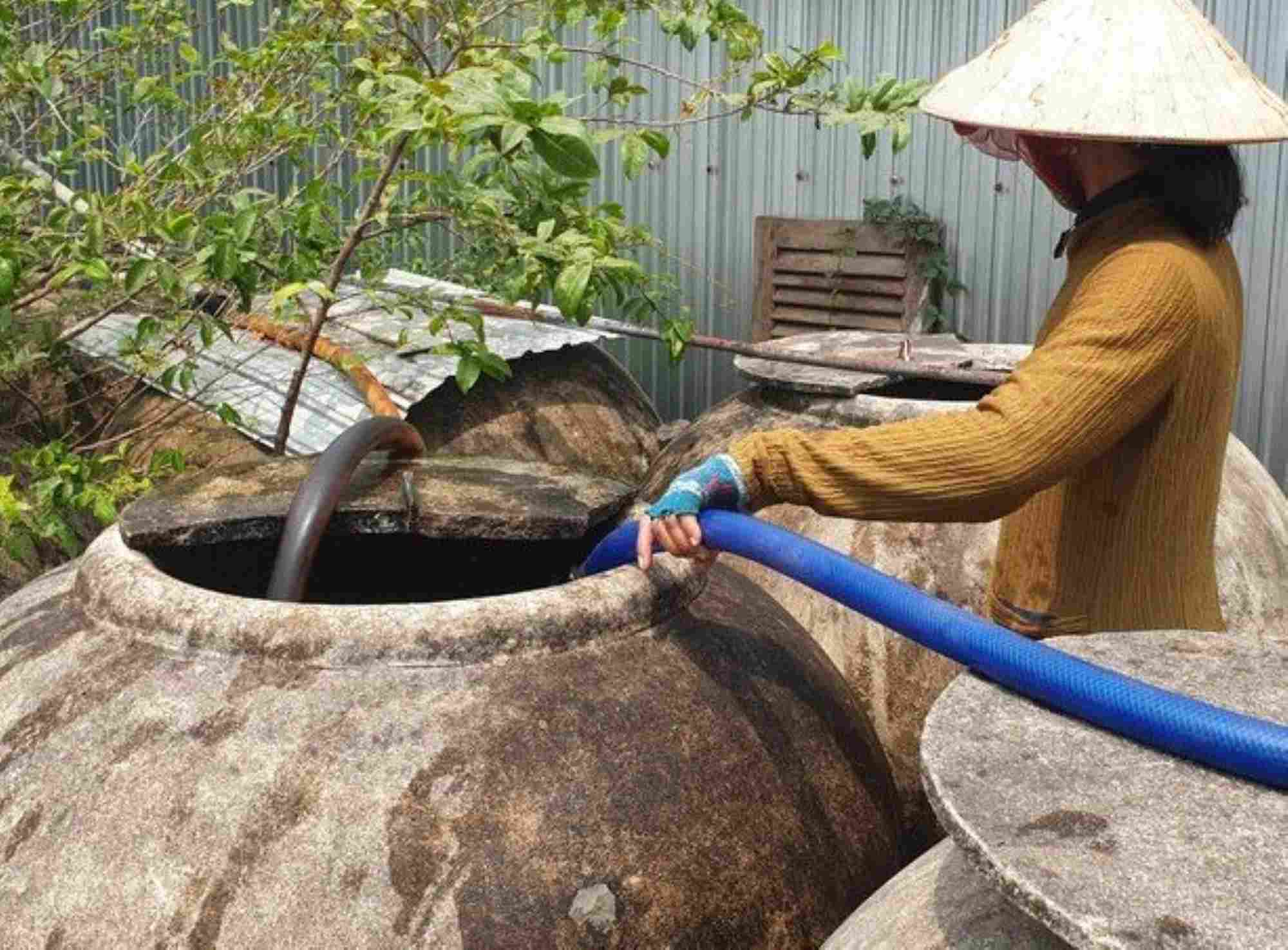
In many rural areas, people still have to find ways to ensure domestic water. In U Minh and Nguyen Phich communes, where there are no fresh groundwater sources and surface water is contaminated with alum, people mainly depend on stored rainwater.
Ms. Nguyen Thi Phung (Ong Bich hamlet, Khanh Binh commune) shared that her family still has enough water to use, but if the sun lasts, she is very worried about water shortage.
Can Tho city is also strongly affected by climate change. In Khanh Hoa ward, groundwater is increasingly contaminated with alum and salt, so many households have to store rainwater. Ms. Danh Thi Sen (No Tom hamlet) said that previously, her family lacked water for a long time throughout the dry season, now her family has to proactively build freshwater tanks.
Mr. Nguyen Hoang Anh - Deputy Director of the Department of Agriculture and Rural Development of Can Tho city assessed that flooding, drought, and saltwater intrusion are becoming increasingly common. The demand for water exploitation is increasing, while climate change is putting greater pressure on the entire region.
Water shortage for production
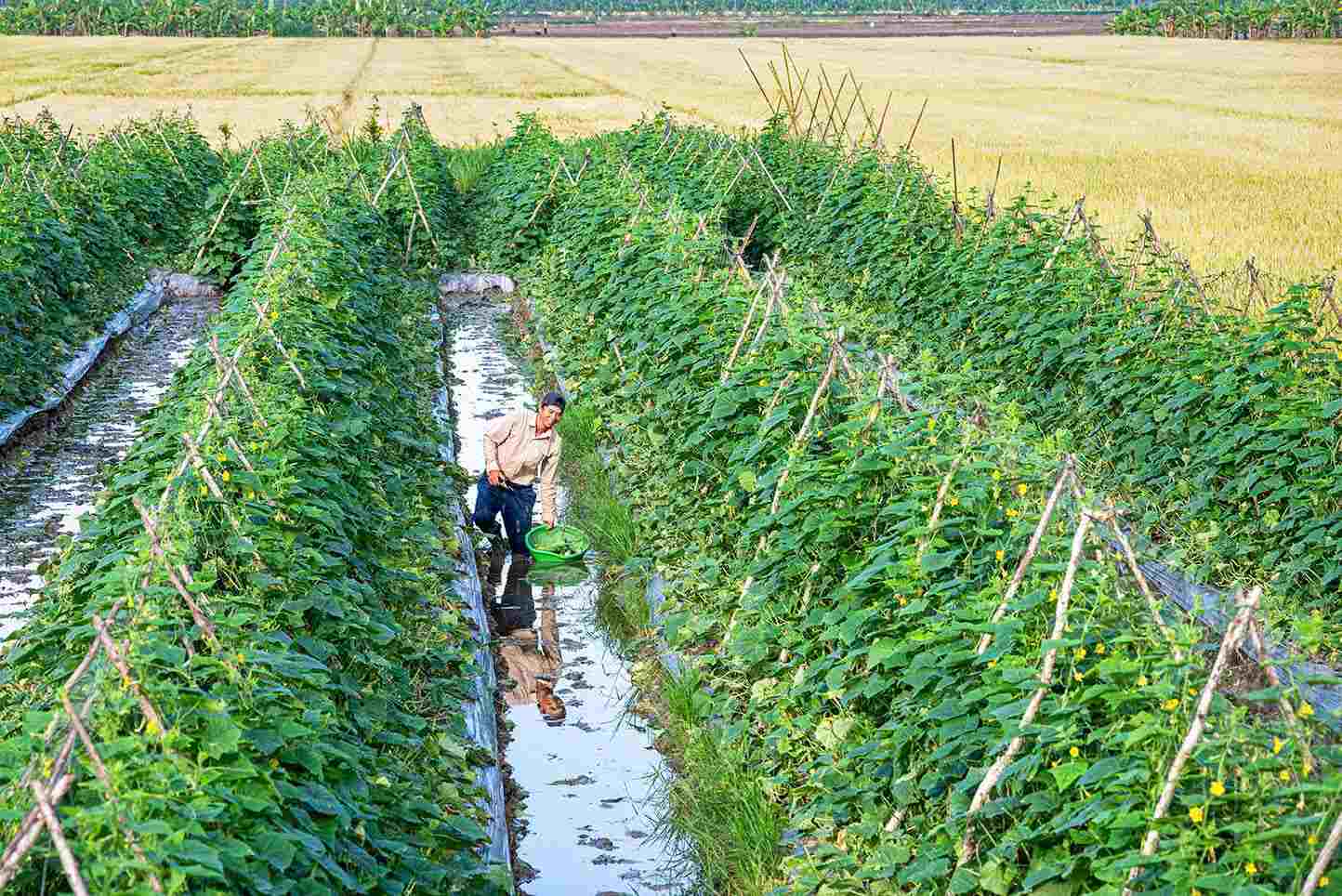
The Mekong Delta is not only lacking domestic water but also stressed with water sources for production. In Mo O hamlet, Tran De commune, Ms. Nguyen Thi Hieu, a watermelon farmer, dug a small pond about 20-25m2 wide, lined with tarpaulin to store rainwater or pumped from canals. The pond is used gradually for the entire crop season. The drip irrigation system helps save every drop of water.
In Vinh Chau, purple onion fields also have a water storage pond of 15 - 30m2 wide and about 2m deep. The pond both stores rainwater and water pumped from drilled wells in the dry season.
Irrigation culverts such as Cai Oanh (Tan Thanh commune) operate "timekeeping" to get fresh water, opening and closing flexibly according to salinity. 24/24 duty force in the dry season, both regulating water and ensuring waterway traffic.
According to the Can Tho Department of Agriculture and Environment, after the merger, the city's irrigation system has 12,800km of canals, 72km of coastline, nearly 668km of dykes, 889 culverts and 292 electric pumping stations. This network not only serves agricultural production but also contributes to controlling flooding, drought, salinity and supporting waterway traffic.
Assoc. Prof. Dr. Nguyen Phu Quynh - Deputy Director of the Southern Institute of Irrigation Science - said that the storage capacity of the Mekong Delta increased from 15 billion cubic meters to 65 - 73 billion cubic meters in the period 2001 - 2025. However, agricultural production area is forecast to increase by 16% by 2040, creating great pressure on water sources.
Mr. Nguyen Minh Khuyen - Deputy Director of the Department of Water Resources Management, Ministry of Agriculture and Environment - informed that the flow from upstream to the Mekong Delta has decreased significantly. The dry season of 2015-2016 decreased by 36%, 2019-2020 decreased by 28%. Increased tides and high tides are 20 - 25cm higher, causing saltwater intrusion to come earlier and stronger. Livelihoods and agricultural production are directly affected.
Despite dense rivers and canals, the Mekong Delta still faces increased water pressure, land subsidence, and prolonged drought. Water from the Mekong River accounts for 95% of the total water volume, but declining flow makes people's lives increasingly difficult.
Synchronous engineering solutions, proactive water source
Faced with drought and increased saltwater intrusion, the Mekong Delta simultaneously implemented solutions to store water, control salinity and change production to adapt.
In Ca Mau, the Provincial People's Committee has approved the Emergency Rural Water Supply Project for the period 2026 - 2030. Accordingly, the province will build 5 new projects and upgrade and expand 1 water supply project, with a total capacity of about 11,200m3/day and night, serving about 6,000 households in the communes: Bien Bach, Dat Moi, Dat Mui, Da Bac, Tran Van Thoi and Khanh An.
At the same time, the province is also studying a large-scale water supply plan from the upper reaches of the Hau River to ensure a long-term stable water source.
In Can Tho, Mr. Nguyen Hoang Anh - Deputy Director of the Department of Agriculture and Environment - said that the city focuses on developing freshwater storage facilities, prioritizing the use of surface water, reducing groundwater exploitation, and at the same time protecting and restoring degraded and polluted water sources.
According to Mr. Nguyen Hoang Anh, in the plan to 2030, vision to 2050, the management, exploitation and effective use of water resources is a key task.
In Vinh Long, Mr. Van Huu Hue - Deputy Director of the Provincial Department of Agriculture and Environment - said that the locality is effectively operating irrigation works to proactively store fresh water; strengthen dredging and upgrading the canal system; promote monitoring and forecasting salinity to promptly advise people.
The locality encourages people to store water on the spot, convert crop structures and crop seasons to suit water source conditions," Mr. Van Huu Hue shared.
In particular, people in the region are also gradually changing production methods to adapt to increasingly volatile water source conditions.
In Con Son (Can Tho), Mr. Ly Van Bon - Deputy Director of the Agricultural Tourism Cooperative - said that the change in water sources has directly impacted the traditional production model.
Previously, fish were mainly raised thanks to natural organisms from alluvium, but now it is almost gone. Farming costs increased from 40,000 VND/kg to 60,000 - 70,000 VND/kg due to the use of industrial feed," Mr. Ly Van Bon shared.
According to him, saltwater intrusion not only increases costs but also damages farming rafts and affects fruit tree land. Faced with that reality, people are forced to switch to raising fish species that are salt-tolerant and brackish-tolerant, and at the same time adjust production models.
Assoc. Prof. Dr. Nguyen Phu Quynh - Deputy Director of the Southern Institute of Water Resources Research informed that the water source trend in the Mekong Delta is changing clearly. Floods on the Mekong River are decreasing sharply, while saltwater intrusion and saltwater peak are coming earlier and deeper. Meanwhile, the possibility of large floods appearing in the future is very low, making the source of fresh water supply increasingly limited.
According to forecast scenarios, salinity will continue to penetrate deep into the fields in the coming years, posing a requirement to change thinking in water resource management and use.
Assoc. Prof. Dr. Le Anh Tuan - Scientific Advisor of the Mekong Institute - said that it is necessary to shift from agricultural production thinking to agricultural economy, in which saltwater, brackish water and fresh water are all considered resources. Solutions need to aim at integrated inter-regional management, application of digital technology, building water storage systems, salinity control and connecting water resources between regions.
In addition, flexible production organization according to water source conditions and seasonal response scenarios will also help minimize risks. In the context that the Mekong Delta continues to be heavily affected by climate change and upstream development activities, the combination of engineering solutions and people's proactive adaptation will be key to ensuring water security and sustainable development for the entire region.
According to forecasts from the National Center for Hydro-Meteorological Forecasting, in the dry season of 2025 - 2026, increased saltwater intrusion in the Mekong Delta estuary is likely to concentrate in March and April.
Mr. Nguyen Hong Khanh - Deputy Director of the Department of Management and Construction of Irrigation Works (Ministry of Agriculture and Environment) said that the forecast for rainfall and river and stream flow in the southern areas (South Central Coast, Southeast Coast and Mekong Delta) is at a level equivalent to the multi-year average but at a low level due to entering the peak of the dry season.
The Department of Management and Construction of Irrigation Works assessed that from now until May 2026, the flow on the Mekong River to the Mekong Delta will continue to gradually decrease. Although many irrigation works have been invested, the water source to the Mekong Delta in the dry season depends greatly on the flow from the upper Mekong River. Therefore, it is necessary to prevent abnormal fluctuations, the risk of localized water shortages may occur in some downstream areas of provinces such as: Tay Ninh, Dong Thap, Vinh Long, Ca Mau.
An An


