
I, a reporter sticking to the area assigned by the Editorial Office to O2 village, recorded the election work of 131 voters in the village, representing 57 households with more than 200 Ba Na people.
O2 is located precariously on the top of Kong Along, nearly 800m high, "locked" by a unique road. I heard a lot about O2, but only when I set foot there did I fully understand the two words "obstruction".
Life hanging in the clouds
From the center of Quy Nhon to village O2 is more than 120km long. The roads are strange and dangerous, forcing me to set off 1 day earlier, with a backpack, machinery, just enough to carry up the mountain. After nearly 100km of road, I had to overcome more than ten kilometers of dirt roads, mountain passes, and mud to reach the bridge of village O2 - where I had to leave my motorbike behind, starting the arduous journey through forests and slopes.
From here to the village is only about 6km, but it is enough to explain why people's lives here are still lacking in many ways. The only road leading to the village is a series of steep slopes connecting each other, with an inclination of 30-40 degrees. The entire route has only been paved with concrete for about half, and the rest is still muddy dirt road.
Climbing more than 1km at the beginning, I started to feel tired. In the middle of the mountain, there was almost no way to turn around. Going down was more dangerous than going up. Just one step short and you could slip into a deep abyss. narrow bends have few resting places. Sitting for a long time, my limbs became even more exhausted. Standing up, dizziness and nausea rushed in.
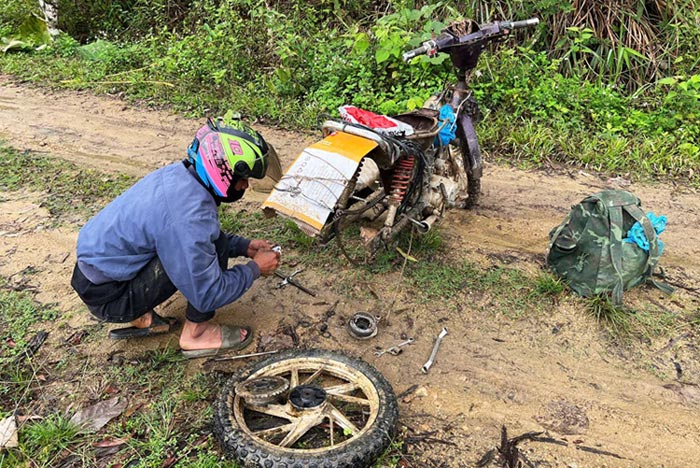
After trying halfway, my strength was almost exhausted. My legs were heavy, even one step was too much. The remaining slope had to be "modified" by motorbikes, leaving only an iron frame.
But sitting behind the "iron horse" is not pleasant either. The car presses the gas, I in the back struggle with each gust, precarious between the mountain cliff and the deep abyss. Drizzle and cold wind cover the mountainside, soaking into my skin, my legs numb, sometimes I just want to stop.
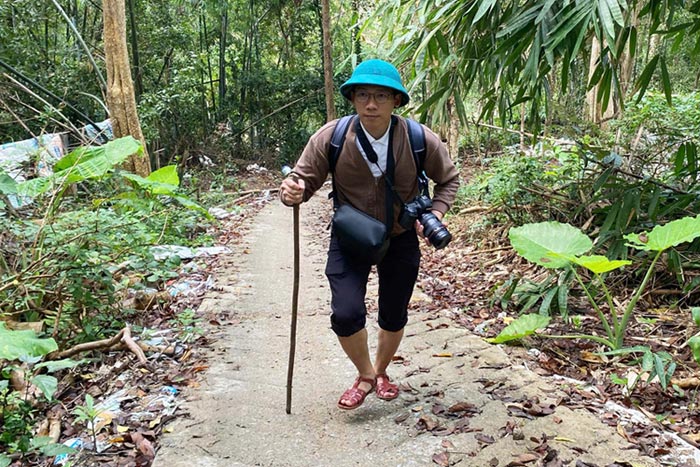
Throughout the journey, I was told by a special "guide" - Secretary of the Party Committee, Chairman of the People's Council of Vinh Son commune Dinh Hoai Duc - about the life, hardships and solidarity of the villagers, making the whole journey like a "role-playing", living with the villagers.
Nearly half a day of climbing slopes, wading through mud under the cold rain, I also reached O2. After the dirt road covered with weeds, the first few houses were revealed. Going deeper, wooden stilt houses, corrugated iron roofs gathered in clusters on a gentle land, connected by a small trail.
Arriving there, it was past noon. The village was deserted, many doors were tightly closed but could not hide the destitution of the place surrounded by mountains and forests.
Electricity is intermittent, water is precarious, phone signal is almost non-existent; the only road is still steep and muddy... The villagers' lives are mainly self-sufficient, relying on the swiddens and small fields of each family.
Going around the village, you see that many deprivations in O2 all start from the road to the village.
Roads are dangerous, every trip in and out of the village is strenuous. Food oil, medicine or familiar necessities in the lowlands all increase in price because of the labor of carrying and carrying. Agricultural products are difficult to bring down the mountain, hired labor is scarce, so life just revolves around the fields, in frugal meals and the cycle of self-sufficiency, not knowing when it will end.
The last few kilometers, but enough to make more than 200 people in the small village revolve around in a state of shortage for many generations.
Where "forests remain, villages remain
Only 1 day of eating and staying with the villagers, but I clearly understand the hardship here. The seemingly normal activities became difficult.
Despite the deprivation, the people of O2 village are still united and attached through many generations.
Afternoon in O2 falls very quickly. The sun has just set, cold mist has spread over the stilt house roof. Next to the red-hot kitchen, villagers sit around, mentioning old lifestyles and customs, stories of strangers who have set foot in the village... in a very ordinary way.
I was able to live as a villager for the first time.
Picking up more dry firewood branches to put on the stove, Mr. Dinh Khich - Head of Village O2 - slowly recounted that in mid-2015, when O2 was still in Vinh Kim commune (Vinh Thanh district, former Binh Dinh), people discovered a strange man wandering in a livestock breeding area, kilometers away from the village.
This person was wearing a thin t-shirt, shorts, with a tattoo, his body trembling, starving. Seeing this, the villagers took him back to the village, fed him, dressed him, and arranged accommodation for overnight. While some people were worried about food and accommodation, a few others quietly ran to report the news to the village chief.
At that time, the means of communication at O2 were extremely limited. The whole village only had a few "brick" phones in black and white. To report the news to the government or the commune police, people had to run around the village, finding the right place with signal to make a call.
From the descriptions of the people, the police determined that the strange man coincided with the suspect in the murder case that occurred a few days ago, in the forest along the Kon River. Villagers immediately mobilized youth and village troops to guard, and took this person down the mountain to hand over to the police.
At O2, when encountering strangers or lost people, villagers are willing to help but everyone is cautious.
Village O2 was officially established in 1961, but from decades ago, this land has been the residence of many Ba Na ethnic households.
During the years of resistance, O2 was a place to hide cadres and serve the revolution. To keep it secret, the Vinh Thanh district government at that time used Arabic letters and numbers to name the villages. The name O2 was born from then on.
After the war, the people of O2 village still maintained their old lifestyle. Lack of food followed them through many generations. As life in the lowlands gradually changed, the local government once proposed to allocate land and mobilize people to relocate to reduce difficulties in life.
But for the villagers, there is a nearly unchanged principle: "As long as the forest exists, the village exists". A land associated with the sacred soul of ancestors, where people have fields and cultivated land. Lack of electricity, water, and all kinds of things, but not to the point of food shortage.
Leaving O2, I turned back to look at the steep slopes. That only road is still quietly lying there, like an invisible boundary separating the small village from the rhythm of life outside.
Amidst mountains and forests and deprivation, the people of O2 village still live with affection, solidarity, maintain village customs and stick to the land. And above all, they still yearn for a day to be closer to life in the lowlands.


