
According to the Quang Ngai Provincial Military Command, as of September 1, survey and verification work has been deployed in 15 localities; 21 sets of martyrs' remains have been collected. Biological samples have been taken at 88/113 cemeteries, excavated 10,978 graves, of which 7,382 graves are eligible for sample collection; 3,348 samples have been handed over for DNA testing and identifying martyrs.
The province aims to complete 100% of the sampling target at 113 martyrs' cemeteries in September 2026, and at the same time link sampling with data digitization, creating a basis for identifying martyrs' remains.
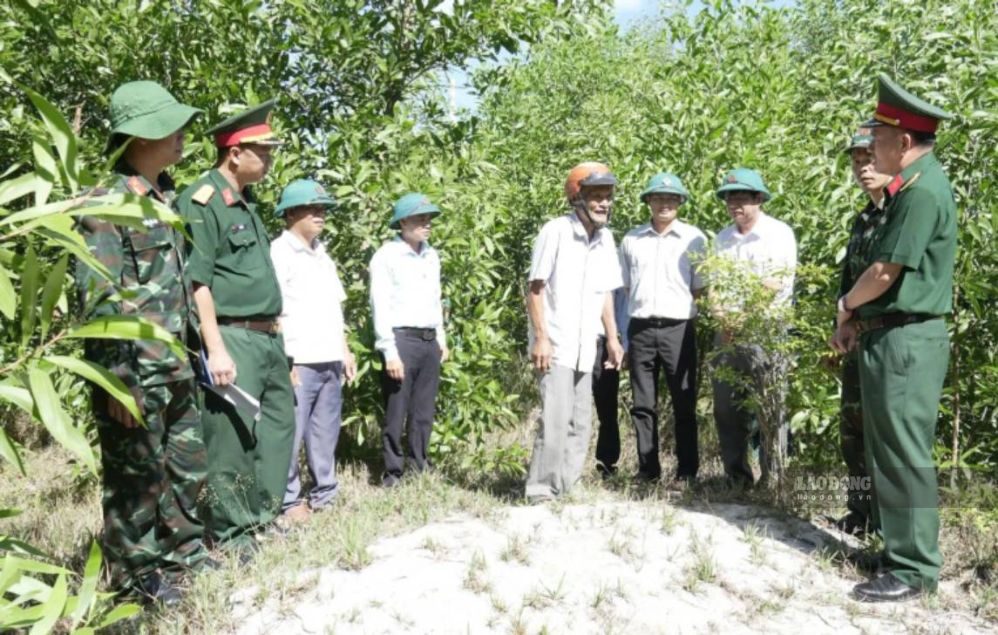
Functional forces are taking advantage of every day, following each trace to search for and repatriate more martyrs' remains, contributing to bringing those who sacrificed to their comrades, families and homeland.
In An Thach residential group, Tra Cau ward, from sources of witnesses, functional forces surveyed and excavated the melaleuca garden area next to Pho An Secondary School and discovered a set of remains and many artifacts such as buttons, clogs, and bone samples.
These traces are believed to be related to information about martyr Nguyen Dinh Nu, who sacrificed himself in the anti-American resistance war in 1966.
According to Mr. Nguyen Dinh Nhe, in An Thach residential group, when he was young, his father pointed out the burial location of a martyr, next to the school. Over the years, the terrain has changed, and the traces of the grave are no longer clear.
From Mr. Nhe's account, functional forces surveyed, compared information and organized a search. The newly discovered set of remains has not been identified, but the location and artifacts collected are the basis for functional forces to continue verifying.
In Nghia Giang commune, Ms. Le Thi Xuan Duoc (74 years old), a former guerrilla in An Son village, recalled the fierce battles that occurred in the Go Tram area in 1969. At that time, many soldiers sacrificed and were injured. People took wounded soldiers to the health station for treatment. The sacrificed were buried at the scene of the battle, including cases where they had to be buried right in the basement because they could not be taken out.
Lieutenant Colonel Ngo Nhu Vu - Deputy Political Commissar of the Military Command of Nghia Giang commune said that after receiving information, functional forces met with people who had directly fought, transported wounded soldiers, rescued wounded soldiers and people living in the area for many years to verify. From there, excavation and repatriation of a martyr's remains and many artifacts such as buttons, pens, spoons and rubber sandals were organized.
Colonel Trinh Cong Son - Deputy Political Commissar of the Provincial Military Command said that from sources of witness information provided, the Steering Committee for searching, repatriating and identifying martyrs' remains of the province compared with field maps and war history documents to identify areas with survey and search facilities.
Reality shows that many sources of information have helped functional forces identify areas, organize searches and repatriate martyrs' remains. Therefore, functional forces are taking advantage of each source of information, each trace to expand searches.


