
Hanoi City People's Committee is conducting opinions on the draft resolution of the City People's Council with content regulating a number of measures to limit the use of road vehicles that emit emissions causing environmental pollution in the city.
According to the draft, from January 1, 2035, the City People's Committee will decide the roadmap, scope of traffic restrictions on some roads, lanes, directions and time frames suitable to actual conditions.
Explaining the proposal to restrict the circulation of private cars, the drafting agency said that according to the overall project for urban railway construction investment, by 2030, Hanoi is expected to complete the construction of 96.8 km of metro lines No. 2, 3 and 5, and at the same time deploy investment preparation for 301 km of the remaining lines, including lines No. 1, 2A (extended to Xuan Mai), No. 4, 6, 7, 8 and satellite lines Son Tay - Hoa Lac - Xuan Mai.
The entire system is expected to be completed by 2035, and thus will meet the increasing demand for passenger transport. When combined with the existing bus network and public bicycle and motorbike services connecting major routes, the city will own a modern, synchronous and convenient public transport system.
According to the drafting agency, the determination of the scope of restrictions on the circulation of personal vehicles will be based on the ability to provide public passenger transport services (including: urban railways, buses, public bicycles...) in the region when it has met the travel needs of people...
Limited areas are also identified to ensure conditions on traffic infrastructure, organization, traffic diversion and monitoring systems.
According to the draft, no later than 12 months before each period of restriction application, the Hanoi City People's Committee will publicly announce the map of the restricted area, implementation roadmap, vehicle conversion support package and alternative travel options for people.
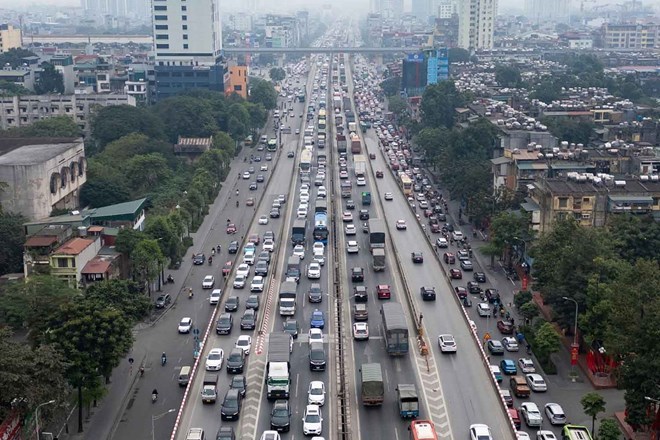
The draft also sets out a roadmap to restrict road vehicles using fossil fuels in transport business activities.
For transport business motorbikes, including vehicles using transport connection applications, the platform provider must ensure that the rate of vehicles using electricity or clean energy reaches 20% before January 1, 2027, 50% before January 1, 2028 and 100% before January 1, 2030.
For taxis and passenger cars up to 8 seats engaged in transport business, including cars using connection applications, the rate of vehicles using clean energy must reach 50% before January 1, 2028 and 100% before January 1, 2030. From July 1, 2026, newly invested taxis and cars under 9 seats are required to use clean or green energy.
According to statistics, Hanoi has about 8.1 million road motor vehicles, of which 1.1 million are cars (accounting for 13.6%) and about 7 million are motorbikes and mopeds (accounting for 86.7%), not to mention about 1.2 million road motor vehicles from other provinces and cities across the country participating in traffic in the Capital. Among about 7 million motorbikes and mopeds, 95% of vehicles use gasoline.


