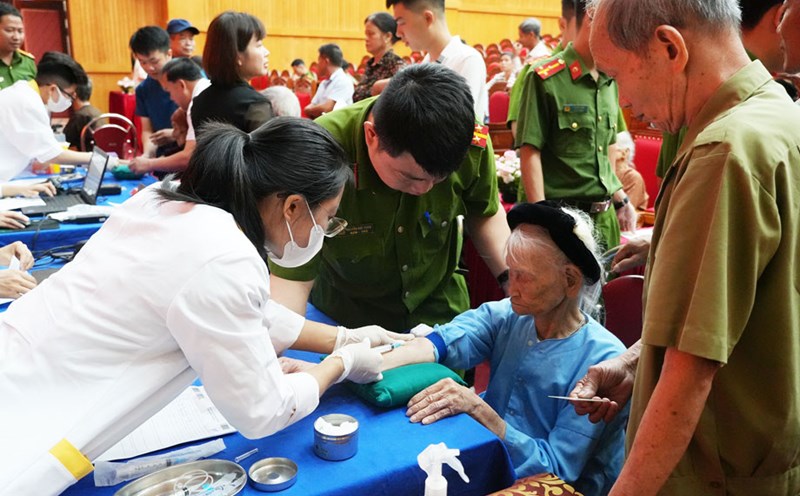
On February 27, Quang Tri Provincial Police confirmed that the unit is deploying DNA sampling of relatives of martyrs whose identities have not been identified and whose graves information has not been found throughout the province.
Accordingly, from February 26 to March 2, 2026, control samples of relatives of the mother line will be collected. The subjects of DNA sample collection are relatives of unidentified martyrs according to the list that has been surveyed, reviewed, and updated into the National Population Database system by the Police of communes and wards in coordination with sectors.
The purpose of collecting DNA samples is to create a gene database of martyrs and their relatives, serving the work of comparing and identifying martyrs' remains that lack information.
To deploy, the Provincial Police established points, stations and working groups in some wards and communes to organize sample collection. For cases of elderly and sick relatives, the police force will arrange mobile sample collection plans or forms of support suitable to actual conditions.
The collection of control samples according to the mother line is carried out according to the guidance of the Department of People with Meritorious Services, with the priority order: mother of the martyr, grandmother; siblings of the same mother; uncles, aunts, cousins who are biological siblings of the martyr's mother. In case there are no more of the above-mentioned relatives, functional agencies will guide the collection of samples of people with blood relations according to the mother line at a further level.
According to Quang Tri Provincial Police, this is an important activity, contributing to the work of identifying martyrs' remains in the area.
The Department of Home Affairs of Quang Tri province in 2025 also reviewed the entire current status of martyrs' graves in the area, serving the work of identifying identities in the coming time.
Quang Tri currently has 157 martyrs' cemeteries, burying more than 74,000 martyrs, of which more than 26,000 graves have not been identified. In the province, there are still more than 50,000 martyrs who sacrificed but their graves have not been found.
The construction of a gene database is expected to help many families reduce the hardship in the journey of searching for and testing DNA, gradually bringing martyrs back to their families.