
On April 17, the Ho Chi Minh City People's Committee issued a document assigning the task of preparing a Report proposing investment policies for the project to build the 15B connecting section and renovate and upgrade Rung Sac road according to the public-private partnership (PPP) method, construction - transfer (BT) contract.
According to the previous proposed plan, the project is divided into two sections. The first section is the 15B connecting route, from the D1-D3 intersection (Tan My ward) to the Can Gio bridge project boundary, nearly 2 km long, with a scale of 6 lanes (4 motorized lanes, 2 parallel lanes).
The second section is to upgrade Rung Sac road, more than 35 km long, from the Ben Luc - Long Thanh expressway intersection to the main road in Can Gio coastal urban area. The route will be expanded from 6 to 10 lanes (8 motorized lanes, 2 parallel lanes).
The preliminary total investment of the project is over 19,000 billion VND, including site clearance costs and loan interest during construction. The investor plans to arrange all capital sources and deploy in the period 2026 - 2028 if approved by competent authorities.
According to the direction of the Ho Chi Minh City People's Committee, the Department of Finance and relevant departments and agencies are assigned to coordinate, guide and be responsible for the legality and accuracy of the proposal dossier.
Assigning research does not mean appointing investors; investor selection will be carried out in accordance with current legal regulations.
The unit assigned to organize research and prepare a proposal report is Can Gio Tourism Urban Joint Stock Company. This enterprise will self-allocate funds for implementation, not using the city budget; and is responsible for ensuring the content of the dossier in accordance with legal regulations.
The deadline for completing the investment policy proposal report is 12 months from the date of issuance of the document.
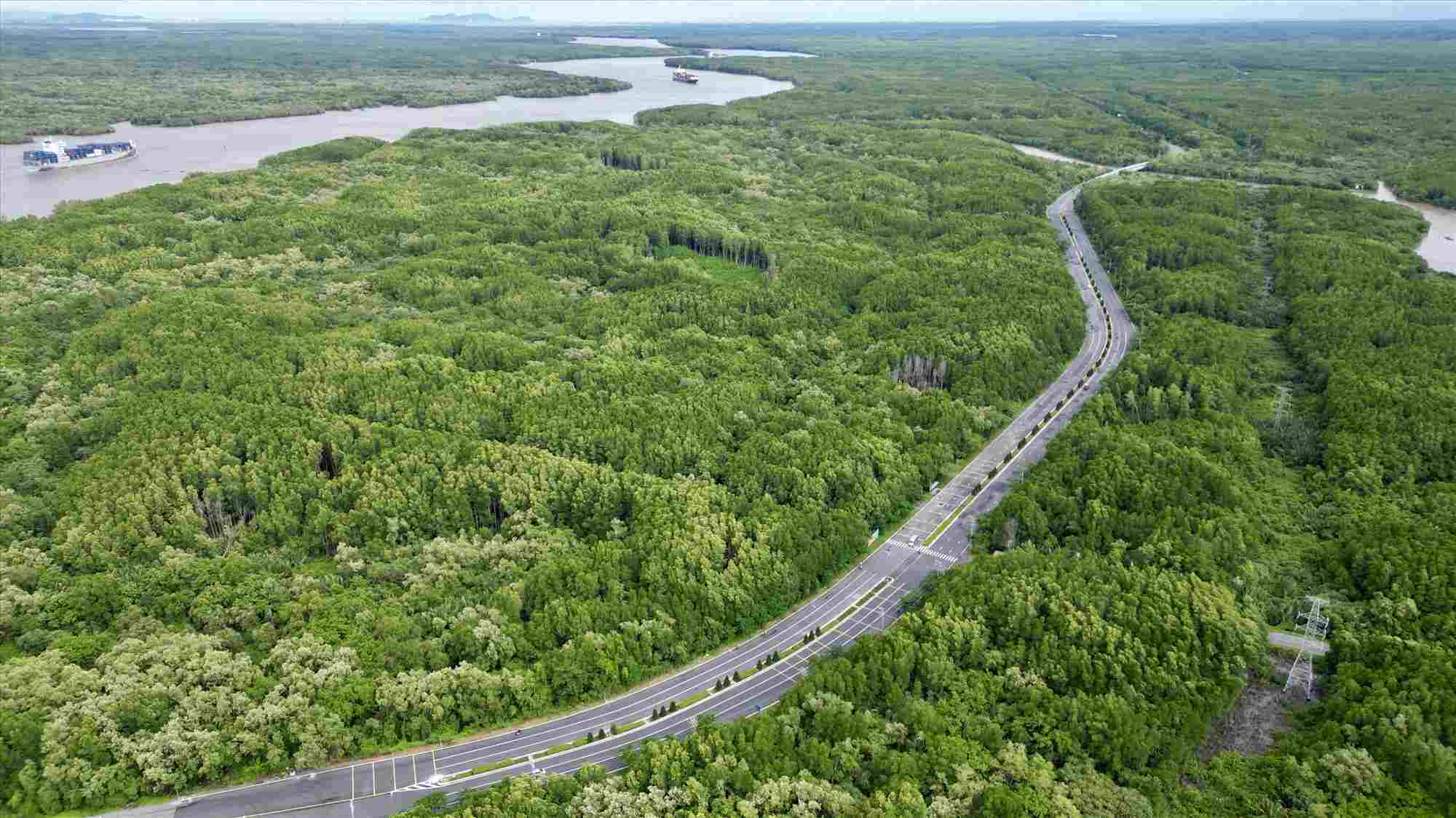
Due to the overlap in the scope of upgrading Rung Sac road and the 15B connecting route with some projects in the process of preparing for public investment, Ho Chi Minh City decided to temporarily suspend the implementation of related investment preparation tasks to ensure synchronicity.
The projects include: Phu Xuan 2B bridge; section 15B connecting from Can Gio bridge to Phu Xuan 2B bridge; An Nghia bridges (phase 2), Nong Truong District 5 bridge (phase 2), Rach Dong bridge (phase 2), Long Giang bridge (phase 2), Loi Giang bridge (phase 2) on Rung Sac road.
Currently, Rung Sac road is the only route connecting the center of Ho Chi Minh City with Can Gio. The road has been upgraded and expanded since 2004 with a total capital of more than 1,561 billion VND, completed and put into use in 2011 with a scale of 6 lanes.
In the context of a series of large infrastructure projects, new urban areas, inter-regional traffic routes and Can Gio international transshipment port gradually forming, traffic pressure on this route is forecast to increase sharply in the near future.
With its role as a vital traffic axis, Rung Sac road not only serves travel needs but also plays an important role in inter-regional connectivity, promoting economic and tourism development in the Can Gio area.
According to the development orientation, the expansion of Rung Sac road is identified as one of the key infrastructure tasks in the period up to 2027, in order to meet the increasing demand for population and tourists.
The general plan of Ho Chi Minh City to 2040, vision to 2060 (approved by the Prime Minister in 2025) also identifies Rung Sac as the main urban axis with a cross-section of 40 - 60 m.
Therefore, the option of expanding to 8 motor vehicle lanes and 2 parallel lanes, with a width of about 60 m, is assessed to be consistent with Resolution No. 12 of the Ho Chi Minh City Party Committee on the development orientation of Can Gio to 2030.


