
The Ho Chi Minh City Department of Construction has just sent a document to the Department of Finance, People's Committees of wards, communes, special zones and the Project Management Board for Investment and Construction of Transport Works on studying the use of overpass solutions in investment in transport infrastructure projects.
According to the Department of Construction, to effectively implement expressway projects in the 2026-2030 period and the following years, agencies assigned to prepare for investment and investors need to study and select design options right from the stage of preparing pre-feasibility study reports, investment policy proposal reports or project proposals.
Consulting units must calculate and choose construction solutions suitable to the actual conditions of each area.
For sections of the route passing through weak soil, areas that require deep digging or high embankment, it is necessary to study the option of building an elevated bridge to ensure long-term sustainability, adapting to climate change and sea level rise.
In addition, each project must be comprehensively compared between design options, from the ability to ensure material sources, construction progress to stability, durability and exploitation efficiency.
On that basis, clearly analyze the advantages and disadvantages of each option to choose the optimal solution in terms of economy - technology, ensuring investment efficiency throughout the project life cycle.
In fact, Ho Chi Minh City has been and is implementing many traffic projects using overpass solutions.
Typically, the Ring Road 3 section in the East of Ho Chi Minh City is more than 14 km long, built with a 4-lane elevated bridge from the Ho Chi Minh City - Long Thanh expressway to Tan Van intersection.
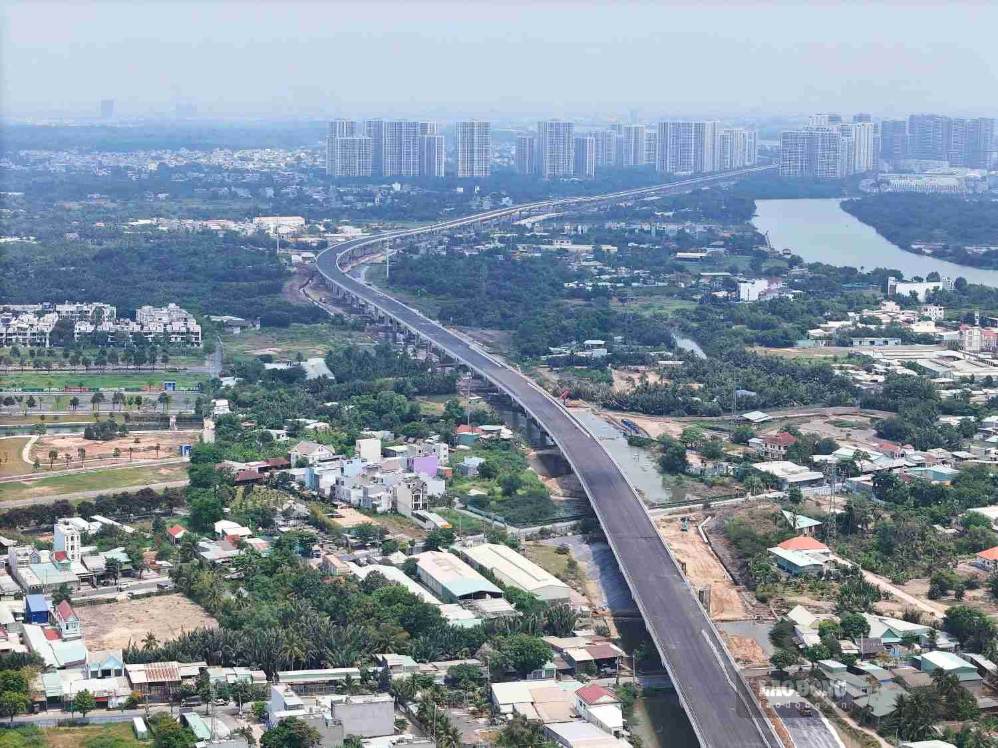
Two other key projects, Nguyen Khoai bridge and road and Binh Tien bridge and road, are also designed as viaducts on the route.
In the near future, the National Highway 13 expansion project (section from Binh Trieu bridge to Vinh Binh bridge) will build an elevated bridge about 3.2 km long, with 4 lanes, extending from the railway area to Binh Phuoc intersection.
The North-South axis road project (section from Nguyen Van Linh road to Ben Luc - Long Thanh expressway) will also build an elevated bridge in the middle of the route with a length of more than 7 km, with a scale of 4 lanes.
According to research, although the initial investment cost is higher than the traditional embankment road option, reinforced concrete viaducts are assessed to bring high economic and technical efficiency in the long term.
This solution helps to proactively schedule construction thanks to prefabricated components, while reducing dependence on the scarce source of filling sand. Meanwhile, the embankment road needs a large area of site clearance, affected by material shortages, sand price fluctuations and the risk of landslides due to exploitation.
For areas with weak soil foundations, the viaduct also shortens the construction time because it does not have to treat the foundation for more than 12 months as in the filling road plan. In addition, the viaduct helps reduce land recovery area, save compensation costs, ensure flood drainage capacity, limit waterlogging, saltwater intrusion and reduce residential area fragmentation.
Thanks to the stable reinforced concrete foundation structure, few intersections and no subsidence of the foundation, the elevated bridge is also more convenient in management, operation and maintenance, contributing to improving the long-term operation efficiency of the project.


