
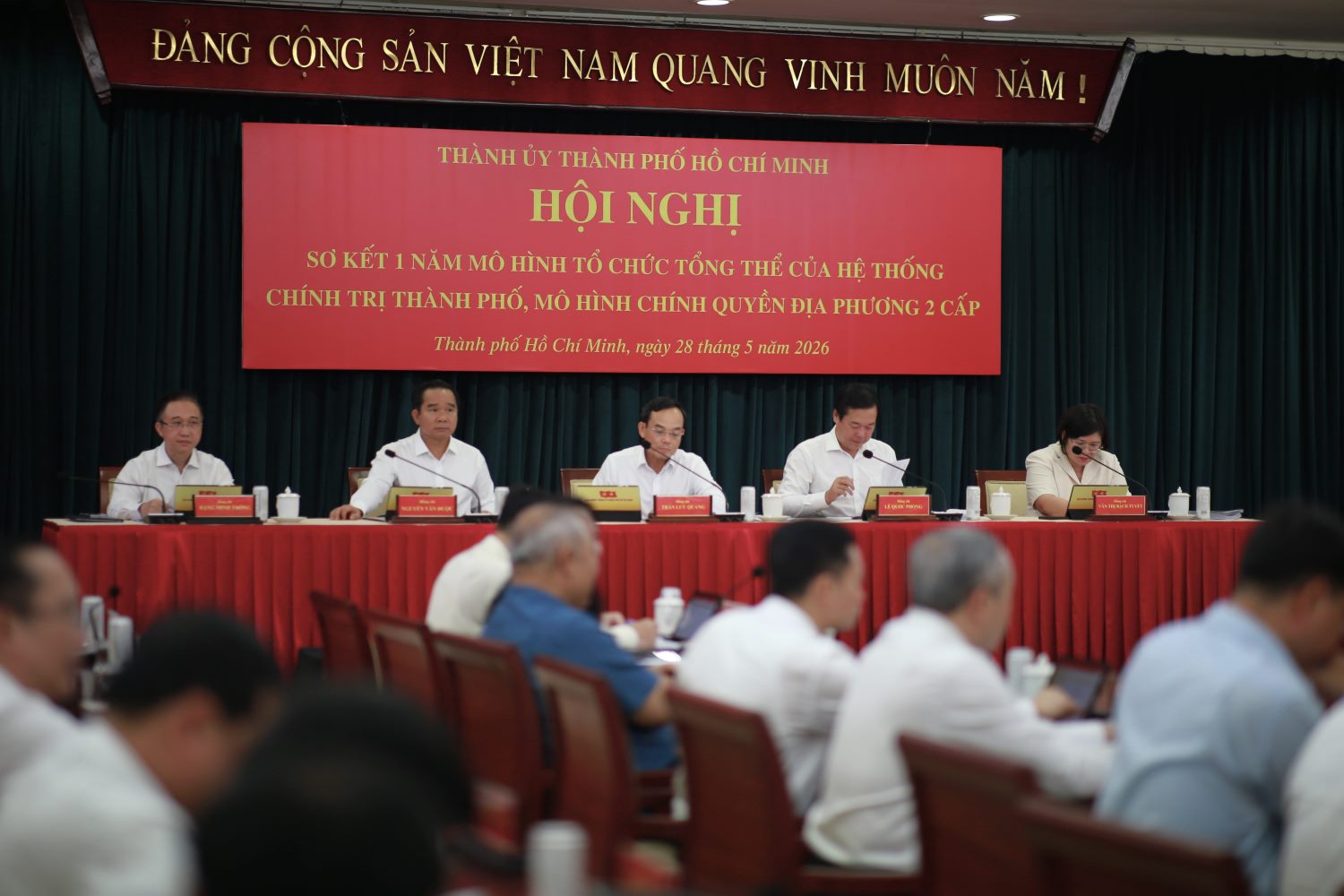
On the morning of May 28, the Ho Chi Minh City Party Committee organized the Conference "Preliminary review of 1 year of operation of the overall organizational model of the political system, 2-level local government model".
Reporting at the conference, Ms. Van Thi Bach Tuyet - Deputy Secretary of the Ho Chi Minh City Party Committee - said that after a year of implementation, the City has focused on arranging the organizational structure, consolidating the contingent of officials, promoting decentralization, delegation of power and administrative reform.
Ho Chi Minh City has reduced 10/15 grassroots-level Party committees directly under the City Party Committee; reduced 4/9 non-business units directly under the City Party Committee. Particularly, units directly under the Office of the Vietnam Fatherland Front Committee of the City were reorganized from 55 units to 6 units, down 89.1%.
For the government system, the City reduced 2/6 other administrative agencies and reduced 27/43 specialized agencies under the City People's Committee. At the commune level, Ho Chi Minh City rearranged from 441 units to 168 communes, wards, and special zones, a decrease of 64.9%...
The city has also decentralized and authorized 900 tasks of departments and branches and 108 tasks of the People's Committee and Chairman of the City People's Committee to the commune level. Through practical operation, many procedures are resolved faster right at the grassroots level, significantly reducing the situation of dossiers having to be transferred through many intermediate levels.
In addition, Ho Chi Minh City has implemented many new models such as "one door - one decision - one focal point responsible", resolving non-territorial administrative dossiers, and at the same time promoting the role of Portal/1022 switchboard in receiving and processing feedback from people and businesses.
In the field of administrative reform, the rate of timely dossier resolution reached over 99.5%, the rate of online dossiers reached over 88%, and the level of satisfaction of people and businesses reached over 96%.
However, Ho Chi Minh City also faces some difficulties and obstacles in the process of operating the new model.
Overload pressure appears in many densely populated areas due to the sharp increase in workload, while the staff size is not suitable for the population size and special urban characteristics after consolidation.
Many fields such as land, construction, justice - civil status, investment, education and health generate large volumes of dossiers. Meanwhile, many localities still lack cadres, civil servants, and public employees with in-depth expertise and experience, especially in the fields of Party building, information technology, finance - accounting, land management, construction - transportation and health.
In addition, specialized data between systems is not completely synchronized; data sharing between agencies is still limited in some areas such as land, construction, civil status, insurance and investment.
Some commune-level People's Committee headquarters after arrangement have not yet met the requirements for area, having to be arranged scattered in many different locations, affecting coordination work as well as people's transactions.
Regarding the orientation for the coming time, Ms. Van Thi Bach Tuyet said that Ho Chi Minh City will continue to maximize resources to effectively operate the 2-level local government model and the post-arrangement political system.
Ho Chi Minh City will complete the plan to arrange public headquarters, continue to streamline the contingent of cadres, civil servants, and public employees; build high-quality human resources, avoiding the situation of surplus and shortage of cadres in specialized fields.
Ho Chi Minh City will also promote administrative reform in the direction of reviewing and minimizing unnecessary procedures; strengthening inspection, urging and removing difficulties arising at the grassroots level, especially in areas that directly affect people and businesses.


