
On the morning of May 27, the Ho Chi Minh City People's Committee organized a workshop to gather business opinions on the Draft Law on Special Urban Areas.
One of the notable contents is the stronger delegation of power to the Ho Chi Minh City People's Council and the Ho Chi Minh City People's Committee in the fields of transport infrastructure development, logistics and environmental protection.
According to the draft, the Ho Chi Minh City People's Council is empowered to issue policies to develop transportation, support public transport activities; encourage investment and exploitation of large-volume public passenger transport systems such as urban railways, buses, train stations, bus stations, multi-functional parking lots, underground space exploitation and transportation in low-lying space.
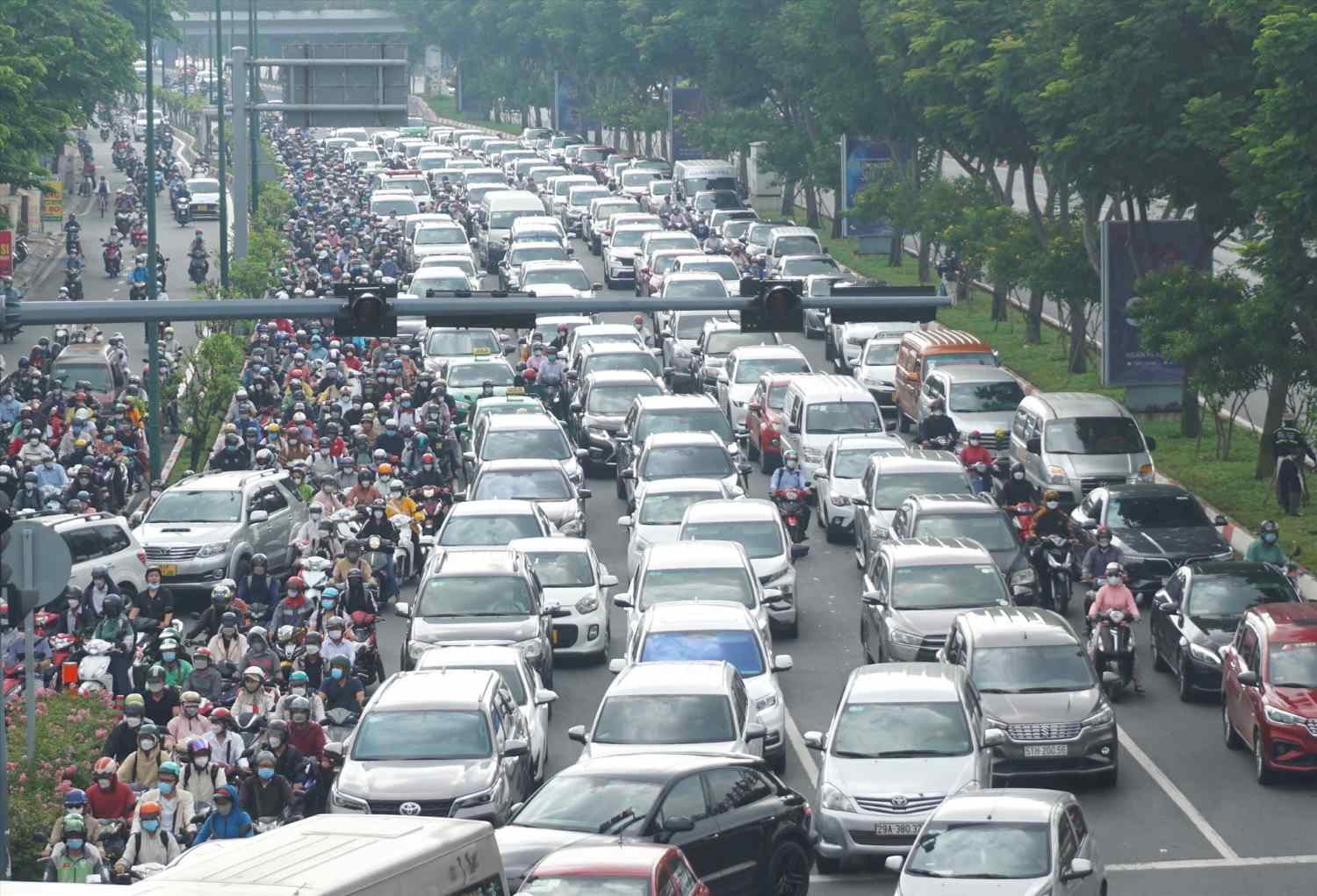
Notably, the Ho Chi Minh City People's Council is proposed to have the right to regulate the restriction of personal vehicles entering the central area to reduce congestion and emissions, and at the same time apply traffic congestion reduction fees.
Meanwhile, the Ho Chi Minh City People's Committee is assigned the right to determine the scope of low-emission zones (LEZs) to limit polluting vehicles and gradually improve air quality.
The Ho Chi Minh City People's Committee is also proactively applied measures to control traffic vehicles based on the level of congestion, the responsiveness of existing infrastructure and the requirement for green transformation, ensuring traffic order and safety.
Currently, Ho Chi Minh City is developing a Project to control emissions from vehicles in two phases.
Phase 1 focuses on building a roadmap and mechanism to support the conversion of public passenger transport vehicles to using electricity and green energy. This phase is being implemented. After expanding administrative boundaries, Ho Chi Minh City currently has about 180 inter-provincial and inter-provincial bus routes with more than 2,400 vehicles, of which electric buses account for nearly half.
Phase 2 will focus on building emission reduction policies for the remaining road vehicles.
According to the draft phase 2, from the beginning of 2027, Ho Chi Minh City is expected to establish a low emission zone in the central area. The scope includes previous districts such as districts 1, 3, 5, 6, 8, 10, 11, Binh Thanh, Tan Binh, Tan Phu and Phu Nhuan, which are limited by 15 bridges and 17 main roads.
When the low-emission zone is implemented, cars that do not meet Euro 4 emission standards will be charged when entering the central area, except for special vehicles such as ambulances, fire trucks, defense vehicles, police and funeral vehicles.
From September 2027, motorbikes that do not meet Euro 2 emission standards will be banned from circulating in low emission zones during two peak hours from 6am to 9am and from 4pm to 7pm.
According to the expected roadmap, by 2028, all gasoline-powered motorbikes will be banned from circulating in low-emission areas, except for vehicles for people with disabilities. At the same time, Euro 4 cars will also be banned from entering the central area during peak hours, except for special vehicles.
By 2030, the scope of the low-emission zone is expected to expand to the Ring Road 1 area, including major routes such as Pham Van Dong, Kha Van Can, the area around Tan Son Nhat airport, Cach Mang Thang Tam, Au Co, Luy Ban Bich, Kinh Duong Vuong and Vo Van Kiet. Emission control measures will also be tightened in stages.
In addition to the central area, the project also proposes early implementation of green transformation solutions in Con Dao and Can Gio.
In Con Dao, the goal by the end of 2026 is to basically complete the conversion of gasoline and oil vehicles to electric and green energy vehicles, except for trucks from 2 tons or more and specialized vehicles.
For Can Gio, the conversion roadmap is similar, expected to be completed by the end of 2028.


