
The above policy was agreed upon by the Executive Committee of the Ho Chi Minh City Party Committee at the 3rd Conference, held on the morning of January 7.
According to the proposed plan, the new political and administrative center has a scale of about 26 floors, including a 6-story base block and a 20-story tower block.
The project is designed in the shape of an arc, embracing the central space axis, directly connected to the square and the theater area, creating architectural highlights for Thu Thiem city.
The project is oriented to develop according to a green, environmentally friendly model; organizing open spaces, creating conditions for people to easily access administrative services. Functional areas are arranged with multi-functions, sharing infrastructure such as meeting rooms, conference rooms, flexible working spaces, to avoid waste and be suitable for the operating requirements of a special city.
Regarding capital sources, the Political and Administrative Center and the surrounding green park system will use public investment capital. Theaters - performance and conference centers are also invested with budget capital. The pedestrian bridge and some other auxiliary items will be implemented in the form of socialization.
In addition, commercial land in Thu Thiem area will be auctioned to create financial resources, contributing to balancing capital for the project.
According to the plan, Ho Chi Minh City will complete planning and investment procedures in the first quarter of 2026, start construction immediately afterwards and strive to put the project into use in 2027.
To ensure synchronicity, the city plans to adjust the planning of Thu Thiem New Urban Area, including swapping the location of some cultural - public works. The Symphony - Music - Ballet Theater is proposed to be moved from Ba Son area to the adjacent area of the administrative center; the old land area will be converted into a green park.
Ho Chi Minh City Children's Palace is also being studied for location conversion, prioritizing land funds for green spaces, water surfaces, and community activities.
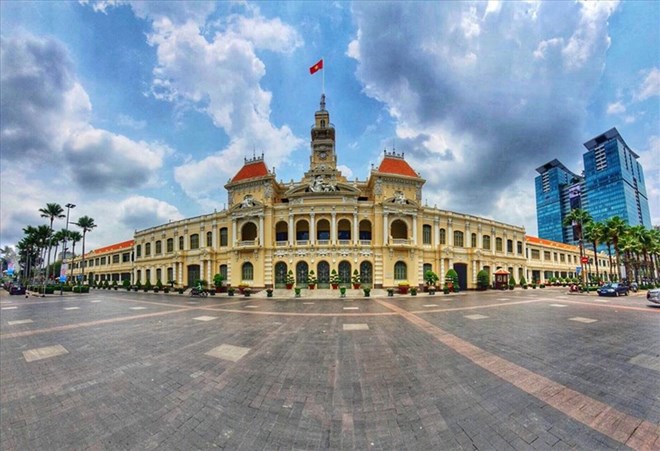
According to the Ho Chi Minh City People's Committee, after the merger, Ho Chi Minh City becomes a special urban area with 168 communes, wards, special zones, about 7,000 officials and civil servants working in administrative agencies, expected to streamline by 20% in the next 5 years.
Currently, the headquarters of the Party and government agencies of the city are scattered in many different locations, many works have deteriorated and no longer meet working requirements.
This situation causes difficulties for inter-agency coordination between units, affecting operational efficiency as well as service quality for people and businesses.
Meanwhile, Thu Thiem New Urban Area has concentrated land funds, synchronous technical infrastructure, and convenient connectivity with the existing center and the city's financial - commercial axis, which is considered a suitable location to form a centralized and modern administrative center.
Previously, according to old plans, the centralized administrative area of Ho Chi Minh City was once planned to be located in the existing center or Binh Quoi - Thanh Da peninsula.
Before the merger, the Department of Construction also proposed to build an administrative center at 86 Le Thanh Ton, with an area of about 1.8 hectares, serving nearly 1,700 officials and civil servants.
However, this option is assessed as not meeting the increasing personnel demand, and at the same time limited in space and traffic connection.


