
The above information was shared by Secretary of the Ho Chi Minh City Party Committee Tran Luu Quang at the 3rd Conference of the Executive Committee of the Ho Chi Minh City Party Committee for the term 2025 - 2030, held on the morning of January 7.
According to the Secretary of the Ho Chi Minh City Party Committee, currently people from Ho Chi Minh City to Vung Tau mainly have to travel through the Ho Chi Minh City - Long Thanh - Dau Giay expressway, passing through Dong Nai province.
However, with the new development space map after administrative boundaries are arranged, the city is facing the requirement to open direct connection directions, especially towards the sea.
The development direction towards the sea on the Can Gio side, directly connected to the Bai Truoc - Bai Sau area of Vung Tau, has many advantages, with a distance of only about 13 - 14 km" - Mr. Tran Luu Quang analyzed.

From this orientation, Ho Chi Minh City leaders have worked with strategic investors and agreed on the idea of building a 6-lane overseas road, starting from the Can Gio sea encroachment urban area.
According to the initial scenario, the project includes two main components: the elevated road section on the sea surface and the underground section under the seabed in the navigation area, built with technology similar to Thu Thiem tunnel. At the same time, the project will build two artificial islands arranged on both sides of the navigation area.
Compared to the option of building a sea bridge about 60 m high, the option of combining elevated road - underground tunnel is assessed as more feasible and convenient in construction. Initial estimates, the construction time for the entire route is about 3 years.
If the project is implemented on schedule, the car travel time from the center of Ho Chi Minh City to Vung Tau is only about 60 - 70 minutes.
Ho Chi Minh City will continue to invest synchronously in connecting infrastructure such as expanding Rung Sac road, building Can Gio bridge, opening more inter-zone connecting roads. When completed, travel time will be more stable and proactive than traveling on the Ho Chi Minh City - Long Thanh - Dau Giay expressway, which is often congested" - Ho Chi Minh City Party Secretary said.
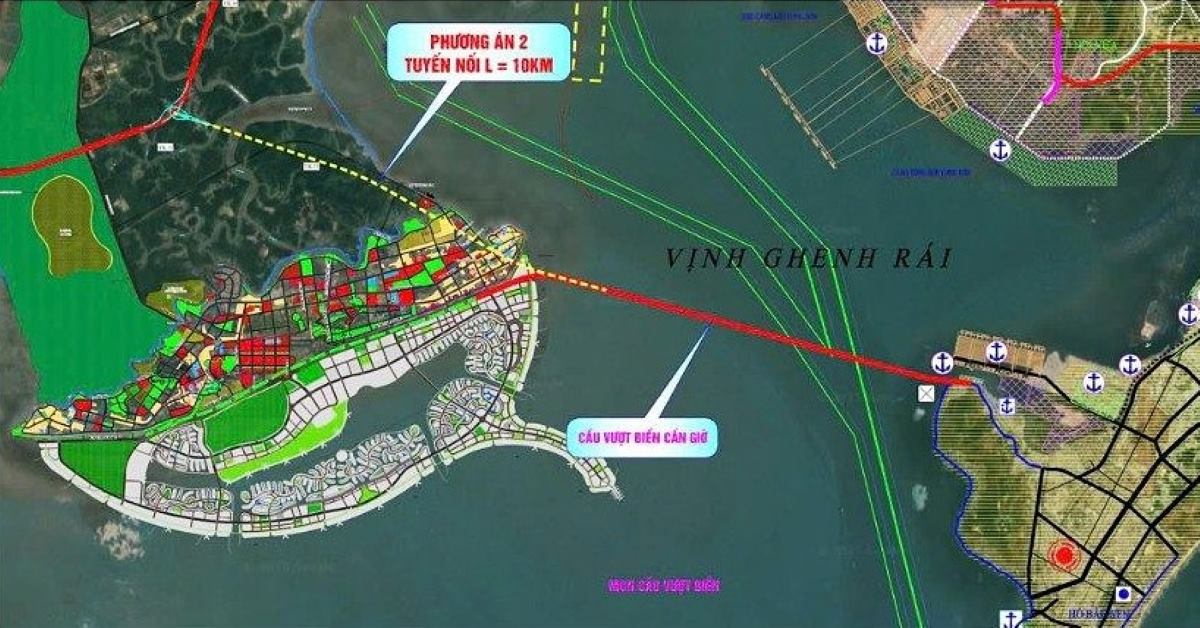
Previously, at the conference, Vice Chairman of Ho Chi Minh City People's Committee Nguyen Cong Vinh presented a submission from the Standing Committee of the Ho Chi Minh City Party Committee for the Executive Committee of the Ho Chi Minh City Party Committee to consider and give unanimous opinions on the investment policy of the sea crossing project connecting Can Gio - Vung Tau, and at the same time approve the adjustment of related plans as a basis for project implementation in accordance with regulations.
The Can Gio - Vung Tau sea crossing project was proposed by the investor to start construction in June 2026, complete and put into operation in the second quarter of 2029.
The starting point of the project is Bien Dong 2 road, belonging to Can Gio sea encroachment urban area; the ending point connects the Mai Sao - Ben Dinh planned road, intersecting with 30/4 road in Vung Tau. The route goes in the Southeast direction, overcoming Ghenh Rai Bay, with most of the length lying on the sea.
The entire route is more than 14 km long, including about 3.1 km of tunnels, nearly 8 km of bridges and about 3 km of access roads. The preliminary total investment is about 104,410 billion VND, including loan interest.
According to the proposal, the investor implements the project in the BT form, allocating all capital, including site clearance costs, without using the state budget; The State will pay with a land fund of equivalent value to the project.
Thu Thiem tunnel is nearly 1,500 m long, with a total investment of more than 2,200 billion VND, connecting the center of Ho Chi Minh City with Thu Thiem New Urban Area. This is the most important item of the East-West Highway project, a 22 km long traffic route with a total investment of about 9,800 billion VND, inaugurated in 2011.
At the time of commissioning, Thu Thiem tunnel was the first river tunnel in Vietnam, and also the longest tunnel constructed using casting and submersion technology in Southeast Asia.
The tunnel consists of 4 main sections, each section 93 m long, 9 m high, 33 m wide, the tunnel wall is 2 m thick. The tunnel sections are pre-cast, then towed on the river and accurately submerged to the bottom of the Saigon River for complete assembly.


