
At about 14:37 on December 14, at Km124+300 National Highway 6, the section passing Thung Nhuoi Pass, Mai Chau Commune, Phu Tho Province, a particularly serious landslide occurred.
Thousands of cubic meters of rock and soil from the positive slope suddenly collapsed, completely burying the road surface, causing traffic through the area to be cut off.
The dash cam of vehicles traveling through the area recorded the moment rocks and soil from the mountainside collapsed onto the road in just a few seconds. The image shows that at least 3 people were buried in the landslide.
Initial information said that the landslide killed 3 people and injured 2 others.
Speaking to Lao Dong Newspaper reporter, Associate Professor, Dr. Nguyen Van Vuong, Faculty of Geology, University of Natural Sciences - Vietnam National University, Hanoi said that landslides in the absence of heavy rain are not an unusual phenomenon if viewed from the perspective of geological science.
According to Associate Professor, Dr. Nguyen Van Vuong, many people often think that landslides only occur when there is heavy rain and floods, but in reality, rain is only a trigger, making the landslide process happen faster.
The root cause of landslides is an imbalance between the weight of the soil and rock on the steep slope and the resilience of the geological foundation below.
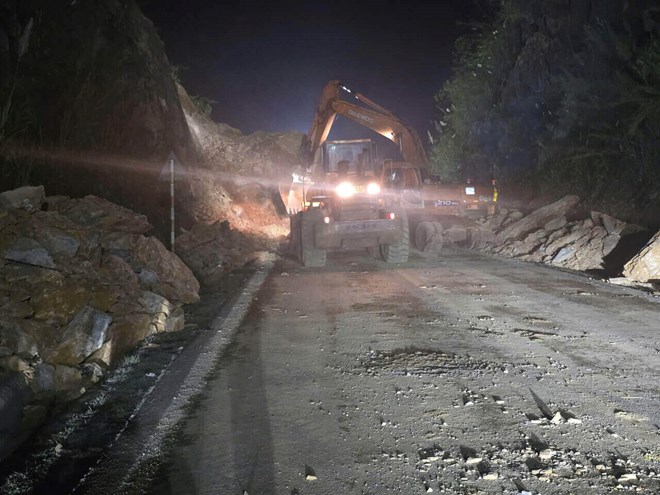
In areas with steep terrain, especially those affected by road opening and digging, the layers of soil and rock will gradually phong hoa and weaken over time.
Meanwhile, the weight of the ribs does not decrease but can increase due to water storage, trees, and carpets above. When the resistance level drops below the load-bearing threshold, a landslide phenomenon can occur at any time, even in dry weather conditions, Associate Professor, Dr. Nguyen Van Vuong analyzed.
According to the expert, Mai Chau and the Northwest region in general have complex geological foundations, interspersed with broken limestone and layered soil and rock, which pose a high risk of landslides.
In addition to natural factors, human impact also contributes to the increased risk of landslides. If the construction, expansion of traffic routes, and excavation into the positive slope are not fully reinforced, it will change the natural balance of the steep slope, causing the risk of landslides to always be present.

To limit the risk of landslides, Associate Professor, Dr. Nguyen Van Vuong said that technical solutions in the construction of transport infrastructure are necessary, but more importantly, they must be calculated right from the planning stage.
Geological assessments must be conducted in detail and fully, clearly identifying areas at high risk of landslides to have appropriate design and reinforcement plans.
According to experts, it is very difficult to determine the exact time of landslides.
To predict when landslides will occur, a long-term monitoring process is needed, in-depth research on geological structure and changes in influencing factors. In many cases, landslides only occur when factors exceed the load-bearing threshold, and the time to exceed this threshold is difficult to determine, emphasized Associate Professor, Dr. Nguyen Van Vuong.
According to the update until the morning of December 15, according to Mai Chau Commune Police, there is still a potential risk of further landslides in the landslide area.
Traffic through this area is not guaranteed to be absolutely safe. Requesting people and vehicle operators to strictly follow the instructions and traffic flow of the authorities.


