
People proactively "store sweetness" waiting for salty food
In recent years, climate change has made saltwater intrusion in the downstream area of the Tien River unpredictable. In Cho Lach commune, people have quickly changed their thinking, proactively storing fresh water to protect production.
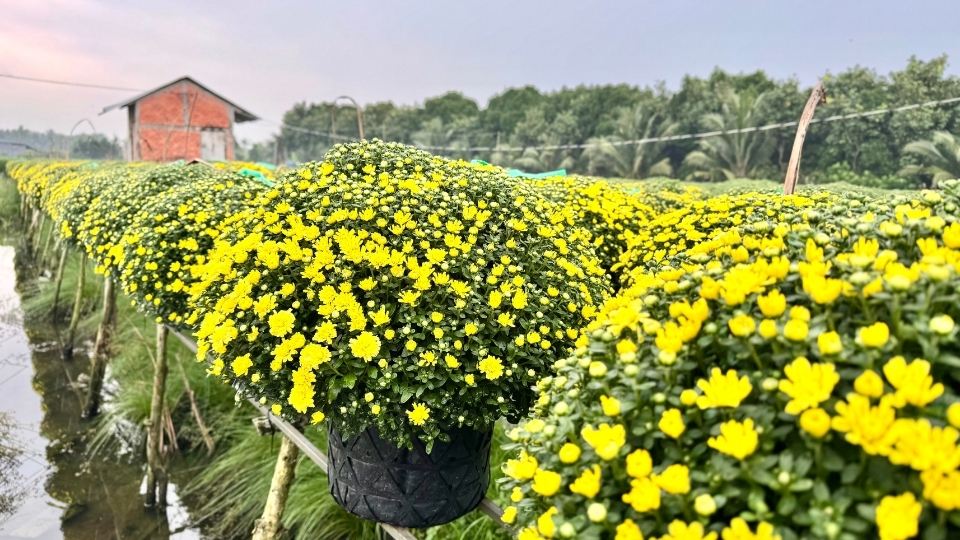
Instead of completely waiting for water sources outside the river, many flower and ornamental plant growers have invested in storage ponds and carefully lined with tarpaulins, considering this a fundamental solution in the face of the risk of saltwater intrusion deep in the dry season.
Mr. Dang Van Mi - Long Thoi Agricultural Cooperative - said that his family has prepared a water storage pond of about 1,000 square meters, with a capacity of more than 5,000 cubic meters, sufficient to serve irrigation during the salty month.
According to Mr. Mi, lessons from previous years of saltwater intrusion show that just being slow in water storage, ornamental flowers are very easily damaged, especially in the growth and sale preparation stage.

With the same proactive spirit, Ms. Ho Thi Son - a long-time chrysanthemum and raspberry farmer - said that her family had completed the reservoir early, strictly controlled the water source, and did not let saltwater intrude unexpectedly.
I don't wait until it gets salty to worry about dealing with it. With fresh water available in the lake, I can feel secure in production, especially at the time near Tet, ornamental flowers are very sensitive to salinity," Ms. Son shared.
In fact, saltwater intrusion in the locality has become a frequent problem. At the end of 2019, the salinity in the Tan Phu ferry terminal area reached 7‰, causing heavy damage to agricultural production.
Through many years of monitoring, people have noticed that the Co Chien river branch is salty, rising quickly but receding early, while the Ham Luong river is salty, coming slower but persistently prolonged.
Understanding the law of saltwater intrusion according to each river branch helps farmers proactively choose the right time to take water and store water, minimizing the risk of affecting flower and ornamental plant gardens.
4 scenarios for responding to saltwater intrusion
Talking to Lao Dong Newspaper, Mr. Tran Huu Nghi - Vice Chairman of Cho Lach Commune People's Committee - said that the whole commune currently has about 3,000 households directly producing ornamental flowers and seedlings on an area of more than 1,000 hectares.
According to Mr. Nghi, to respond to the 2025-2026 dry season saltwater intrusion, people in the area have invested and equipped about 1,000 freshwater reservoirs with tarpaulins, distributed evenly in the hamlets.
This stored water source is considered a key solution to help maintain production in times of deep and prolonged saltwater intrusion, especially when the water source outside the river is not safe.
Ornamental flowers are the main economic sector of the commune, with an estimated output of about 5 million products per year, creating jobs and stable income for thousands of rural workers.
To protect the production area, the locality has developed 4 scenarios for responding to saltwater intrusion, corresponding to levels from mild to severe, based on years of historical saltwater intrusion.
The goal is that depending on each scenario, the commune still maintains from 75 to 100% of the flower and ornamental plant production area, minimizing damage to people," Mr. Nghi emphasized.
At the same time, the commune has equipped salinity meters for all hamlets, organizing regular salinity measurements at at least 2 points per hamlet to closely monitor actual developments.
Salt content measurement results are continuously announced through the loudspeaker system and community Zalo groups, helping people proactively close sewers or take fresh water in a timely manner.
Local authorities also coordinate with specialized sectors to guide farmers to irrigate sparingly, use water reasonably, and improve the efficiency of invested storage ponds.
With the proactiveness of the people and the companionship of the government, Cho Lach is gradually building a solid "shield", protecting the flower and ornamental plant area from the increasingly fierce challenges of saltwater intrusion.


