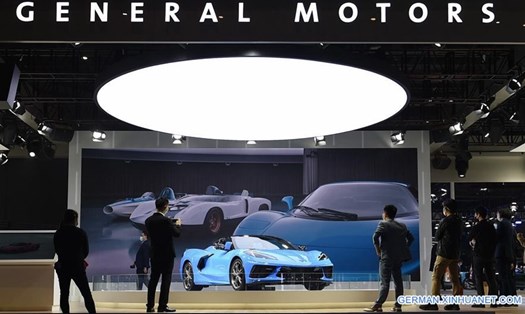
According to Car and Driver magazine, General Motors (GM) has just added a new direction in its battery development strategy by announcing a partnership with a startup company called Peak Energy to research and produce Sodium-ion batteries.
However, contrary to many predictions, this technology has not been used for electric vehicles immediately, but will initially serve large-scale energy storage systems.
According to the company's plan, Sodium-ion batteries will be deployed in battery storage systems (BESS), including battery clusters placed in containers or specialized facilities to store electricity for power grids, data centers and renewable energy sources such as wind power and solar power.
Currently, GM's electric car models use many different battery technologies. Most Cadillac, Chevrolet and GMC cars use NMCA batteries (nickel, manganese, cobalt and aluminum).
The new generation Chevrolet Bolt model uses lithium-iron-phosphate (LFP) batteries, while GM is also developing lithium-rich manganese (LMR) batteries for large-size electric vehicles. Sodium-ion batteries have become the fourth technology in the company's battery portfolio.
According to GM leaders, the main reason why the company chooses sodium batteries for energy storage is low cost and high durability throughout the 20-25 year life cycle of the system.
Even the lifetime cost of sodium batteries is estimated to be lower than LFP batteries, which are cheap batteries widely used in the electric vehicle market.
Another advantage of sodium batteries is the abundance of raw materials and less dependence on the supply chain. This helps manufacturers in North America have more choices in the context of increasingly fierce competition for battery material supply.
In addition, sodium batteries are capable of operating well in low temperature conditions and are much more heat-resistant than current lithium-ion batteries. In fixed energy storage systems, this technology almost does not require complex liquid cooling systems, helping to significantly reduce operating and maintenance costs.
However, sodium batteries still have the limitation of lower energy density than LFP batteries and significantly lower than high-end lithium-ion batteries. This is the reason why this technology is not suitable for electric vehicles, which require large capacity in small spaces and optimal weight.
However, GM believes that sodium-ion batteries still have much room to improve. According to Mr. Kurt Kelty, GM's Vice President in charge of battery development, traditional battery technologies such as NMCA or LFP have entered a mature stage, slowing down the pace of improvement.
Meanwhile, sodium batteries and LMR batteries still have great potential to improve efficiency and reduce costs.
To accelerate this process, GM has put into operation the new Battery Development Center (BCDC) in Warren, Michigan, USA. This facility will act as a bridge between laboratory research and actual production, helping to shorten the commercialization time of new battery technologies by up to one year.
This is considered an important step in GM's long-term strategy to reduce battery costs and increase competitiveness for electric vehicles in the future.