
From July 1, 2026, the regulation requiring the use of child safety devices in cars officially takes effect. This is considered an important step forward in protecting young children when participating in traffic, while enhancing the responsibility of vehicle operators.
In fact, many parents still have the habit of allowing their children to sit in the front passenger seat for easy observation or conversation during travel. However, according to experts and car manufacturers, this is one of the most potentially risky locations for children when collisions occur.
Front seats pose many risks
According to car manufacturer and assembler Daehan Motors Vietnam, the front seats are designed mainly for adults, not suitable for the physical condition of young children.
One of the biggest risks is the front airbags. When a collision occurs, the airbags deploy at a very high speed and force to protect adults. However, for children, this force can cause serious injuries to the head, neck and chest area.
In addition, the seat belt on the front seat is designed according to the body size of an adult. When children use it, the seat belt may not hug the body tightly or not fully promote protective effectiveness in the event of an accident.
In addition to technical factors, children sitting next to drivers can also distract the driver. With their hyperactivity, children can play or constantly interact with the driver, increasing the risk of traffic unsafety.
For vehicles with only one row of seats, putting children in front is inevitable. In this case, children need to be fixed with appropriate safety equipment as recommended by the manufacturer.
Which position is the safest for children?
According to advice from Long Bien Ford, on 5-seater cars, the seating position next to the driver is one of the most dangerous positions for children.
When a head-on collision occurs, the driver often reacts to steering to protect themselves. This can cause the front passenger seat area to be more affected in some situations.
People sitting in the front seats also have to bear great inertia when the car crashes. If the seat belt or airbag does not work effectively, the risk of impacting the dashboard or windshield is very high.
Therefore, a safer position for children is the rear seats, especially the position behind the driver's back or the position between the rear seats. This is an area that is usually less affected in direct collisions and helps reduce the risk of injury.
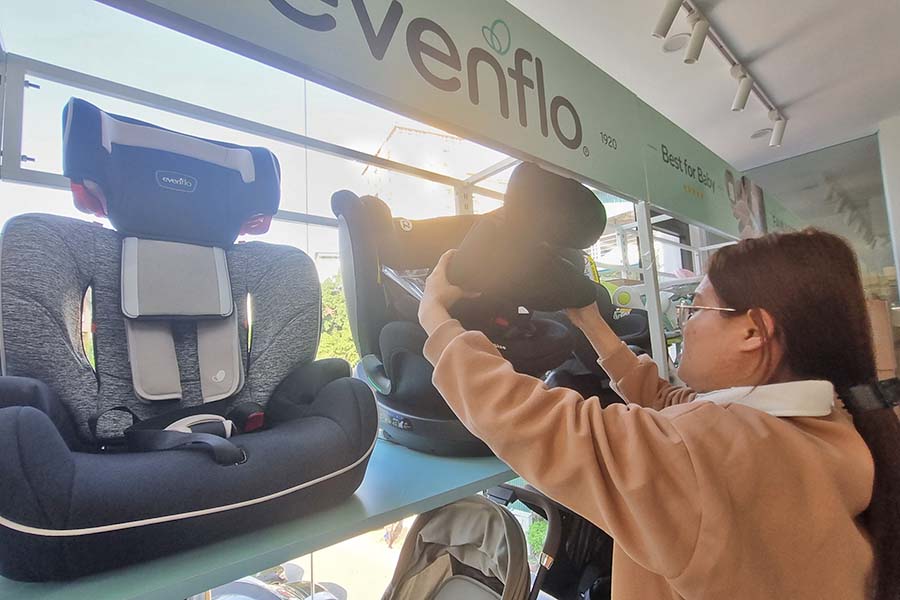
The driver is subject to punishment
Talking to Lao Dong Newspaper, Lawyer Hoang Ha (Ho Chi Minh City Bar Association) said that from July 1, 2026, if personal vehicles carrying children under 10 years old and under 1.35 m tall do not use appropriate safety equipment, vehicle operators will be subject to penalties.
According to point m, clause 3, Article 6 of Decree 168/2024/ND-CP, car drivers may be fined from 800,000 VND to 1,000,000 VND if carrying children under 10 years old, under 1.35 m tall sitting in the same row of seats with the driver, unless the car only has one row of seats or does not use safety equipment suitable for children.
This means that if the vehicle owner directly controls the vehicle, the vehicle owner will be penalized. In case the vehicle owner hands over the vehicle to another driver, the driver at the time of the violation is the person responsible.
According to Lawyer Hoang Ha, the regulation does not only apply to cases where safety seats are not equipped for children. Even if there is safety equipment on the vehicle but children do not use it or use it incorrectly, vehicle drivers may still be penalized.


