
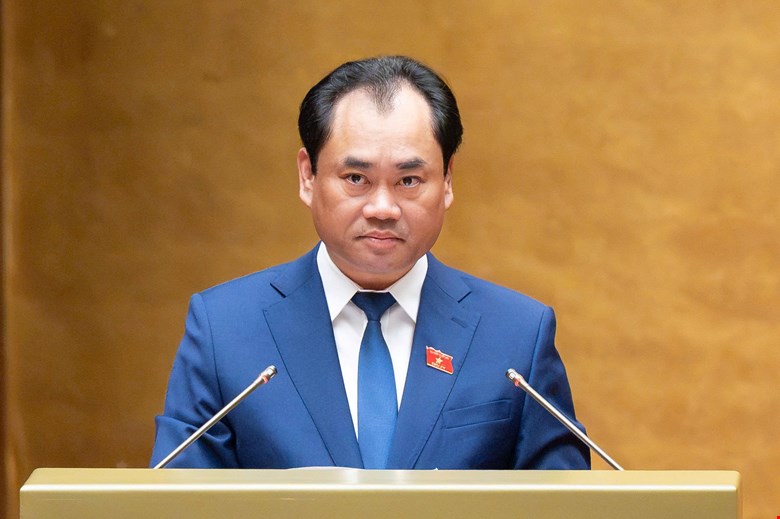
On the morning of August 19, at the First Extraordinary Session, Member of the Party Central Committee, Minister of Agriculture and Environment Trinh Viet Hung presented a report on policy orientations for amending the 2024 Land Law to the National Assembly.
Minister Trinh Viet Hung said that based on the viewpoints and orientations approved by the Central Government in Resolution No. 21, the results of summarizing the implementation of the 2024 Land Law, the Government has approved 7 groups of policies.
The first is to innovate land use planning and plans in the direction of combining the allocation of land use targets with the organization of development space, zoning land use and zoning areas that need protection.
The second is to improve the mechanism for land allocation, land lease and land use purpose conversion in a public, transparent, competitive direction, selecting investors with sufficient capacity and effective land use.
The third is to improve the mechanism for land recovery, compensation, support and resettlement in the direction of more clearly stipulating project criteria and land recovery scope.
Amending the Land Law this time will strongly shift from the mindset of "compensating for recovered assets" to the mindset of "rebuilding people's lives when the State recovers land".
Along with the policy of prioritizing people with recovered residential land to be compensated with residential land or on-site housing, the Government proposes not to rigidly stipulate that land recovery is only carried out after the compensation, support, resettlement plan has been approved and resettlement arrangement has been completed.
Fourth is to innovate the land financial mechanism and land prices. Accordingly, the Government clearly states that the land price orientation is decided by the State based on data, scientific methods, publicity, transparency, interconnection between land data and related specialized data; not to let prices be manipulated, forming virtual prices; reasonably regulate the added value from land.
Fifth, it is to improve regulations on the rights and obligations of land users, land use regimes in the direction of unblocking land resource resources through expanding the mechanism of using land combined with multi-purpose but with a management and control mechanism.
Sixth is to promote administrative reform, digital transformation and decentralization and delegation of power in land management; complete the national land database; handle historical shortcomings in Certificate issuance.
Seventh is to innovate, strengthen inspection, supervision, handle violations, resolve disputes, complaints, and denunciations; overcome the situation of not using land, leaving land fallow, polluted, and degraded.
Appraising the Government's submission on the orientation for amending the 2024 Land Law, the Economic and Finance Committee agreed with the necessity and urgency of amending the 2024 Land Law.
According to Deputy Chairman of the Economic and Finance Committee Nguyen Ngoc Bao, the appraisal agency proposed to carefully review the cases allowing land recovery before approving compensation, support, and resettlement plans.
At the same time, review land recovery before completing resettlement arrangement, ensuring that it is truly necessary and urgent, for the common good because the mechanism to ensure legitimate interests and minimize risks for land users in this case is not clear.
Regarding finance for land and land prices, the appraisal agency proposed to continue to study and build a mechanism to determine land prices for production and business to ensure reasonableness, contributing to improving land use efficiency, promoting investment, business development, creating jobs and contributing to growth, ensuring revenue for the State budget.
Also according to the Economic and Financial Committee, it is necessary to clearly and feasibly stipulate the land price list, the land price adjustment coefficient and the ratios can all be adjusted upwards or downwards to suit the goal of mobilizing land resources for socio-economic development in each period.
The thẩm tra agency proposed separating the determination of land prices from the mechanism of compensation, support, and resettlement.


