
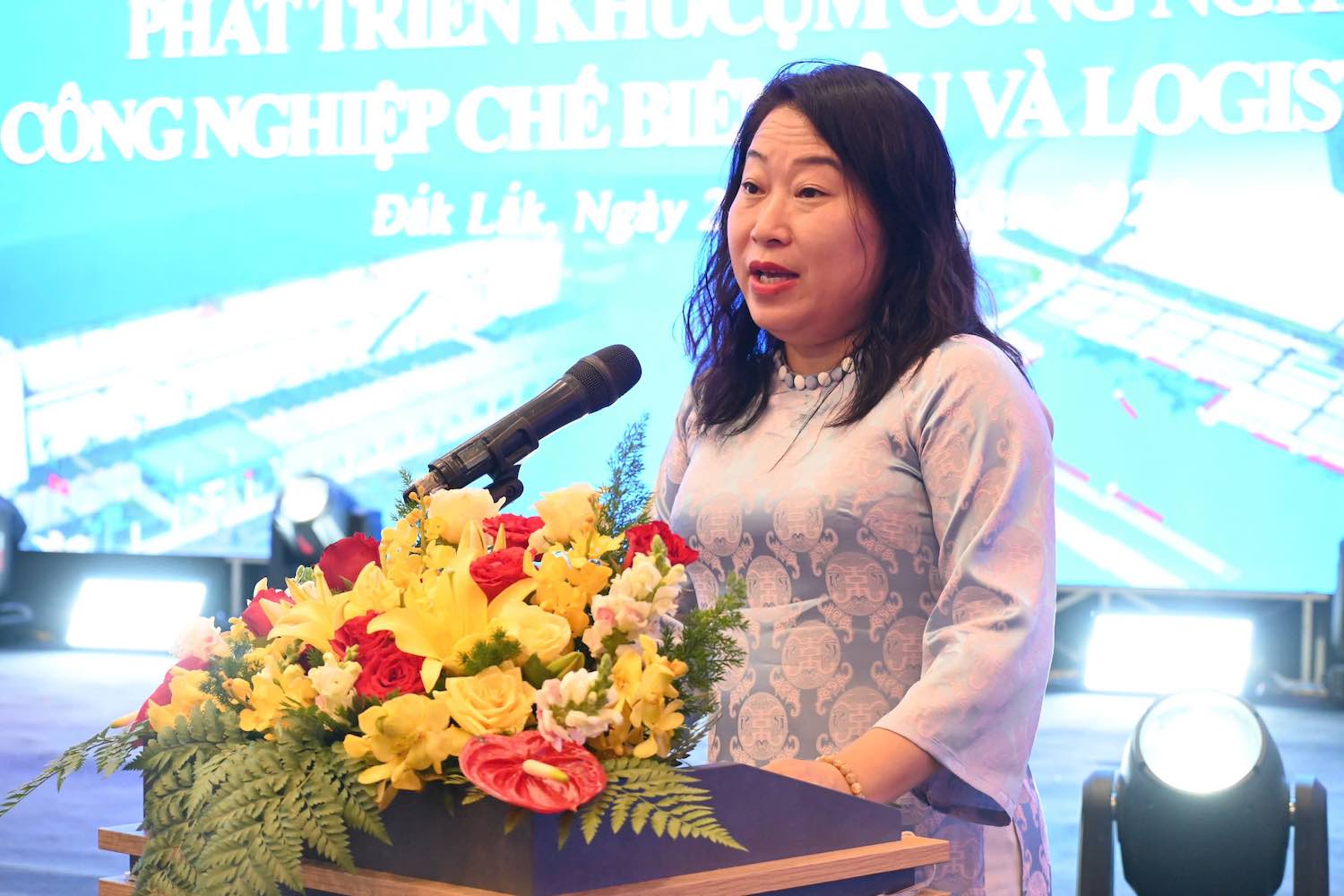
On the morning of June 26, Dak Lak Department of Industry and Trade organized a workshop on developing industrial zones and clusters associated with deep processing industry and inter-regional logistics.
At the workshop, many opinions suggested that the development of industrial zones and clusters should not only stop at investing in factories and production premises, but also need to build a synchronous ecosystem to meet the needs of businesses and workers.
Synchronous investment is needed
Ms. Tran Phuong Lam - Chairwoman of the Board of Directors of N&G South Central Group Joint Stock Company, investor of Phu Yen High-Tech Industrial Park - said that a sustainable industrial park cannot only have technical infrastructure but needs to be synchronously invested in social infrastructure.
According to Ms. Lam, when choosing investment locations, businesses are currently not only interested in land funds, transport infrastructure or preferential policies, but also focus on living environment, living conditions and the ability to stabilize human resources.
Citing real evidence, she said that the Southern Hanoi Supporting Industrial Park (Hanssip) developed by members of N&G Vietnam Group has formed a fairly complete industrial and urban service ecosystem with utilities in health, education, culture and a career orientation academy for supporting industries.
This model is highly appreciated by many domestic and foreign investors. According to Ms. Lam, the synchronous development of social infrastructure not only improves the quality of life for workers but also helps businesses stabilize human resources, creating a foundation for sustainable development.
From the above reality, delegates believe that Dak Lak needs to synchronously calculate between production development and ensuring the lives of workers when building industrial zones and clusters, avoiding the situation where production infrastructure develops but lacks essential accompanying services.
Removing infrastructure bottlenecks, improving competitiveness
At the workshop, delegates agreed that appropriate planning is the foundation for the effective development of industrial zones and clusters.
However, planning is not only about allocating land funds reasonably but also about clearly defining the role and function of each area in the overall local economic development.
For Nam Phu Yen Economic Zone and Hoa Xuan Dong, Hoa Xuan Tay IPs, many opinions suggest that it is necessary to clearly define the functions of each zone, avoiding spreading, overlapping and intra-regional competition.
According to Dr. Tran Thi Anh Tam (Faculty of International Business - Marketing, Business School, Ho Chi Minh City University of Economics), besides strategic planning orientation, Dak Lak is still facing limitations in transport infrastructure and logistics connectivity capacity.
Dr. Tran Thi Anh Tam proposed that localities soon complete the adjustment of the Provincial Plan for the period 2021 - 2030, with a vision to 2050 in the direction of green economic development and circular economy.
At the same time, prioritize investment in logistics infrastructure, connectivity infrastructure and digital infrastructure; restructure key industries, standardize production processes to meet increasingly strict export standards such as EUDR and green standards.
According to Ms. Tam, when agricultural, forestry and fishery products of Dak Lak - Phu Yen are improved in quality, effectively connected with the logistics system and global value chains, the locality will have more opportunities to attract investment, develop deep processing industries and create stable jobs for workers.


