
When Thomas Tuchel was appointed by Chelsea mid-season 4 years ago, he arrived in London by plane. Right on that flight, Tuchel outlined a tactical plan to help a team struggling in the second half of the Premier League table reach the top of the Champions League. The focus of the plan is to change the system, switching to a 3-4-3 formation.
And when Michael Carrick was promoted to lead Manchester United until the end of the season, the context was completely different and the solution was also different. Carrick chose to do the simplest, most pleasing thing. That is to abandon the 3-4-3 formation.
However, Carrick entered the mission with a coherent mindset, with a formula showing suitability for the available forces. Carrick's 4-2-3-1 formation made an impression by having an immediate impact on some individuals.
Patrick Dorgu, brought in as a full-back and once criticized by Ruben Amorim for making the team "worried" when having the ball, previously only scored one goal for Man United. When Carrick pulled him up to play as a left winger, he immediately scored twice in 2 matches.
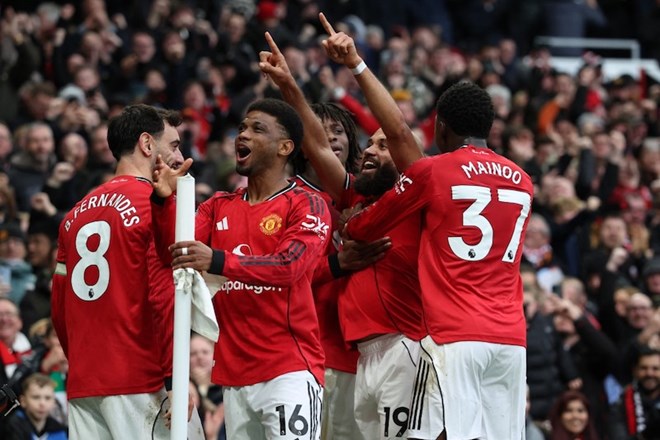
Bryan Mbeumo was bought to play the right-leaning number 10 role and was mostly used in that position. But when playing as a center forward - a role he rarely took on at Brentford last season - Mbeumo scored in victories against Manchester City and Arsenal. Diogo Dalot returned to the right-back position, Bruno Fernandes was returned to the right number 10 role, and Kobbie Mainoo was given the opportunity to start this season for the first time.
These choices created contrast with the start of some predecessors. Amorim started with a draw against Ipswich, when he applied the style of stuffing inappropriate pieces into inappropriate positions that the 3-4-3 formation required.
Noussair Mazraoui plays to the right in the three-man defense, Dalot guards the left wing, Alejandro Garnacho takes on the number 10 role. Erik ten Hag has a whole summer to prepare, yet in his debut match against Brighton, he used Christian Eriksen as a false striker.
Ralf Rangnick deployed his favorite 4-2-2-2 in the first match as interim coach, with Jadon Sancho and Fernandes playing number 10 behind Marcus Rashford and Cristiano Ronaldo. That system was soon abandoned, partly because Ronaldo did not press well. Louis van Gaal even started by pulling Jesse Lingard down to play as a full-back, and Man United lost to Swansea.
Compared to those beginnings, Carrick's decisions seem more certain. His task is short-term, but the pace is extremely favorable, helping Man United rise to fourth place.
That recovery also leads to a big question, what will the next journey be like. When there are only 15 matches left in the season, does Carrick need to change much?
Casemiro's condition may make it difficult for him to start continuously, but Man United's schedule is quite easy, as they only have 2 mid-week matches left in the remainder of the season. If desired, Carrick can completely operate the team with a relatively thin group of key players.
The question is whether the "Red Devils" need a different approach in matches that are considered easier or not. They attack sharply, have high speed and technique, have scored 5 goals so far. But they also only control the ball for a limited period of time in each match, partly because they are considered inferior. For most of the remaining 15 matches, Man United may enter the game as superior.
And there are names that Carrick has not chosen early. Matheus Cunha has responded to expectations quite impressively, becoming Carrick's super substitute. There is not much reason to shuffle the starting lineup when the team is winning, but the Brazilian striker will definitely continue to strive to win a starting spot.
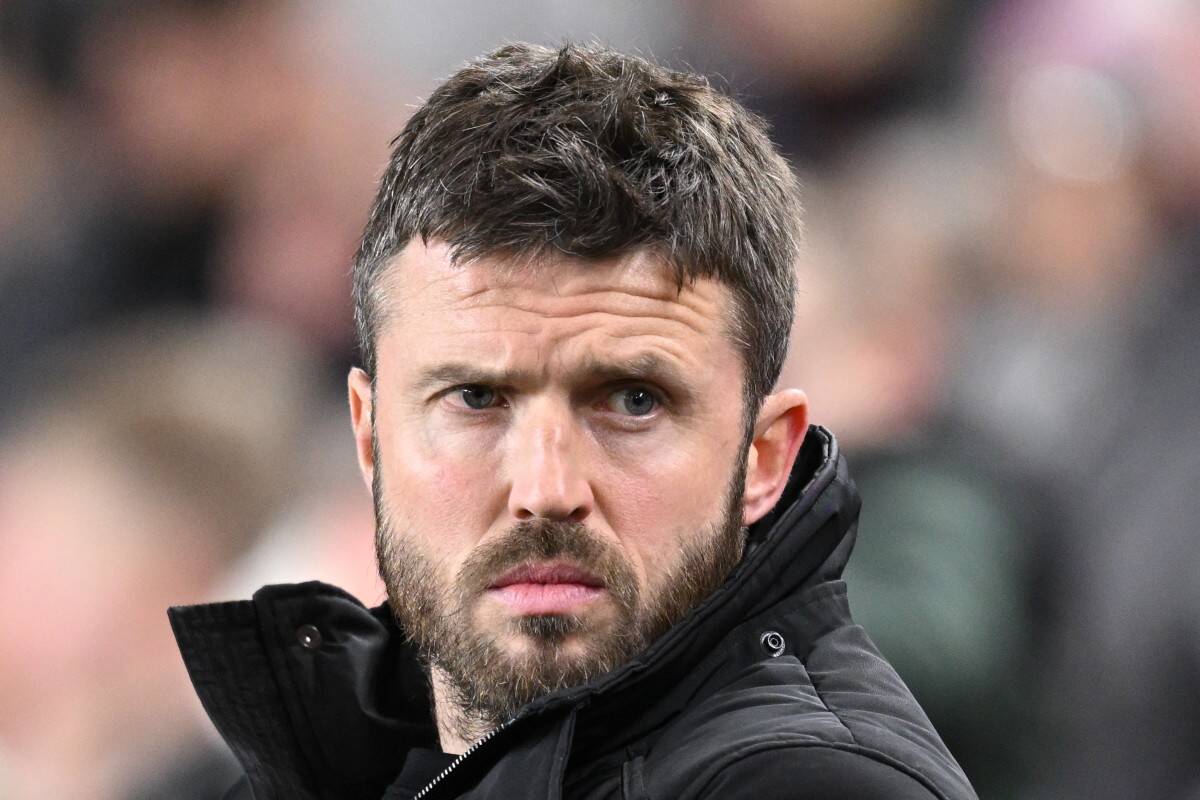
A few others seem to be lower in the priority order. Carrick was praised for his boldness when he brought Benjamin Sesko on to replace Dorgu in the match against Arsenal. However, looking at the adjustments in the first 2 matches, the Slovenian striker now seems to be only the third choice.
Similarly, Leny Yoro must also recognize his position when Harry Maguire returns to the starting lineup against Man City. And this veteran center-back played well in both matches under Carrick. However, Yoro as well as Sesko are both seen as future contracts.
Part of the reason Carrick let Mbeumo lead the attack may lie in the fact that he is the best finisher in the team, and also suitable for the counter-attacking style that Carrick is applying. Maguire, in a sense, is still the most reliable name of Man United in defense.


