
Proactively plan to streamline the apparatus from commune and ward levels
After operating the 2-level local government model, the population size and management area in many communes and wards in the city have changed greatly. To overcome the situation of local overload, reduce intermediate management focal points and improve teaching quality, localities have urgently developed plans to review and merge schools under their authority.
In Lien Chieu ward - a key industrial area with a very high rate of mechanical population growth, school pressure is always a difficult problem. The ward currently manages 10 public educational institutions directly under it (including 4 kindergartens, 4 primary schools and 2 secondary schools) operating at 12 school sites, serving nearly 10,000 students. According to the newly issued plan, the ward is implementing the merger of small-scale kindergartens and primary schools to reduce from 10 schools to 7 schools, achieving a reduction rate of 30% of focal points, in which, the locality maintains all 12 existing school sites, without mass transferring students to avoid causing difficulties and disruptions for parents.
Talking to a reporter of Lao Dong Newspaper, Mr. Le Minh Chien - Chairman of Tra Tan Commune People's Committee - said that the locality proactively built a plan to reduce about 33.3% of school branches. Accordingly, the commune merged 1 primary school and 1 secondary school into a multi-level school, thereby reducing 2 principal titles to be arranged to be deputy principals.
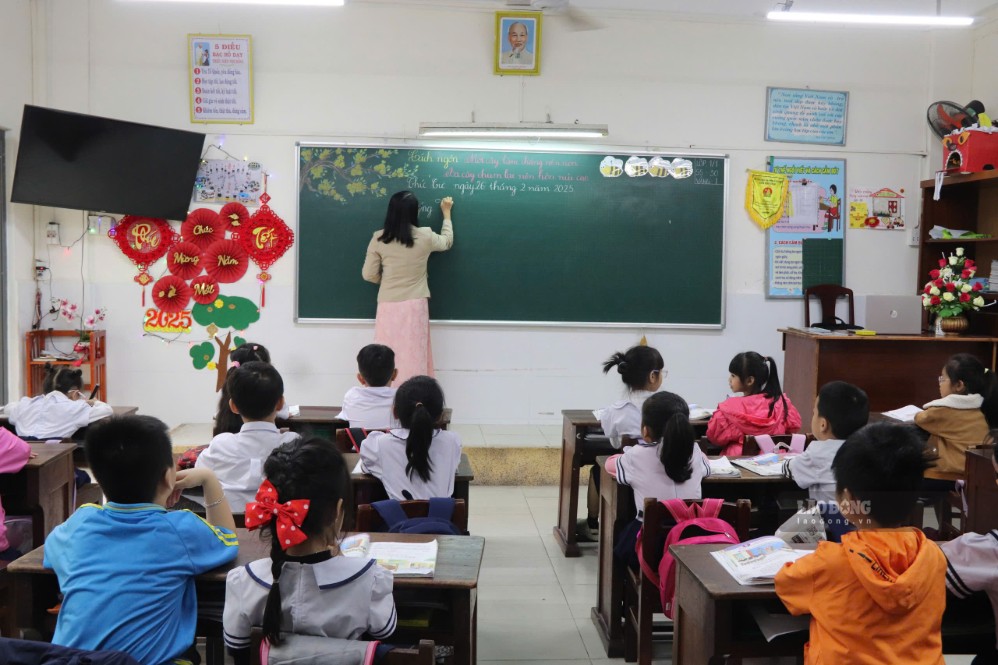
Roadmap to reduce at least 30% of city-wide focal points
Da Nang City People's Committee has issued documents directing departments, branches and localities to simultaneously implement plans to review and restructure the school network. Currently, the whole city has 1,315 educational institutions (including 501 kindergartens, 326 primary schools, 278 secondary schools, 103 high schools and 4 continuing education centers).
The city's overarching goal is to reduce at least 30% of public educational institutions compared to July 2025. City leaders thoroughly grasp the principle of "Taking learners as the center, ensuring learning rights and educational access opportunities, creating more favorable conditions for students to go to school, without creating geographical and cost barriers". The reorganization is implemented according to two main models: a large-scale one-level school with branches and a large-scale multi-level general education school. In particular, the city clearly directs "Only merge preschool educational institutions together, not merge preschool educational institutions with general education institutions".
According to the plan, no later than August 5, Da Nang City People's Committee will approve the overall plan for the whole city. Districts, towns, communes, and wards will complete the procedures for merging, establishing, and consolidating the management apparatus before August 25. The city's determination is to put the entire school and classroom system after arrangement into stable operation from September 1, ready for the new school year 2026-2027.


