
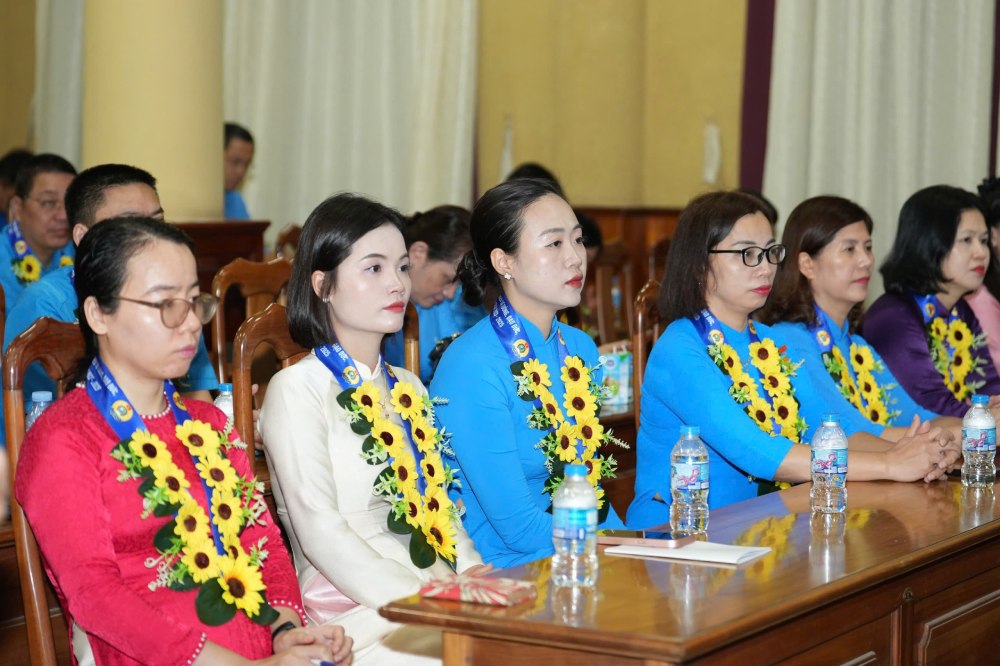
On the morning of May 19, speaking at the Forum "Trade Union members studying and following Uncle Ho's ideology, ethics, and style to compete in good labor, high productivity, and good income", Dr. Duong Thi Thuy Van stated that in practice today, learning is extremely important; for workers, learning and improving productivity is a matter of survival.
We are living in a historical moment. Resolution 57-NQ/TW of the Politburo on scientific and technological breakthroughs, innovation and digital transformation; Resolution 71-NQ/TW on breakthroughs in education and training development - all send a clear message: high-quality human resources are the number one strategic resource of the nation," said Dr. Duong Thi Thuy Van.
Reality poses a significant challenge, Vietnam's labor productivity is inferior to many countries in the region and in the world. The root cause is not only the lack of machinery or technology - but also the lack of skills, lack of updated knowledge and lack of motivation for workers to study. In that context, accompanying workers to study and improve their skills has become an issue that is not unique to any agency or organization. This is also an issue of the entire trade union system.
Dr. Duong Thi Thuy Van proposed 6 solutions for the trade union system to accompany and improve the quality of human resources.
First, build a "Digital Bookcase" at each grassroots trade union. Instead of investing heavily from the beginning, you can start with a "Digital Bookcase" on existing platforms such as websites, Zalo, Google Drive or internal applications, compiling concise documents on vocational skills, digital skills, labor law, labor safety, occupational health...
Second, piloting "SKILL Passport" for workers - learning is recognized. To make learning motivational and recognized, it is necessary to gradually build "SKILL Passport" for union members, in the immediate future, it can be piloted in some industries, localities, and businesses with conditions. Workers who complete short courses on digital skills, labor safety, professional foreign languages, AI application or process improvement will be recognized and accumulated in the "SKILL Passport". The accumulated learning results in the "SKILL Passport" can be considered in emulation evaluation, reward proposals, training planning, salary increases or arrangement of suitable jobs.
Third, "Uncle Ho's Study Hour" - 30 minutes of study per week at workplace. From Uncle Ho's self-study example, grassroots trade unions can launch the "30 minutes of study per week" model right at workshops, construction sites or offices. The learning content is concise, practical, and associated with daily work such as using digital tools, identifying occupational safety risks, communication skills, practicing communication in English, improving professional operations, applying AI in office work, or handling professional situations...
Fourth, popularize digital and AI skills according to each occupational group. Trade unions at all levels coordinate with businesses, universities, and technology organizations to build short-term courses of about 40 hours/year/worker with practical training program content, associated with specific work, not academic, prioritizing practical content, and ready to use immediately after completion.
Fifth, develop a network of "Learning Ambassadors" among union members. Practice shows that workers often absorb and apply it more effectively when guided by colleagues in the same profession, in the same working environment. On that basis, a solution that is both feasible and has a spreading effect is to select active union members, good workers, young officials, and people with good skills to become "Learning Ambassadors" at the unit. The model of "typical workers teaching workers" is suitable for the tradition of solidarity and mutual support of the working class and helps significantly reduce training costs.
Sixth, trade union officials must be learners first and innovators first. Uncle Ho once taught: "Officials are the root of all work". To help union members learn, trade union officials must set an example in learning and innovating. It is necessary to stipulate that trade union officials annually complete a minimum number of hours of training on digital skills, AI, labor law, dialogue skills and mobilization of union members... Learning should not only stop at certificates but must be associated with specific products such as initiatives, new models or effective solutions in caring for and protecting workers. The results of learning and innovation need to become criteria for evaluating and emulating trade union officials.


