
Technology pressure and the worry of falling behind
At a seminar and survey on mobilizing female workers and civil servants and the emulation movement "Good at work, good at home" recently organized by the Da Nang City Labor Federation, the grassroots Trade Union of Daiwa Vietnam Co., Ltd. had a noteworthy presentation on the pressures and challenges that female workers are facing in the context of digital transformation and current job fluctuations.
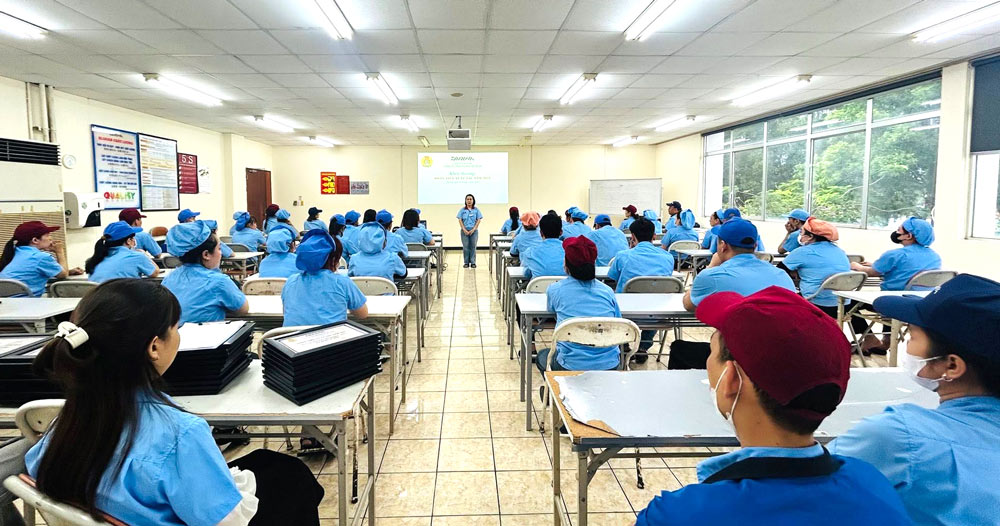
According to representatives of the Trade Union of Daiwa Vietnam Co., Ltd., the enterprise currently has more than 3,400 employees, of which female workers account for 78%. This is the force directly participating in most stages of production, operation and management at the factory.
However, as the digital transformation process takes place strongly, the pressure of technology adaptation is becoming a very big challenge for many female workers, especially older workers.
Through actual surveys at businesses, about 45% of female workers over 35 years old said they have difficulty adapting to new control software and digital reporting operations. Many women fall into a state of stress because they have to complete productivity targets and worry about being left behind in an increasingly automated production environment.
Representatives of the Trade Union of Daiwa Vietnam Co., Ltd. said that current technology pressure is no longer just a story of the technical department or office personnel, but has directly impacted workers on the production line.
Not only technological pressure, global labor market fluctuations also put many female workers at risk of working hours being reduced, income being reduced, or having to change jobs.
According to Daiwa Vietnam Trade Union, among the group of female workers who have had to change jobs, up to 58% have difficulty changing shift times or moving due to being busy taking care of children and family. This makes the opportunity for female workers to be re-arranged significantly narrower than male workers.
Accompanying to prevent female workers from being left behind
Faced with those pressures, many businesses and trade unions have proactively changed their approaches to support female workers to adapt to the new production environment.

At Daiwa Vietnam, the grassroots trade union coordinates with businesses to organize digital skills training classes, device operation instructions and computer skills for female workers. The courses are designed to be short, visual, and reduce theory to help women access new technologies more easily.
According to trade union representatives, after the training process, the rate of female workers who can master new equipment and machinery at enterprises has reached over 90%. This is not only a solution to improve skills but also helps many women feel more confident when working in a digital environment.
In addition to skills training, the trade union also launched many emulation movements associated with production improvement. In just the past two years, female workers and female engineers at the enterprise have had more than 150 initiatives applied in practice, bringing billions of VND in profit to the company.
According to Daiwa Vietnam Trade Union, these initiatives show that female workers not only adapt to digital transformation but can also become an important force promoting innovation in businesses if appropriately facilitated.
Not stopping at the working environment, many policies to care for the lives of female workers are also being given more attention. At Daiwa Vietnam, the business has invested in building breastfeeding rooms for female workers raising young children, organizing skills workshops on maintaining family happiness and taking care of children in the digital age.
Representatives of the Trade Union of Daiwa Vietnam Co., Ltd. said that for female workers to truly feel secure working in the context of digital transformation, it is very necessary to have more policies to support digital skills training, kindergartens, schools and trade union facilities around industrial parks.
Digital transformation is an irreversible trend. But the important thing is to have a mechanism for female workers to be supported to adapt, not to be left behind in that change process.


